

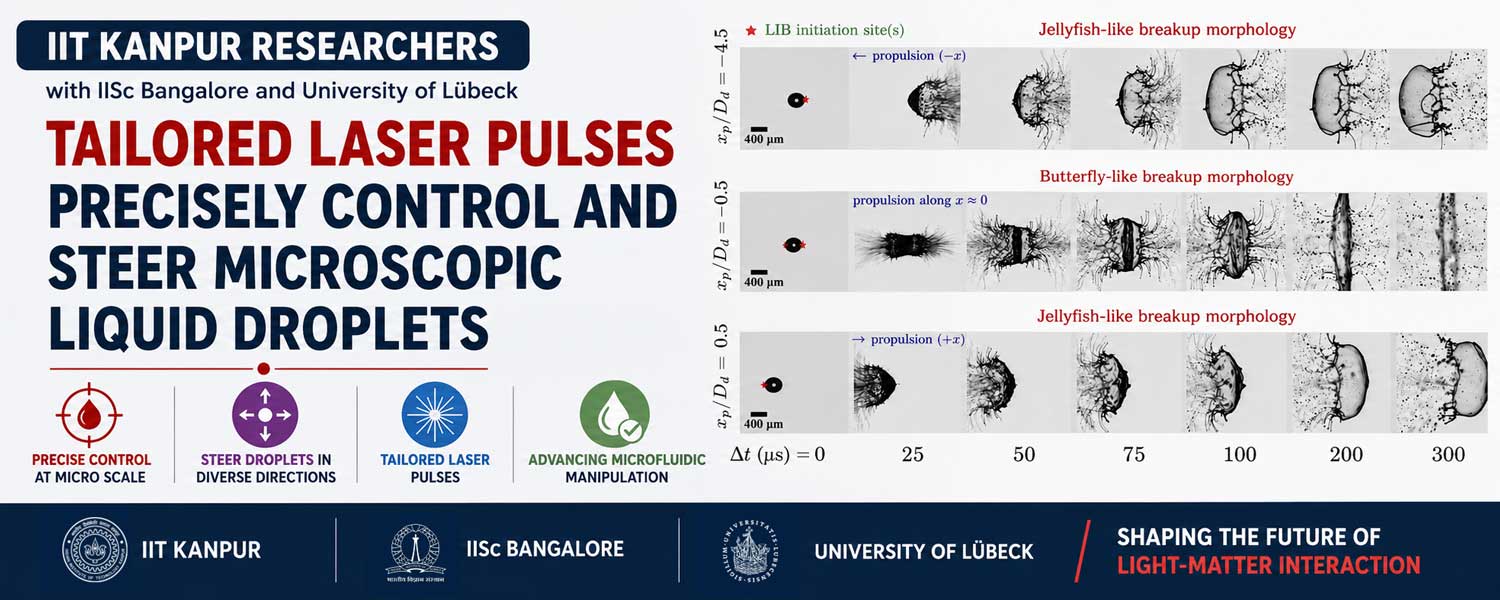
IIT Kanpur researchers, with colleagues from IISc Bangalore and the University of Lübeck, show how tailored laser pulses can precisely control and steer microscopic liquid droplets in diverse directions.
New framework for laser‑driven droplet control
Researchers from the Indian Institute of Technology Kanpur (IIT Kanpur), in collaboration with scientists from the Indian Institute of Science Bangalore (IISc) and the University of Lübeck, Germany, have developed a predictive framework to precisely control the propulsion and breakup of liquid droplets using laser pulses. The work, published in the prestigious journal Proceedings of the National Academy of Sciences (PNAS), provides a physics‑based model that links laser‑pulse parameters to the droplet’s motion and fragmentation, opening fresh pathways for applications in microfluidics, biomedicine, and advanced manufacturing.
The team’s approach moves beyond empirical trial‑and‑error by deriving clear relationships between laser focus, pulse energy, and droplet‑positioning geometry on one side and propulsion direction, speed, and breakup pattern on the other. This predictive capability allows engineers to design laser‑driven droplet systems with higher accuracy and reproducibility, rather than relying solely on repeated experimentation.
Steering droplets in multiple directions
The study demonstrates that microscopic liquid droplets can be made to move in forward, backward, or radially outward directions by precisely adjusting the relative position of the droplet with respect to the laser focus and by tuning the energy of the laser pulse. When the laser strikes the droplet at a specific offset from its centre, the resulting asymmetric heating and plasma formation generate localized pressure gradients that push the droplet in a controlled direction.
By varying these parameters, the researchers can selectively steer droplets along desired trajectories, enabling fine‑tuned manipulation of individual droplets in a fluid medium. The framework also explains how different combinations of laser focus and energy can trigger continuous propulsion, limited oscillation, or complete breakup of the droplet, giving users a toolkit of controllable outcomes for diverse applications.
Role of laser‑induced plasma in droplet dynamics
A key insight from the work lies in the location and strength of the initial laser‑induced plasma inside or around the droplet. The researchers show that the position where the plasma forms strongly governs the subsequent deformation, fragmentation, and propulsion of the droplet. When the plasma appears closer to one edge of the droplet, the resulting pressure asymmetry stretches the liquid, leading to elongated jets or splits along specific directions.
By deliberately shifting the laser‑focus spot, the team can control whether the plasma develops near the droplet’s surface, within its core, or just outside it. Each configuration produces distinct flow patterns and breakup modes, such as clean propulsion without fragmentation for targeted transport or controlled disintegration for applications that require fine mist generation. The group’s framework captures these mechanisms in compact mathematical terms, enabling users to predict the outcome before firing the laser.
Implications for technology and industry
The findings could significantly advance several technology areas that rely on precise manipulation of liquids at small scales. In biomedical engineering, the ability to steer droplets with laser pulses may improve targeted drug delivery, where micro‑droplets loaded with therapeutic agents move along specific paths before releasing their payload at a precise site. The control over breakup also holds promise for laser‑assisted tissue ablation, cell‑level surgery, and micro‑surgical tools where directional force and minimal collateral damage are critical.
In inkjet printing and micro‑printing technologies, the framework could help optimise droplet behaviour for higher resolution and sharper patterns, particularly in high‑speed industrial printing and printed electronics. Engineers can adjust laser parameters to avoid unwanted splashing or coalescence while maintaining consistent droplet size and direction. Similarly, in laser‑assisted manufacturing and additive manufacturing, the technique could assist in controlling molten‑metal or polymer droplets during layer‑by‑layer deposition, enhancing surface quality and dimensional accuracy.
From fundamental insight to applied innovation
Beyond specific applications, the study deepens the understanding of laser–matter interactions in liquid systems, highlighting how tightly confined laser energy can generate complex hydrodynamic responses. The researchers’ use of high‑speed imaging, numerical simulations, and analytical modelling together provides a comprehensive view of the droplet dynamics, from the instant the laser pulse hits the liquid to the final propulsion or breakup state.
By translating these insights into a predictive, parameter‑based framework, the IIT Kanpur‑led team has effectively bridged the gap between basic physics and engineering practice. As laser‑based technologies continue to scale down in size and increase in precision, the ability to steer and control droplets on demand may become a standard feature in next‑generation microfluidic platforms, lab‑on‑a‑chip devices, and advanced manufacturing setups, with India‑centric expertise at the forefront.
Disclaimer
The information in this article is based on available public sources and official statements as of the time of publication. While we aim for accuracy, we do not guarantee completeness or correctness. We advise readers to verify key details from official sources before making any decisions. The website (iitiimsamvaad.com) is not liable for any loss or damage arising from the use of this content. The authors are also not responsible for any such loss or damage.