


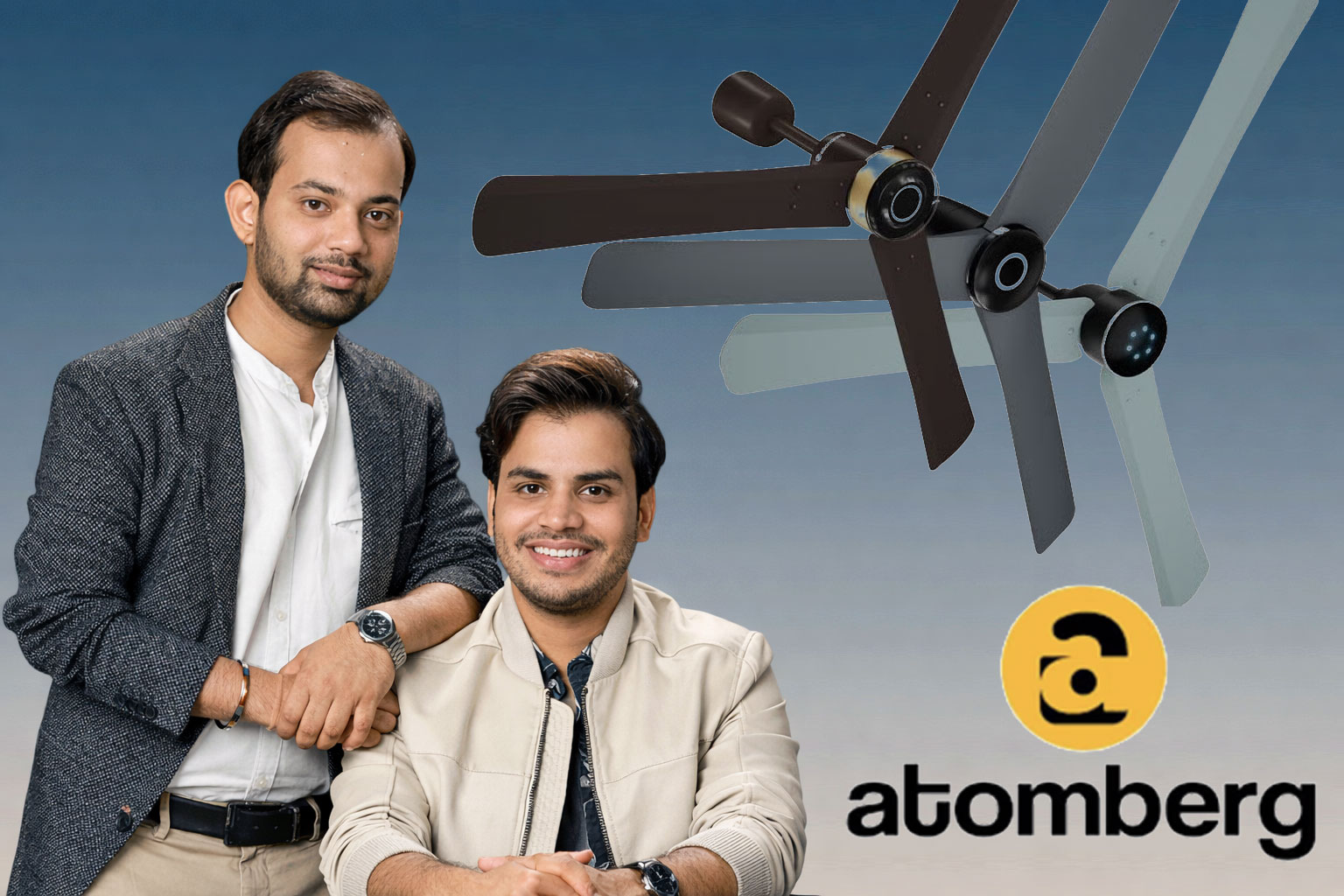
Atomberg Technologies was established in 2012 by two graduates of Indian Institute of Technology Bombay – Manoj Meena and Sibabrata Das. When the company was first created, its focus was not on the consumer appliance market. Instead, the founders initially concentrated on developing advanced technological solutions for research laboratories and specialised engineering applications.
During its early years, Atomberg worked on technology-driven projects that leveraged the founders’ engineering expertise. However, the founders soon realised that their capabilities in energy-efficient motor technology could be applied to consumer products in a way that would address a large and meaningful problem in India: high electricity consumption by household appliances.
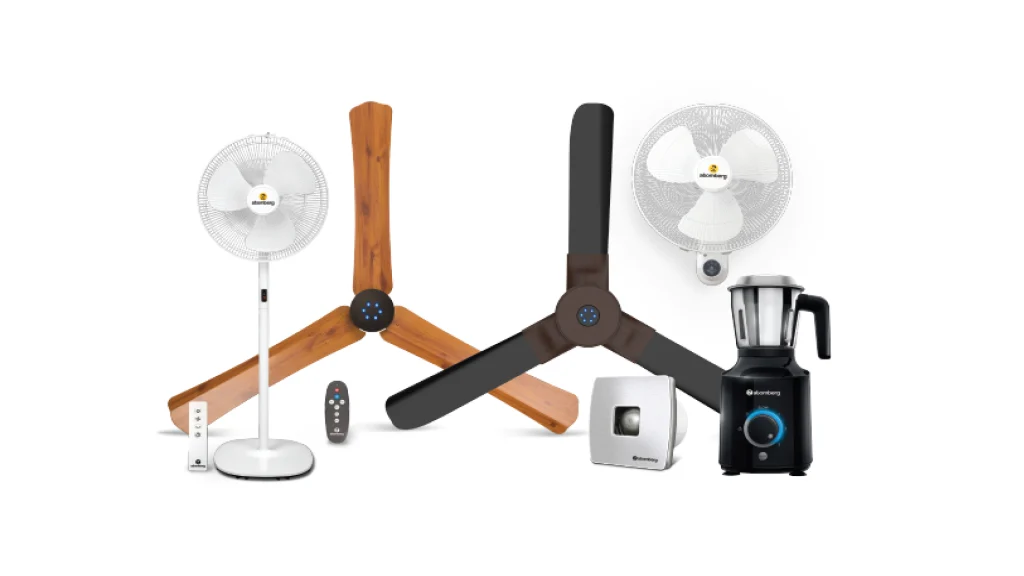
This insight led to a major strategic pivot in 2015. The company shifted its focus toward the consumer market and introduced BLDC (Brushless Direct Current) ceiling fans, a category that was still relatively new in the Indian appliance ecosystem at the time. Unlike conventional induction-motor fans, BLDC fans consume significantly less electricity – often up to 60–65% less power – while delivering comparable or better performance.
This move proved to be a defining turning point for Atomberg. At the time, the ceiling fan market in India was dominated by large and long-established appliance manufacturers. However, Atomberg’s emphasis on energy efficiency, smart technology, and modern design helped it carve out a distinct identity in a highly competitive segment.
Headquartered in Mumbai, the company adopted a digital-first strategy in its early growth phase. Rather than immediately building a traditional dealer network, Atomberg focused heavily on online sales channels and digital marketing platforms. This allowed the company to build brand awareness and reach tech-savvy consumers without the large distribution investments typically required in the appliances industry.
As its brand gained recognition and customer adoption increased, Atomberg gradually expanded into offline retail distribution, partnering with physical stores and distributors across multiple Indian cities. This hybrid approach – combining online-first marketing with expanding offline retail – helped the company scale its presence in the Indian home appliances market.
Revenue Growth and Funding Journey
In the financial year FY25, Atomberg reported operational revenue of ₹958.4 crore, generated primarily from the sale of ceiling fans and other household appliances. Fans continued to remain the company’s core product category and accounted for the largest share of revenue, while newer categories such as mixers, smart appliances, and related consumer products are still in their growth phase.
Unlike some technology companies that derive income from services or subscription-based offerings, Atomberg’s revenue model is straightforward: its primary earnings come entirely from selling physical products.
In addition to its core operational revenue, Atomberg reported ₹42.45 crore as non-operating income. This income was generated largely through interest earned on investments and gains from the sale of certain assets. When combined with its operational revenue, the company’s total income for FY25 reached ₹1,000.9 crore.
To understand the scale of growth, it is useful to look at Atomberg’s financial performance in recent years. According to its consolidated filing with the Registrar of Companies (RoC), the company reported ₹796.9 crore in operational revenue in FY24. Comparing FY25 revenue with this figure shows that the company achieved approximately 20% year-on-year revenue growth.
Going further back, Atomberg’s operational revenue in FY23 stood at ₹645 crore, highlighting a consistent upward trajectory in sales over the past three financial years.
To support this expansion and product development strategy, Atomberg has actively raised capital from investors. Since its inception, the company has secured more than $150 million in funding.
The largest funding round in the company’s history took place in 2023, when Atomberg raised $86 million from prominent investors including Temasek, Steadview Capital, and A91 Partners.
Later, in December 2025, the company raised an additional $24 million in an extension round led again by Temasek, with participation from the founders themselves. The funds from this round have been directed toward product development, building inventory, and strengthening the company’s distribution network as it continues to expand its market footprint.
Understanding Atomberg’s FY25 Expense Structure
In FY25, the largest portion of Atomberg’s spending continued to be raw material costs, which are inherent to a manufacturing-driven business. The company spent ₹535.2 crore on materials, representing roughly 61% of its total expenses for the year. This increase was largely aligned with the company’s higher sales volumes and expanded production levels.
One of the most notable financial changes during the year occurred in employee-related costs. In FY24, Atomberg had reported employee benefit expenses of ₹248.3 crore. In FY25, this figure dropped significantly to ₹158.6 crore, representing a reduction of nearly ₹89.7 crore.
This substantial decline played a crucial role in reducing the company’s overall losses. Although Atomberg has not publicly detailed the reasons behind the reduction, the change is widely believed to be linked to workforce rationalisation following a period of aggressive hiring during earlier growth phases.
Meanwhile, Atomberg continued investing heavily in brand building and market expansion. Its marketing and advertising expenditure rose to ₹104 crore as the company focused on strengthening brand recognition and expanding its offline retail presence.
Warranty expenses also increased, reaching ₹53.8 crore in FY25. This rise reflects the growing installed base of Atomberg products across households in India, which naturally increases warranty servicing costs over time.
Additional operational expenditures – including logistics, sales commissions, IT infrastructure, administrative costs, and depreciation – contributed to pushing the company’s total annual expenses to ₹1,118.3 crore.
Profitability, Loss Reduction, and Financial Health
Despite its revenue growth, Atomberg remained a loss-making company in FY25, reporting a net loss of ₹117.4 crore. However, this figure represents a substantial improvement compared with the previous year.
In FY24, the company had reported a net loss of ₹199 crore. The reduction to ₹117.4 crore in FY25 represents a 41% decline in losses, largely driven by the reduction in employee expenses and improved operational efficiency.
At the operating level, the company’s EBITDA margin improved to -6.62%, indicating that the business is gradually moving toward operational sustainability even though profitability has not yet been achieved.
Another positive sign in Atomberg’s financial profile is the improvement in return on capital, suggesting that the company is beginning to generate better outcomes from the investments made during its earlier growth phase.
By the end of FY25, Atomberg reported current assets worth ₹594.5 crore, including ₹27.3 crore in cash reserves, giving the company a relatively stable financial base as it continues its expansion strategy.
Financial Trends Over the Last Three Years
A closer look at Atomberg’s financial performance over the past three years reveals a clear strategic shift in the company’s approach.
In FY23, the company reported operational revenue of ₹645 crore, while recording a net loss of ₹202 crore. This period was characterised by aggressive investment in product development, hiring, marketing, and distribution expansion.
In FY24, operational revenue rose to ₹796.9 crore, but losses remained high at ₹199 crore, reflecting the continued costs associated with scaling the business and building organisational capabilities.
However, in FY25, the company appears to have entered a new phase of greater financial discipline. Revenue climbed further to ₹958.4 crore, while losses dropped significantly to ₹117.4 crore.
This shift suggests that Atomberg is now focusing more strongly on cost optimisation, operational efficiency, and sustainable growth, rather than purely prioritising rapid expansion.
Planned IPO and Future Outlook
Looking ahead, Atomberg is preparing for a major milestone in its corporate journey. The company is planning to launch its Initial Public Offering (IPO) in the first quarter of FY26, with the aim of raising approximately ₹2,000 crore from public market investors.
The IPO is expected to be managed by investment banks Avendus Capital and IIFL, both of which are well-known participants in India’s capital markets.
Atomberg’s improving financial trajectory, strong product positioning in the energy-efficient appliances segment, and expanding brand recognition are likely to play a critical role as the company prepares to enter the public markets.
The recent $24 million funding extension has also strengthened the company’s balance sheet, giving it additional resources to invest in new product innovation, deeper distribution networks, and offline retail expansion.
With continued focus on energy-efficient technologies, disciplined cost management, and wider market reach, Atomberg is positioning itself to reduce losses further while building a large and sustainable home appliance business in India in the years ahead.

Lorem ipsum dolor sit amet
Lorem ipsum eirmod tempor invidunt ut labore et dolore magna aliquyam erat, At vero eos et accusam et justo duo dolores et ea rebum.

Lorem Ipsum is simply dummy text of the printing and typesetting industry. Lorem Ipsum has been the industry’s standard dummy text ever since the 1500s, when an unknown printer took a galley of type and scrambled it to make a type specimen book. It has survived not only five centuries.
Lorem Ipsum has been the industry’s standard dummy text ever since the 1500s, when an unknown printer took a galley of type and scrambled it to make a type specimen book
Lorem Ipsum has been the industry’s standard dummy text ever since the 1500s
Lorem Ipsum?
Lorem Ipsum has been the industry’s standard dummy text ever since the 1500s, when an unknown printer took a galley of type and scrambled it to make a type specimen book. It has survived not only five centuries,
Lorem Ipsum? Lorem Ipsum?Lorem Ipsum?Lorem Ipsum?
Lorem Ipsum has been the industry’s standard dummy text ever since the 1500s, when an unknown printer took a galley of type and scrambled it to make a type specimen book. It has survived not only five centuries,
Lorem Ipsum has been the industry’s standard dummy text ever since the 1500s, when an unknown printer took a galley of type and scrambled it to make a type specimen book. It has survived not only five centuries, Lorem Ipsum has been the industry’s standard dummy text ever since the 1500s, when an unknown printer.
Lorem Ipsum?Lorem Ipsum?Lorem Ipsum?
Lorem Ipsum has been the industry’s standard dummy text ever since the 1500s, when an unknown printer took a galley of type and scrambled it to make a type specimen book. It has survived not only five centuries,
Lorem ipsum dolor sit amet,sed diam nonumy eirmod tempor invidunt ut labore et dolore magna aliquyam erat, At vero eos et accusam et justo duo dolores et ea rebum. Lorem ipsum dolor sit amet, no sea takimata sanctus est Lorem ipsum dolor sit amet. Stet clita kasd gubergren, no sea takimata sanctus est Lorem ipsum dolor sit amet. no sea takimata sanctus est Lorem ipsum dolor sit amet. no sea takimata sanctus est Lorem ipsum dolor sit amet. sed diam voluptua. Lorem ipsum dolor sit amet,sed diam nonumy eirmod tempor invidunt ut labore et dolore magna aliquyam erat, At vero eos et accusam et justo duo dolores et ea rebum. Lorem ipsum dolor sit amet, no sea takimata sanctus est Lorem ipsum dolor sit amet. Stet clita kasd gubergren, no sea takimata sanctus est Lorem ipsum dolor sit amet. no sea takimata sanctus est Lorem ipsum dolor sit amet. no sea takimata sanctus est Lorem ipsum dolor sit amet. sed diam voluptua.
Lorem ipsum dolor sit amet,sed diam nonumy eirmod tempor invidunt ut labore et dolore magna aliquyam erat, At vero eos et accusam et justo duo dolores et ea rebum. Lorem ipsum dolor sit amet, no sea takimata sanctus est Lorem ipsum dolor sit amet. Stet clita kasd gubergren, no sea takimata sanctus est Lorem ipsum dolor sit amet. no sea takimata sanctus est Lorem ipsum dolor sit amet. no sea takimata sanctus est Lorem ipsum dolor sit amet. sed diam voluptua. Lorem ipsum dolor sit amet,sed diam nonumy eirmod tempor invidunt ut labore.