

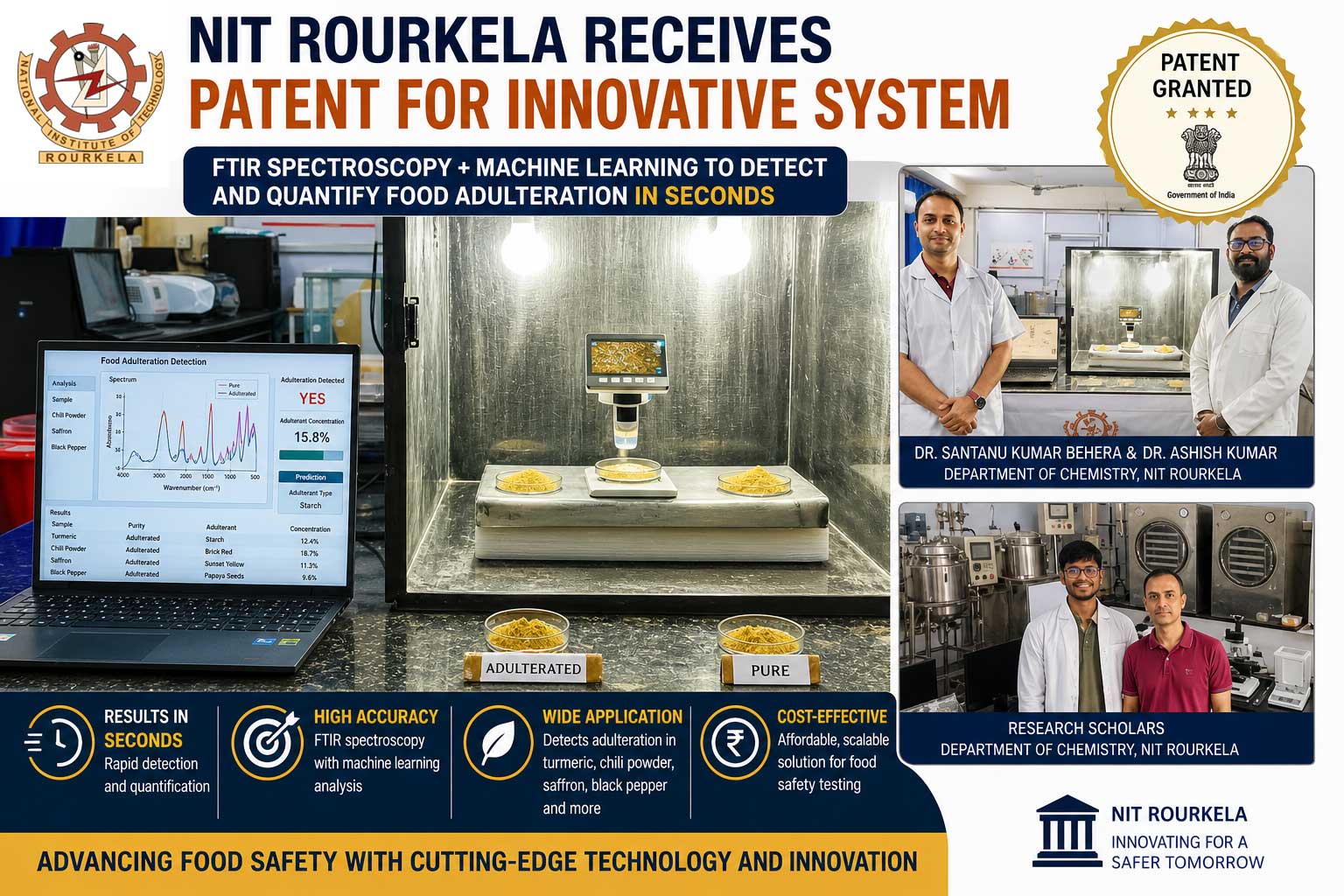
NIT Rourkela receives a patent for a rapid, AI‑powered system that uses FTIR spectroscopy and machine learning to detect and quantify food adulteration in seconds.
NIT Rourkela patents rapid food‑adulteration detector
Researchers at the National Institute of Technology (NIT) Rourkela have secured a patent for a system capable of rapidly detecting and measuring adulteration in spices and other food products. The technology provides a fast, non‑destructive, and cost‑effective solution to a growing global food‑safety challenge.
In a press release issued on 27 April, NIT Rourkela highlighted that traditional methods such as chromatography and molecular‑biology techniques are resource‑intensive and time‑consuming, making them unsuitable for routine, high‑throughput food testing. The new system, in contrast, supports rapid analysis that can be deployed in quality‑control laboratories and industrial food‑processing units.
How the system works: FTIR plus AI
The patented technology combines Fourier Transform Infrared (FTIR) spectroscopy with advanced machine‑learning models to deliver accurate, real‑time readings. FTIR spectroscopy identifies organic and some inorganic materials by measuring how they absorb infrared light, generating unique spectral “fingerprints” for different substances.
During food testing, the system captures these spectral patterns from the sample and then feeds them into machine‑learning models trained to distinguish between pure food components and adulterants. The models analyse subtle differences in the absorption spectra, enabling the system to not only flag adulteration but also estimate the level of contamination.
Beyond yes‑no detection to precise quantification
Most conventional food-safety tests only detect adulteration in a product, and they often fail to quantify how much adulterant is present. The NIT Rourkela system goes further, measuring the level of adulteration within seconds.
This capability is crucial for food‑processing industries, certification bodies, and regulatory agencies, which require precise data to ensure compliance with standards, maintain product quality, and issue recalls when necessary. For example, the technology can identify and quantify adulteration in common spices such as turmeric, chili powder, saffron, and black pepper, where it frequently detects fillers, colourants, and substandard substitutes.
Advantages over conventional methods
The patented system offers several advantages over traditional chromatography and molecular‑technique‑based approaches. First, it is non‑destructive: the food sample remains intact and can often be used for further processing or testing. Second, it is rapid, delivering results in seconds rather than hours or days. Third, it remains relatively low-cost and scalable because FTIR equipment is widely available and machine-learning models can be deployed across multiple instruments.
The method also reduces dependence on chemical reagents and specialised consumables, lowering operational costs and environmental impact. For small‑scale processors and exporters, this makes routine, in‑house quality monitoring more feasible and less dependent on external testing laboratories.
Future plans: industry pilots and broader applications
As the next step, the NIT Rourkela research team aims to collaborate with industry partners to conduct pilot‑scale studies and validate the system under real‑world conditions. These trials will assess the technology’s robustness across different production environments, sample formats, and contamination levels.
The team also plans to run experiments under varied conditions to extend the system’s detection capability beyond spices. The goal is to adapt the platform for other food categories, including dairy products, edible oils, cereals, and packaged foods, where adulteration and quality variability remain persistent challenges.
By combining FTIR spectroscopy, machine‑learning analytics, and patent‑protected design, NIT Rourkela is positioning its food‑adulteration detector as a scalable, versatile tool for food‑safety assurance. If widely adopted, the technology could help strengthen consumer trust, support regulatory enforcement, and enhance India’s food‑export competitiveness – all while enabling faster, cheaper, and more precise monitoring of what is on our plates.
Disclaimer
The information in this article is based on available public sources and official statements as of the time of publication. While we aim for accuracy, we do not guarantee completeness or correctness. We advise readers to verify key details from official sources before making any decisions. The website (iitiimsamvaad.com) is not liable for any loss or damage arising from the use of this content. The authors are also not responsible for any such loss or damage.