

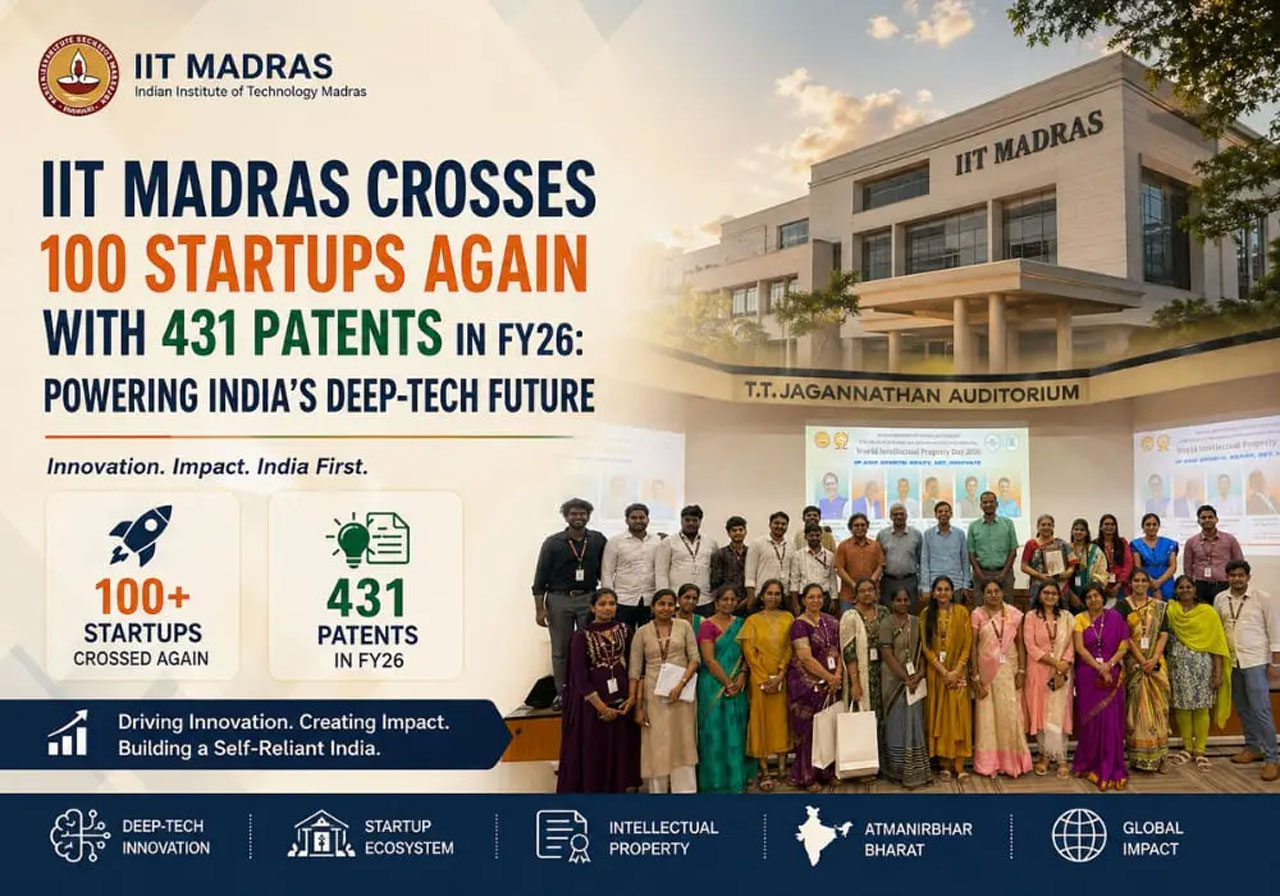
IIT Madras incubates 112 startups in FY 2025–26 under its ‘Startup Shatam’ mission and files 431 patents, reinforcing its leadership in deep‑tech translation and IP creation.
IIT Madras hits deep‑tech milestones
The Indian Institute of Technology Madras (IIT Madras) has announced a major milestone in deep‑tech entrepreneurship, successfully incubating 112 startups in FY 2025–26 – the second consecutive year that the institute has incubated over 100 startups. The achievement comes under the “Startup Shatam” mission, led through the IIT Madras Incubation Cell (IITMIC), which serves as the nodal incubation hub for the institute.
Alongside this entrepreneurial surge, IIT Madras has also sustained a strong innovation and intellectual‑property (IP) push, filing 431 patents during the same financial year. The combined figures also reinforce IIT Madras’s position as a leading university in translating research into real‑world startups and technology assets.
‘Startup Shatam’ mission gains momentum
The ‘Startup Shatam’ mission, launched to scale up deep‑tech entrepreneurship, aims to incubate 100 startups annually and foster a robust ecosystem for technology ventures. Prof. V. Kamakoti, Director of IIT Madras, had set the “100 startups a year” target in 2024 and previously announced a “one‑patent‑a‑day” goal in 2023.
Speaking at the institute’s World Intellectual Property Day celebrations on campus, he highlighted the growing maturity and diversity of the startup ecosystem around IIT Madras. “The highlight of this year’s ‘Startup Shatam’ milestone is the increasing maturity and diversity of startups entering the ecosystem,” he said. Over 60% of the 112 startups were founded by external entrepreneurs from across India, reflecting broader national participation rather than only campus‑born ventures.
Students, faculty, and researchers drive innovation
IIT Madras students, faculty, and researchers continue to be key drivers of the institute’s innovation output. The 431 patents filed in FY 2025–26 originate from the IP‑rich research environment nurtured across departments and centres, also supported by the institute’s IP management and commercialisation structures.
The IP management cell at IIT Madras works closely with inventors to disclose inventions, conduct prior‑art searches, draft patent applications, and coordinate global filings. This integrated ecosystem has enabled a steady rise in both quality and quantity of patenting activity, strengthening the institute’s reputation for research‑based, industry‑ready technologies.
Deep‑tech sectors span multiple domains
The 112 newly incubated startups cover a wide range of critical deep‑tech domains, including:
- Manufacturing, robotics, and automotive technologies
- Batteries, defence, and aerospace systems
- Artificial intelligence, machine learning, and quantum technologies
- Analytics, fintech, healthtech, agritech, and biotech
- Climate technologies, Internet of Things (IoT), and cyber‑physical systems
The diversity of sectors indicates that IIT Madras is not only incubating IT‑centric ventures but also supporting hardware‑intensive, capital‑demanding, and highly regulated deep‑tech segments that require strong scientific grounding and long‑term development timelines.
Strong IP activity in frontier technologies
On the intellectual‑property front, IIT Madras notes particularly strong patenting activity in frontier technological areas such as:
- Artificial intelligence and machine learning
- Quantum technologies and semiconductors
- 5G/6G communications and robotics
- Advanced manufacturing and sustainable energy systems
- Photonics, blockchain, biomedical imaging, and advanced materials
These fields align closely with National Mission priorities in electronics, quantum computing, clean energy, and defence manufacturing, enhancing the potential for technology transfer to industry and public‑sector organisations.
Strengthening India’s innovation ecosystem
By incubating over 100 startups and filing 431 patents within a single financial year, IIT Madras is reinforcing its role as a catalyst for India’s innovation ecosystem. The IIT Madras Incubation Cell (IITMIC) also provides startups with seed funding, mentorship, access to labs, market linkages, and investor‑connect programmes, helping them move from concept and prototype to commercially viable products or services.
The institute’s growing deep‑tech and IP strength also attracts corporate partnerships, government grants, and global collaborations, further amplifying the impact of its research. As more of these startups scale and commercialise, they have the potential to generate jobs, export value, and contribute to India’s self‑reliance in critical technology areas.
A model for research‑to‑venture translation
The IIT Madras experience demonstrates how a research‑intensive institute can systematically translate discovery into deployment – turning academic insights into patents, products, and enterprises. By combining strong IP management, incubation infrastructure, and mission‑driven goals, the institute is shaping a model that other technical universities and research organisations can emulate.
With the Startup Shatam mission and persistent focus on IP creation, IIT Madras is not only building a deep‑tech startup pipeline but also strengthening India’s standing in the global innovation landscape, where research excellence and entrepreneurship converge.
Disclaimer
The information in this article is based on available public sources and official statements as of the time of publication. While we aim for accuracy, we do not guarantee completeness or correctness. We advise readers to verify key details from official sources before making any decisions. The website (iitiimsamvaad.com) is not liable for any loss or damage arising from the use of this content. The authors are also not responsible for any such loss or damage.