

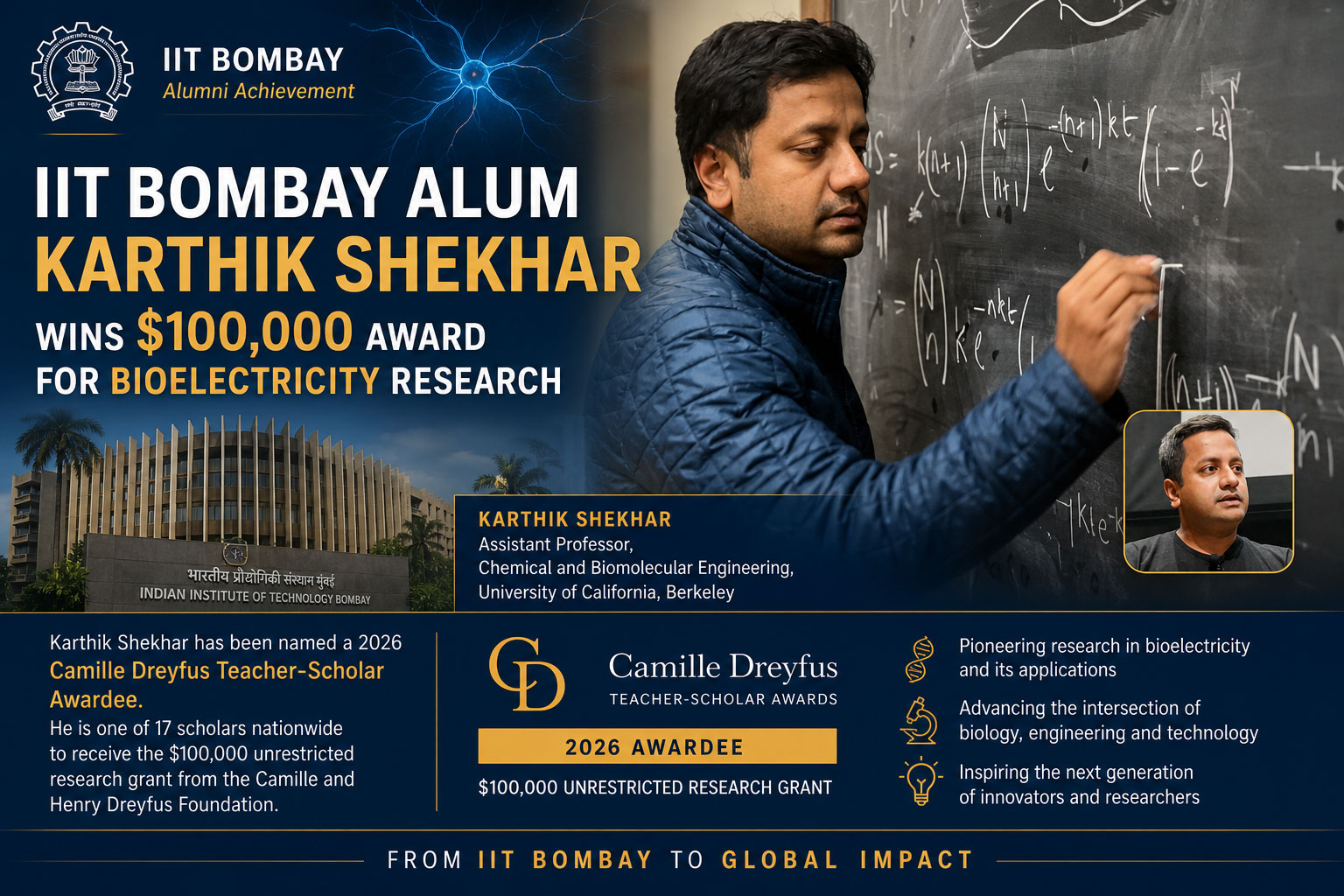
IIT Bombay‑educated Karthik Shekhar, a professor at UC Berkeley, wins the Camille Dreyfus Teacher‑Scholar Award for pioneering work on bioelectricity and neural communication.
Bioelectricity breakthrough earns national recognition
Karthik Shekhar, an assistant professor of chemical and biomolecular engineering at the University of California, Berkeley, has won the 2026 Camille Dreyfus Teacher‑Scholar Award, a prestigious national honour that comes with a $100,000 unrestricted research grant. Shekhar is one of 17 early‑career faculty members across the United States to receive the grant from the Camille and Henry Dreyfus Foundation this year.
The award recognises scholars who have already built an independent body of research while demonstrating a deep and sustained commitment to undergraduate teaching and mentorship. In Shekhar’s case, the recognition highlights both his cutting‑edge research on bioelectricity and his reputation as a standout educator in chemical engineering.
Unravelling the biophysics of neural communication
The research cited for the Camille Dreyfus honour is titled “The Chemical Physics of Bioelectricity: From Ion Channels to Emergent Excitability”. This work sits at the intersection of neuroscience and biophysics, probing how ion channels and cellular‑level electrical activity give rise to emergent patterns of nerve‑cell excitability.
Shekhar’s lab combines single‑cell genomic approaches with advanced computational modelling to decode how the visual system develops and how neurons communicate electrically and chemically. These investigations are crucial for understanding the molecular triggers of neurodegenerative conditions, including glaucoma, where early changes in retinal‑cell excitability may signal the onset of irreversible damage.
By bridging molecular biology, physics, and engineering, Shekhar’s research offers a framework not only for diagnosing neural disorders earlier but also for designing targeted interventions that stabilise or restore healthy neural‑circuit behaviour.
From Mumbai to MIT and Berkeley
The foundation for Shekhar’s high‑level research was laid in India. A native of Mumbai, he earned both his BTech and MTech in chemical engineering from the Indian Institute of Technology Bombay (IIT Bombay) in 2008. His academic excellence was evident early on; he graduated as the Institute Silver Medal recipient and also won the Best Master’s Thesis Award at IIT Bombay.
After completing his master’s, Shekhar moved to the United States to pursue a PhD in biological engineering at the Massachusetts Institute of Technology (MIT), further deepening his expertise in biophysics, systems biology, and computational neuroscience. His trajectory illustrates a clear progression from strong chemical‑engineering training in India to interdisciplinary discovery at the frontiers of bioelectricity in the United States.
A rare balance of research and teaching excellence
Beyond his technical achievements, Shekhar has emerged as a highly regarded educator at Berkeley. He previously received the Donald Sterling Noyce Prize for Excellence in Undergraduate Teaching, an award that recognises outstanding classroom performance and student impact.
Selection‑committee members highlighted his ability to make demanding material in chemical‑engineering kinetics accessible and engaging for students. “I was struck by how successful he has been in the instruction of CBE 142,” remarked a committee member at a prior teaching‑award ceremony. “He has created a learning environment where students feel both challenged and supported.”
This dual excellence in research and teaching is precisely what the Camille Dreyfus Teacher‑Scholar Award seeks to honour, reinforcing Shekhar’s position as a role model for early‑career faculty who aim to shape both scientific knowledge and the next generation of engineers.
A year of major accolades and future impact
The Camille Dreyfus award is the latest in a series of major recognitions for Shekhar in 2026. Earlier this year, the Sloan Foundation selected him as a Sloan Research Fellow, another prestigious early-career honour that underscores the significance of his work in the broader scientific community.
The $100,000 grant from the Camille and Henry Dreyfus Foundation will provide five years of flexible funding, enabling Shekhar to expand his lab’s exploration of neural diversity, bioelectric signalling, and the developmental trajectory of the visual system. The flexibility allows him to pursue high‑risk, high‑reward projects that might not fit within conventional grant‑funding structures.
It also supports his continued commitment to mentoring undergraduate and graduate researchers at Berkeley, giving students hands‑on experience in interdisciplinary, hypothesis‑driven science. As Shekhar builds on this foundation, his work has the potential to reshape understanding of bioelectricity in the nervous system, with implications for neurodegenerative‑disease research, neural‑engineering therapies, and advanced computational‑neuroscience frameworks.
Disclaimer
The information in this article is based on available public sources and official statements as of the time of publication. While we aim for accuracy, we do not guarantee completeness or correctness. We advise readers to verify key details from official sources before making any decisions. The website (iitiimsamvaad.com) is not liable for any loss or damage arising from the use of this content. The authors are also not responsible for any such loss or damage.