

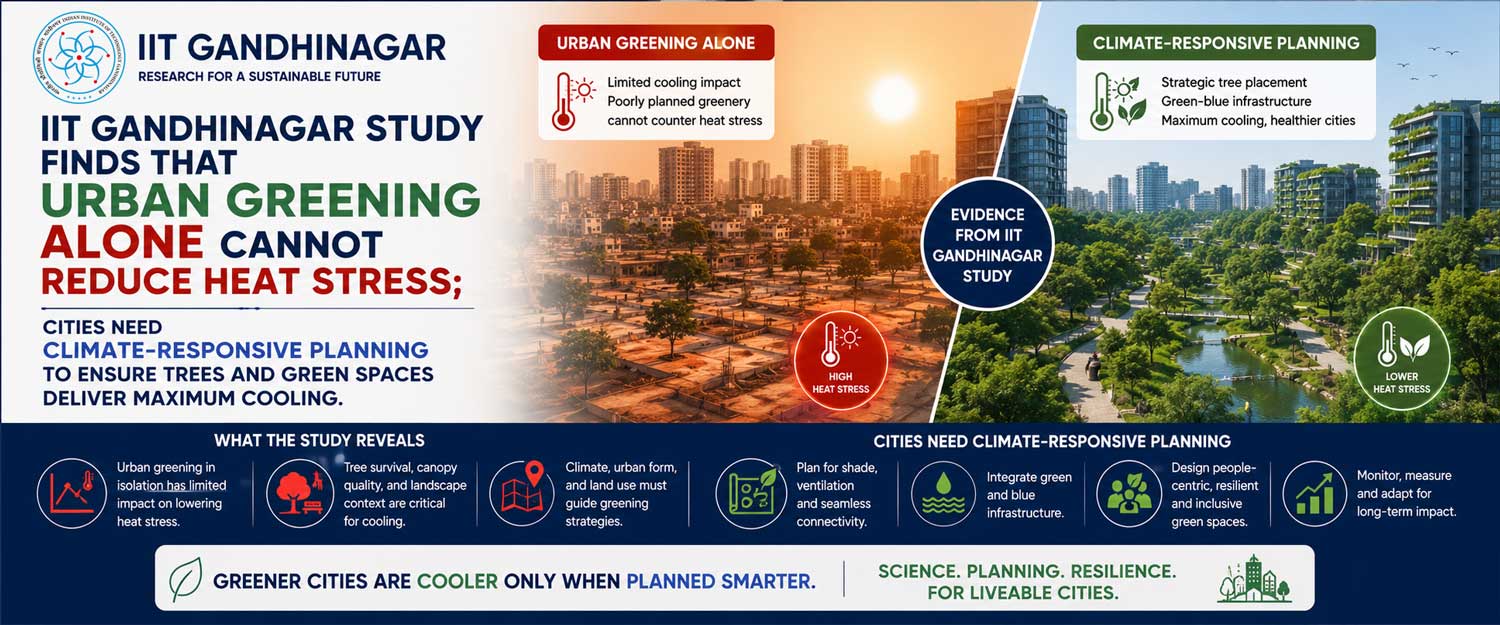
An IIT Gandhinagar study finds that urban greening alone cannot reduce heat stress; cities need climate‑responsive urban planning to ensure trees and green spaces deliver maximum cooling.
Urban greening is not enough
Researchers at the Indian Institute of Technology, Gandhinagar (IIT‑GN) have shown that simply increasing tree cover in cities is not sufficient to reduce heat stress for urban residents. Their analysis reveals that urban greening must be paired with climate‑responsive planning if cities want to fully harness the cooling benefits of green spaces. The study highlights that how and where planners place trees, streets, and built‑up areas can dramatically affect local temperatures and human comfort.
The team’s findings challenge the common assumption that “more trees always mean cooler cities.” Instead, they argue that cities need strategic, climate‑informed design that integrates greenery with building layouts, road networks, and land‑use patterns to truly lower heat‑related risks for residents.
National‑scale analysis of Indian cities
The study, published in Nature Communications, examines 138 Indian cities across three major climate zones: tropical savanna, semi‑arid steppe, and humid subtropical. The researchers used satellite data, land‑use records, and climate models to track changes in urban land cover and surface temperatures between 2003 and 2020. This long‑term, nationwide dataset allows them to compare how different city designs and green‑space configurations affect cooling outcomes.
The analysis shows that cities which expanded their built‑up areas without coordinated planning often experienced greater surface warming, even when they added some green cover. In contrast, cities that structured their growth around green corridors, open spaces, and thoughtful building arrangements saw more noticeable cooling effects from existing tree cover.
How planning shapes cooling outcomes
The IIT‑Gandhinagar team finds that where trees are planted and how they are integrated into the urban fabric strongly influences their ability to cool cities. For example, dense tree cover along streets and around open public spaces can create shaded corridors that reduce direct solar exposure and suppress local heat islands. However, when tightly packed, high‑density developments confine trees to isolated patches, the limited air circulation and restricted shade distribution reduce their cooling effect.
The study also emphasises the role of albedo (surface reflectivity) and urban geometry – the height, spacing, and orientation of buildings – in determining heat stress. High‑rise towers with narrow streets can trap heat and block wind, while low‑rise, well‑spaced layouts with open spaces and green buffers can enhance natural ventilation and radiant cooling. The researchers argue that urban planners must balance tree‑planting with these physical design choices to maximise cooling benefits.
Tailoring strategies to local climates
The IIT‑GN team stresses that climate‑responsive planning must be location‑specific. Indian cities fall under distinct climatic regimes, each with different temperature patterns, rainfall regimes, and vegetation types. In tropical savanna regions, for instance, cities may benefit from dense, shade‑oriented greening that reduces direct solar exposure. However, in semi‑arid steppe areas, planners may need to prioritise water‑efficient vegetation and moisture‑retaining surfaces to avoid increasing water stress while cooling the environment. In humid subtropical zones, thoughtful placement of trees and open spaces can promote airflow and reduce stagnant, humid conditions that intensify heat discomfort.
The study recommends that cities analyse their microclimates at the ward or neighbourhood level and design green infrastructure accordingly. This could include targeting sensitive zones – such as slums, informal settlements, and densely populated commercial areas – for priority greening and improved ventilation, while ensuring that new developments follow climate‑sensitive design codes.
Beyond aesthetics: integrating functionality
The researchers also point out that green spaces are often treated as aesthetic or recreational features in urban plans, rather than as core components of climate‑adaptation strategy. They call for a shift in mindset so that parks, roadside plantations, and tree‑lined boulevards are treated as functional climate‑control infrastructure, similar to drainage or energy‑distribution systems.
By embedding climate‑responsive design into master plans, zoning rules, and building codes, cities can ensure that planners structurally integrate trees and greenery into the urban form rather than simply adding them as an afterthought. This approach would help cities achieve more consistent cooling benefits, especially in the context of rising temperatures and increasing urbanisation.
Policy implications and future planning
The IIT‑Gandhinagar study concludes that policymakers and urban planners must move beyond simplistic tree‑planting drives and adopt holistic, climate‑responsive strategies. The researchers recommend creating cooling‑oriented urban design guidelines and integrating them into national and state‑level urban‑development programmes such as Smart Cities and AMRUT.
If cities adopt such guidelines, they can turn green infrastructure into a systematic, measurable tool for reducing heat stress, improving public health, and enhancing quality of life. The study also underscores the importance of continuous monitoring and data‑driven feedback – using satellite and on‑ground measurements to evaluate how different planning choices translate into actual cooling on the ground.
In sum, the IIT‑Gandhinagar research signals that intentional, climate‑smart planning – rather than tree‑counting alone – will determine how effectively Indian cities can cool themselves in a warming world.
Disclaimer
The information in this article is based on available public sources and official statements as of the time of publication. While we aim for accuracy, we do not guarantee completeness or correctness. We advise readers to verify key details from official sources before making any decisions. The website (iitiimsamvaad.com) is not liable for any loss or damage arising from the use of this content. The authors are also not responsible for any such loss or damage.