

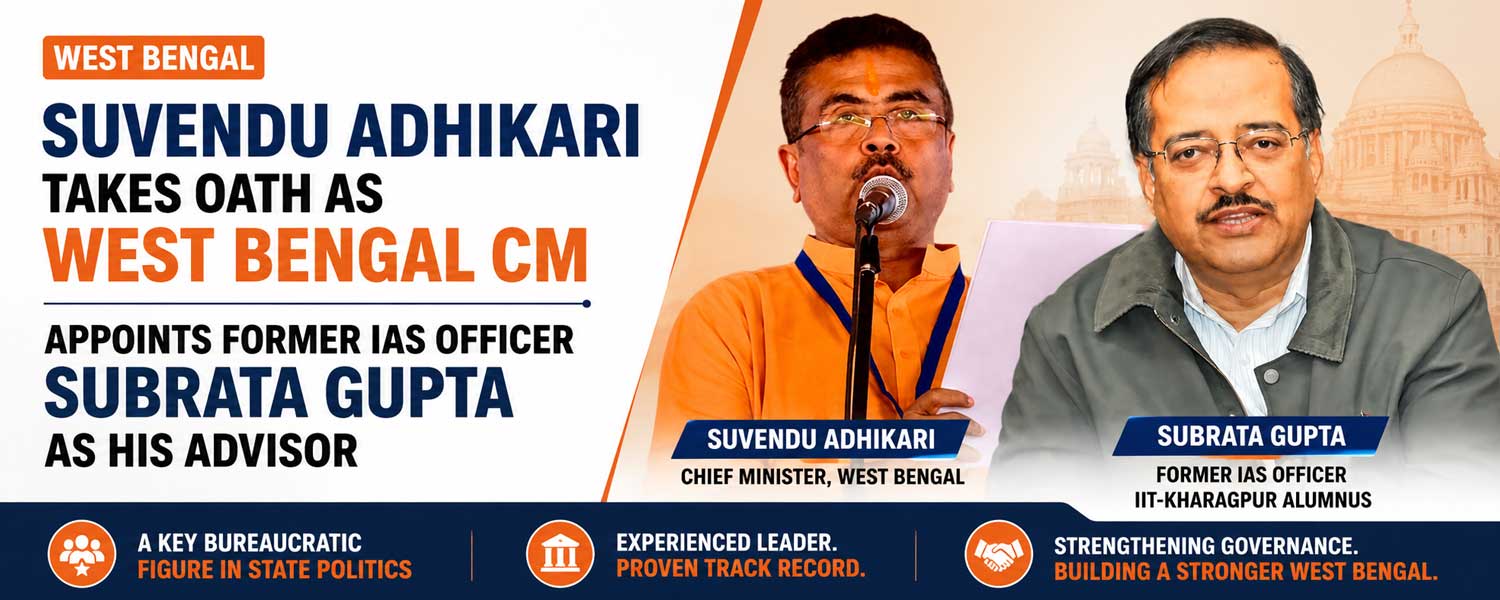
After Suvendu Adhikari took oath as West Bengal CM, he appointed former IAS officer and IIT‑Kharagpur alumnus Subrata Gupta as his advisor, spotlighting a key bureaucratic figure in state politics.
Appointment of a trusted advisor
After the Bharatiya Janata Party (BJP) secured a historic mandate and formed the government in West Bengal for the first time under Suvendu Adhikari, the new chief minister moved swiftly to strengthen his administrative backbone. Within hours of taking oath, Adhikari announced the appointment of Subrata Gupta, a retired IAS officer, as Advisor to the Chief Minister. The move signalled Adhikari’s intention to rely on a seasoned administrator with deep experience in both state and central government machinery.
Subrata Gupta, a 1990‑batch Indian Administrative Service officer, belongs to the West Bengal cadre and hails from the state itself. His long career – spanning the Left Front, the Trinamool Congress (TMC), and the central government – has given him exposure to nearly every major sector of public administration, from infrastructure and industry to food processing and technology.
Career span: from state to central roles
Subrata Gupta’s career trajectory reflects his versatility and institutional trust. The Election Commission of India had recently appointed him Special Election Observer for the West Bengal Assembly elections, where he oversaw the special revision of the state’s voter lists, a critical exercise in ensuring clean and credible polls. Earlier, he had held portfolios in key departments under both the Left Front and TMC governments, managing as many as 27 different departments during his tenure.
At the national level, Gupta served as Secretary of the Ministry of Food Processing Industries in October 2024, a role in which he shaped policy and implementation for a sector vital to agriculture and rural livelihoods. He continued in that position until his retirement in May 2025, after which he remained an influential figure in administrative and policy circles. His appointment as Advisor to the CM now places him at the nerve centre of West Bengal’s new governance framework.
IIT‑Kharagpur roots and corporate‑style leadership
A graduate of IIT Kharagpur, Gupta later earned an MBA from London, blending engineering discipline with management expertise. This dual background has often shaped his approach to public‑sector projects, giving him a reputation for systematic planning, execution focus, and outcome‑oriented governance.
During the Left Front government, Gupta served as Managing Director of the West Bengal Industrial Development Corporation (WBIDC). In that role, he played a central part in the land acquisition and project‑facilitation process for the Tata Nano car project at Singur, a controversial but high‑profile industrial initiative that tested his ability to balance development goals with political and social sensitivities.
Leading the Kolkata Metro and an underwater landmark
Subrata Gupta later took charge of the Kolkata Metro Rail Corporation Limited (KMRCL), heading the organisation during 2012–13. Under his leadership, KMRCL initiated work on India’s first underwater metro project, which began at Howrah Maidan and marked a major engineering leap for the country’s urban transport systems. His tenure at KMRCL drew attention not only for technical ambition but also for the institutional challenges he faced.
Political observers allege that the Mamata Banerjee‑led TMC government did not provide adequate support to Gupta during his time as KMRCL Managing Director. Critics also claim that the government transferred him to comparatively less critical departments, such as State Horticulture and Food Processing, while assigning more prominent portfolios to junior officers. Those decisions reportedly generated unease within sections of the West Bengal bureaucracy and contributed to growing friction between the administration and the ruling party.
Period in “softer” departments and bureaucratic discontent
Between 2020 and 2023, Gupta held postings in departments such as State Horticulture, Food Processing, Science and Technology, and Biotechnology – areas that, while important, carried less policy clout than core infrastructure or revenue‑generating portfolios. Observers argue that these assignments sidelined a senior officer who had previously led high‑visibility projects like the Nano initiative and the Kolkata Metro.
The repeated re‑deployment to smaller departments fuelled discontent and controversy within the state’s administrative cadre, with many viewing Gupta as a symbol of how political discretion could override seniority and expertise. Despite these tensions, Gupta retained a reputation for professionalism, technical competence, and institutional memory, making him a natural choice for advisory roles after his retirement.
Transition to central government and return to state politics
Following his stint in relatively low‑profile state departments, Gupta received important responsibilities at the central government level, culminating in his appointment as Secretary of the Ministry of Food Processing Industries. His move to the Centre was seen by many as a recognition of his capabilities and a partial re‑balancing of his career trajectory.
Now, after the formation of the new government in West Bengal under Suvendu Adhikari, Subrata Gupta has returned to the state in a strategic advisory capacity. As Advisor to the Chief Minister, he is expected to guide policy formulation, coordinate between departments, and help translate the new administration’s development agenda into actionable plans – drawing on his experience in industry, infrastructure, metro projects, and federal governance.
In appointing Gupta, Adhikari has effectively brought an IIT‑trained, technocratic administrator into the core leadership circle, signalling a possible shift toward project‑driven, infrastructure‑centric governance in the state.
Disclaimer
The information in this article is based on available public sources and official statements as of the time of publication. While we aim for accuracy, we do not guarantee completeness or correctness. We advise readers to verify key details from official sources before making any decisions. The website (iitiimsamvaad.com) is not liable for any loss or damage arising from the use of this content. The authors are also not responsible for any such loss or damage.