

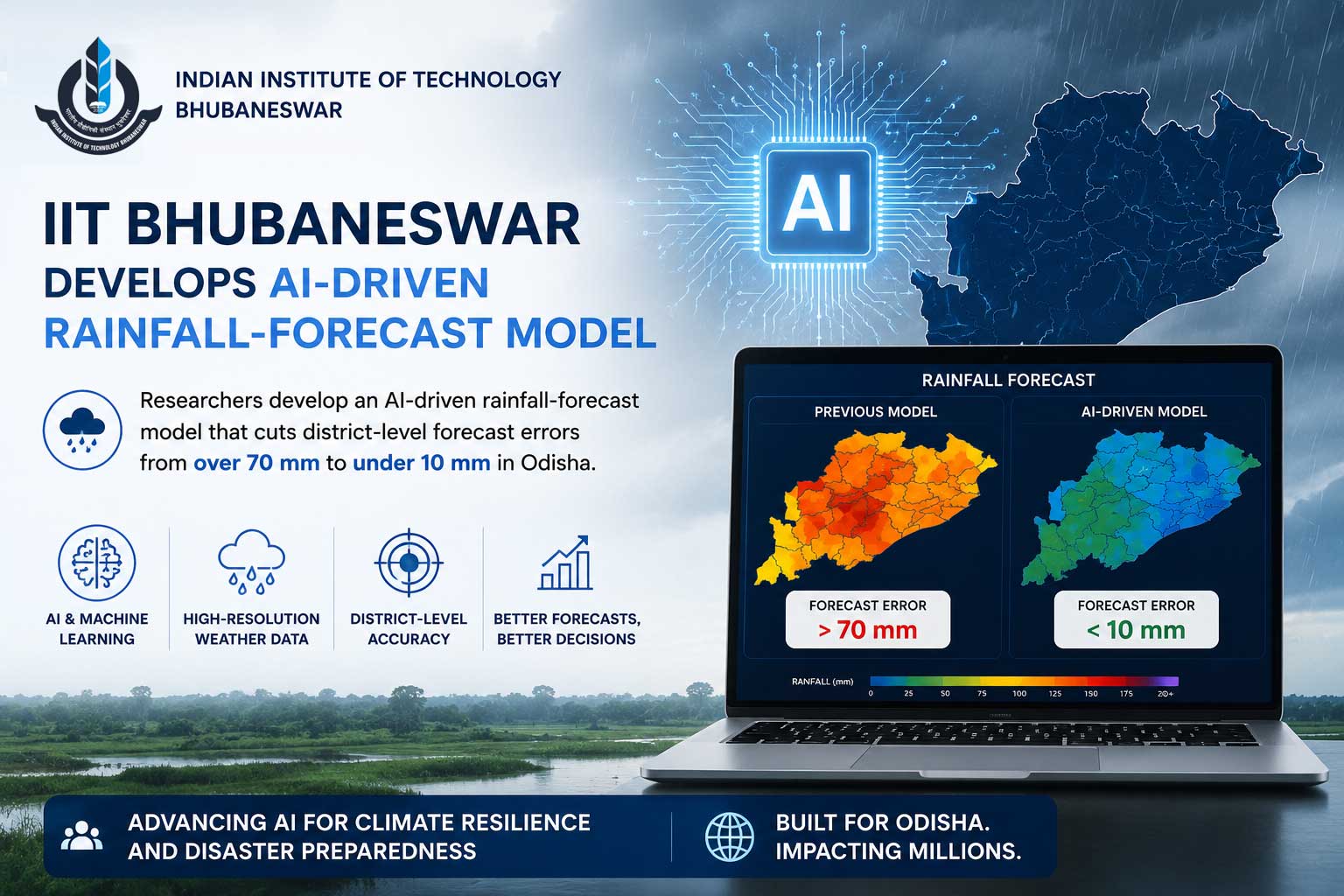
Researchers at IIT Bhubaneswar develop an AI‑driven rainfall‑forecast model that cuts district‑level forecast errors from over 70 mm to under 10 mm in Odisha.
AI supercharges Odisha’s rainfall forecasts
Researchers Dhananjay Trivedi, Sandeep Pattnaik, Anshul Sisodiya, of the Indian Institute of Technology Bhubaneswar (IIT Bhubaneswar) and Omveer Sharma from University of Haifa have developed an advanced artificial‑intelligence‑based model that predicts district‑level rainfall with significantly higher precision, offering a major upgrade to weather forecasting and disaster preparedness in Odisha. The model, created by the School of Earth, Ocean and Climate Sciences, aims to address the limitations of conventional weather‑prediction systems and support better early‑warning capabilities during extreme‑weather events.
The research has been published in the quarterly journal of the Royal Meteorological Society, coinciding with Odisha’s preparations for an active monsoon season marked by an increased risk of localised flooding from low‑pressure systems, depressions, and cyclonic activity over the Bay of Bengal.
Limitations of traditional weather models
Current weather forecasts for India rely mainly on physics‑based dynamical models such as the Weather Research and Forecasting (WRF) Model. These systems simulate atmospheric processes using complex equations and are effective at capturing broad‑scale weather patterns and large‑area rainfall trends.
However, they often struggle to pinpoint the exact location and intensity of heavy rainfall at the district level, especially during short‑duration, high‑impact events. For cyclone‑prone states like Odisha, this gap can hamper early‑warning systems, evacuation planning, and disaster‑response coordination.
An ensemble spatial‑attention AI model
To overcome these limitations, the IIT Bhubaneswar team designed an ensemble‑based spatial‑attention AI model that learns from multiple weather‑simulation outputs and historical rainfall data. The AI system does not replace physics‑based models; instead, it enhances their district‑level precision by evaluating the performance of different simulations under varying conditions.
The model analyses outputs from multiple forecasting simulations and assigns dynamic priority weights to the simulations that perform best for specific rainfall intensity, location, and lead‑time scenarios. This attention‑based mechanism allows the system to focus on the most relevant spatial and temporal signals, improving forecast accuracy for individual districts.
High‑resolution training and remarkable accuracy
The AI model was trained on data from over 500 simulations covering 18 major storm events, including both monsoon and post‑monsoon cyclonic systems that have impacted the region over recent years. By learning from detailed historical rainfall patterns, the model can better anticipate where and when intense rainfall will occur during the next event.
According to the study findings, the AI‑enhanced system reduced district‑level forecast errors from more than 70 mm to less than 10 mm. This level of accuracy dramatically improves the ability of meteorologists to identify high‑risk zones and communicate targeted warnings to local authorities and communities.
Hourly predictions up to 72 hours ahead
In addition to improved spatial precision, the model can generate hourly rainfall predictions up to 72 hours in advance. This near‑term, high‑temporal‑resolution forecasting capability is particularly useful for tracking rapidly evolving weather systems such as thunderstorms, squall lines, and cyclone‑driven rain bands.
Such detailed outlooks enable disaster‑management agencies to plan timely evacuations, pre‑position relief supplies, and coordinate emergency services more effectively. For farmers, fishermen, and coastal communities, the forecasts can support day‑to‑day decision‑making around movement, harvesting, and sea travel, reducing exposure to sudden downpours and storm surges.
Strengthening early‑warning and resilience in Odisha
The IIT Bhubaneswar team believes their AI‑driven rainfall‑forecast model can significantly strengthen early‑warning systems in Odisha. By delivering high‑confidence district‑level rainfall predictions, the system supports more targeted and timely alerts, reduces the risk of false alarms, and enhances public trust in meteorological advisory services.
As cyclone frequency and rainfall extremes increase under climate‑change projections, the model offers a scalable, data‑driven approach to improve catastrophe readiness and risk reduction in the state. Authorities can use the forecasts not only for short‑term operational planning but also for long‑term infrastructure planning, drainage design, and coastal‑protection strategies.
By integrating AI into regional weather‑forecasting workflows, IIT Bhubaneswar is helping Odisha and the broader Indian meteorological community move from broad‑scale guidance to precise, actionable predictions that can save lives, protect livelihoods, and strengthen climate resilience.
Disclaimer
The information in this article is based on available public sources and official statements as of the time of publication. While we aim for accuracy, we do not guarantee completeness or correctness. We advise readers to verify key details from official sources before making any decisions. The website (iitiimsamvaad.com) is not liable for any loss or damage arising from the use of this content. The authors are also not responsible for any such loss or damage.