

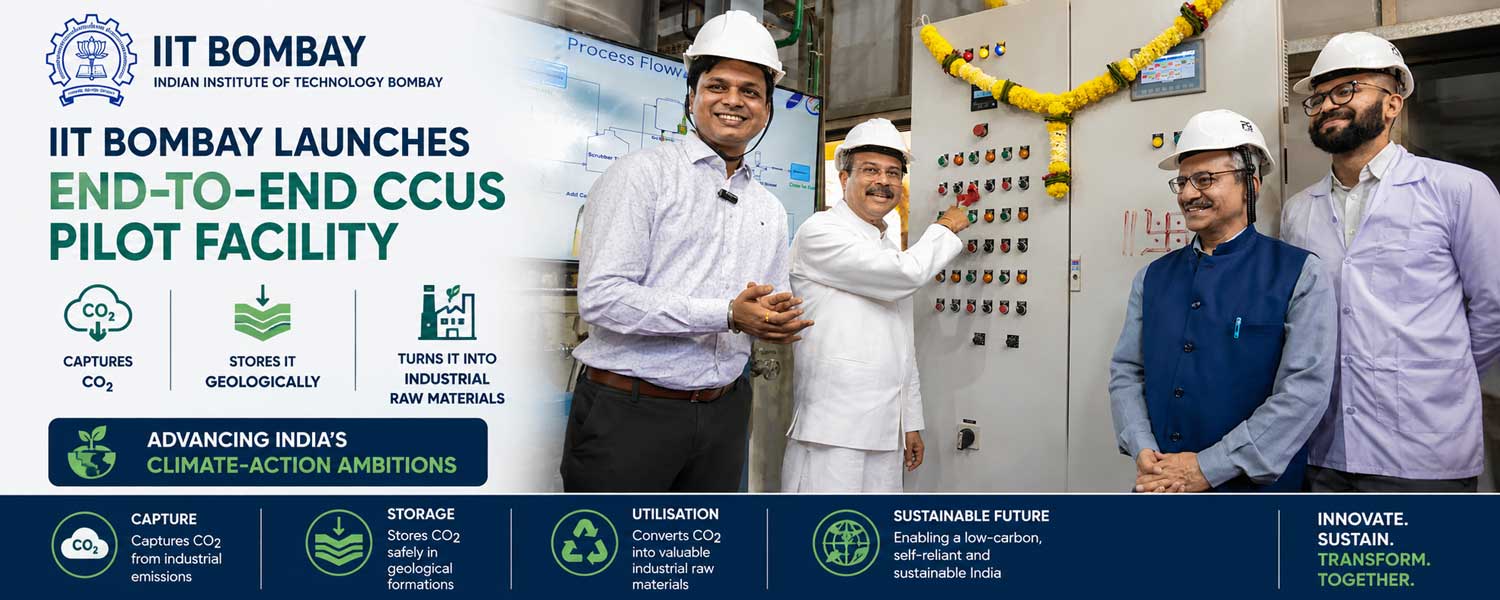
IIT Bombay launches an end‑to‑end Carbon Capture, Utilisation, and Storage pilot facility that captures CO₂, stores it geologically, and turns it into industrial raw materials, advancing India’s climate‑action ambitions.
IIT Bombay inaugurates CCUS pilot facility
The Indian Institute of Technology Bombay (IIT Bombay) has launched an integrated pilot facility for Carbon Capture, Utilisation, and Storage – CCUS, marking the start of geological CO₂ sequestration scientific drilling under an end‑to‑end field‑laboratory project. The facility, inaugurated by Union Education Minister Dharmendra Pradhan, falls under the Bharat Innovates 2026 initiative and positions India among a select group of nations experimenting with full‑cycle carbon‑management technologies.
The pilot project combines an indigenously designed Carbon Capture and Utilisation (CCU) plant with Geological CO₂ Sequestration (GCS) in the Deccan basalt formations, enabling deep underground storage of captured carbon dioxide. By integrating capture, utilisation, and storage, IIT Bombay aims to demonstrate a self‑reliant, closed‑loop carbon‑mitigation pathway that can be scaled for broader industrial and policy applications.
End‑to‑end carbon‑management system
The facility operates as an end‑to‑end field laboratory, from flue‑gas or ambient‑air capture through to secure geological storage and industrial reuse. It uses an IIT Bombay‑patented aqueous CO₂ capture technology that can pull CO₂ from both industrial emissions and the surrounding air, including using non‑potable water in the process. This approach reduces freshwater dependence and lowers operational costs, making the technology more viable for large‑scale deployment.
Engineers and scientists at IIT Bombay have designed the system to capture CO₂ at multiple points, including power plants, cement kilns, and other high‑emission facilities, before injecting the gas into the Deccan basalt formations for long‑term storage. The basalt’s mineral composition supports mineralisation, where CO₂ gradually reacts with rock to form stable carbonate minerals, effectively locking away carbon for thousands of years.
Minister hails India’s home‑grown CCUS solution
Addressing the inauguration, Union Education Minister Dharmendra Pradhan praised IIT Bombay for developing an indigenous solution to a pressing global climate challenge. He highlighted that the project will be showcased during Bharat Innovates 2026, a technology‑showcase platform scheduled for next month in France, where India will present its advances in clean‑energy and climate‑resilience technologies to an international audience.
Pradhan also observed that several countries have conducted successful carbon capture experiments in the past, but the value‑addition challenge – that is, turning captured CO₂ into useful products – had remained unresolved. He noted that IIT Bombay’s CCUS facility now addresses this gap by linking capture with industrial‑grade utilisation pathways, thereby strengthening the economic case for carbon‑management technologies.
Turning CO₂ into industrial raw materials
A key innovation of the project lies in the utilisation stream: the project converts the captured CO₂ into calcium carbonate, a versatile by‑product that finds applications in multiple sectors. The Minister explained that calcium carbonate can replace lime in industries such as steel, paints, cement, and housing materials, reducing the need for energy‑intensive lime‑production processes and cutting associated emissions.
By commercialising this by‑product, the facility creates a circular‑economy model in which the facility stores CO₂ and transforms it into a revenue‑generating industrial input. This dual benefit – emission reduction plus economic value – helps justify the investment in CCUS infrastructure and encourages private‑sector participation in carbon‑management projects.
Strengthening India’s climate‑action and research ecosystem
The CCUS pilot facility also underscores IIT Bombay’s role in advancing low‑carbon technologies and climate‑resilience research. The institute will use the laboratory to train students, researchers, and industry professionals in carbon‑capture engineering, subsurface monitoring, and lifecycle‑emission analysis, building a skilled workforce for India’s clean‑energy transition.
Through this initiative, the Government of India and IIT Bombay are signalling that carbon capture, utilisation, and storage can complement renewable‑energy expansion and energy‑efficiency measures in the country’s broader climate‑action strategy. The project also aligns with India’s long‑term net‑zero‑emission goals, providing a domestic testbed for technologies that could be deployed at scale in future carbon‑management programmes.
Looking ahead: scaling and policy integration
Going forward, IIT Bombay aims to refine the capture efficiency, storage‑safety protocols, and utilisation economics of the CCUS system through continuous experimentation and data collection at the pilot facility. The institute will collaborate with industry partners, regulatory bodies, and international research groups to validate best practices and contribute to national CCUS guidelines and standards.
By integrating scientific research, industrial application, and policy demonstration, the IIT Bombay CCUS facility illustrates how India can harness its academic and technical capabilities to develop home‑grown, climate‑smart infrastructure. The project not only mitigates emissions but also opens new avenues for green entrepreneurship, material innovation, and sustainable industrial growth in the decades ahead.
Disclaimer
The information in this article is based on available public sources and official statements as of the time of publication. While we aim for accuracy, we do not guarantee completeness or correctness. We advise readers to verify key details from official sources before making any decisions. The website (iitiimsamvaad.com) is not liable for any loss or damage arising from the use of this content. The authors are also not responsible for any such loss or damage.