
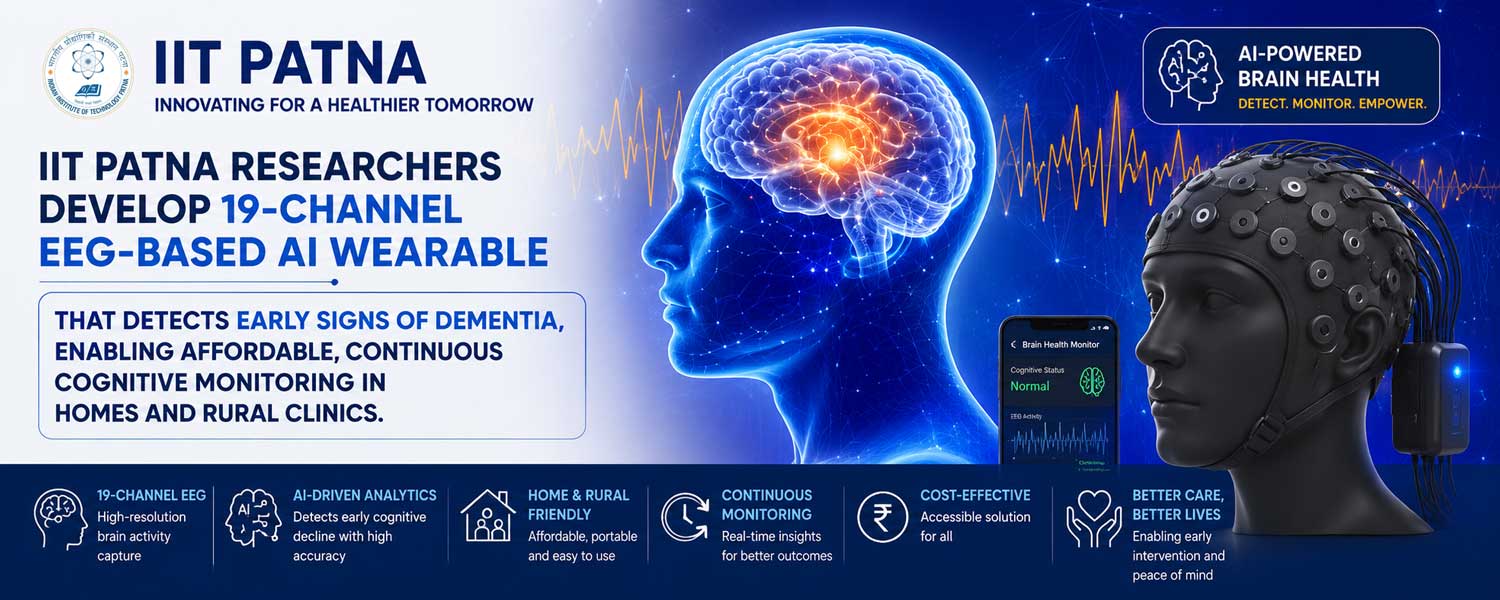
IIT Patna researchers have developed a 19‑channel EEG‑based AI wearable that detects early signs of dementia, enabling affordable, continuous cognitive monitoring in homes and rural clinics.
IIT Patna Unveils AI‑Powered Wearable for Early Dementia Detection
Researchers at IIT Patna have developed an AI‑powered wearable device designed to detect early signs of dementia and cognitive decline. The device uses a 19‑channel EEG‑based helmet to record brain activity and analyse neurological signals in real time, offering clinicians a low‑cost alternative to expensive MRI and PET scans. By focusing on continuous, at‑home monitoring, the wearable aims to make early dementia screening accessible in regions with limited medical infrastructure.
The project team, led by Rahul Mishra, has integrated smart sensors and artificial intelligence into the helmet to capture and interpret brain‑wave patterns linked to cognitive deterioration. Instead of relying on sporadic hospital visits, clinicians can now monitor elderly patients over time, spotting subtle changes that traditional methods often miss.
Why early detection matters
Identifying cognitive decline at an early stage is difficult because symptoms such as mild memory lapses, attention deficits, and slower information processing often appear subtle or are mistaken for normal ageing. The IIT Patna wearable addresses this challenge by continuously tracking neurological activity and flagging statistically significant deviations from a patient’s baseline.
By processing EEG data in real time, the system provides immediate insights into a person’s cognitive state, allowing doctors to intervene sooner with lifestyle changes, medication, or structured therapies. This proactive approach can slow the progression of dementia, improve quality of life, and reduce the long‑term burden on families and healthcare systems.
How the AI‑EEG system works
The wearable helmet records electrical signals from the brain using its 19‑channel EEG configuration, which captures activity across multiple regions of the cortex. These raw signals then pass through an on‑device AI pipeline that filters noise, isolates relevant waveforms, and identifies patterns associated with cognitive impairment. The system compares each recording against a reference model trained on healthy and impaired brain‑activity datasets, generating a risk or probability score for early dementia.
Unlike conventional diagnostic tools, the IIT Patna device does not require large, hospital‑centric infrastructure. Instead, it operates as a portable, plug‑and‑wear unit that nurses, caregivers, or even family members can deploy with minimal training. This design lowers the barrier to neuro‑monitoring in rural clinics, primary‑health centres, and home‑based care settings, expanding access to timely dementia screening across India.
TinyML and low‑power hardware advantages
A key innovation in the system is its use of TinyML (Tiny Machine Learning), a machine‑learning framework optimized to run directly on small, low‑power hardware. Wireless head‑mounted EEG devices typically rely on cloud servers to process large volumes of data, which increases latency, energy consumption, and operational costs. By contrast, TinyML enables the device to perform on‑device inference, analysing EEG signals without sending them to the cloud.
This shift reduces energy use, shortens decision‑latency, and enhances data privacy, since sensitive brain‑wave information stays on the hardware unless explicitly shared. The research team has also fine‑tuned the system to function efficiently on inexpensive processors, further lowering the overall cost of the device. These features make the wearable suitable for deployment in rural medical clinics and remote areas where internet connectivity and high‑end computing resources are limited.
Adding gait and balance analysis
Beyond brain‑wave monitoring, the IIT Patna team is expanding the system to include gait and balance analysis. They are developing sensors that track walking patterns, stride length, weight distribution, and overall movement stability, which can reveal early neurological changes before pronounced memory loss appears. Abnormalities in gait, posture, and balance often correlate with conditions such as mild cognitive impairment, Parkinson’s disease, and vascular dementia, and detecting them early can refine diagnosis and management.
By combining EEG‑based brain monitoring with movement‑based gait analysis, the team is creating a multi‑modal platform for early dementia detection. This holistic approach captures both cognitive and motor‑system changes, giving clinicians a richer picture of each patient’s neurological health. The researchers plan to integrate these two modules into a single wearable platform that delivers continuous, multi‑dimensional monitoring.
Clinical trials and future availability
The team has already conducted experimental trials demonstrating the feasibility and accuracy of the EEG‑based system in detecting early cognitive decline. Clinical validation will now move into a more rigorous phase at AIIMS Patna, where doctors will test the device on a broader cohort of elderly patients in real‑world medical settings. These trials will assess the system’s sensitivity, specificity, and usability, providing the data needed for regulatory approval and eventual deployment in Indian hospitals.
Once validated, the wearable could roll out across public and private hospitals, geriatric clinics, and community‑health centres, particularly in underserved regions. For healthcare professionals who wish to specialise in dementia care, pursuing a certification course in dementia can equip them with the knowledge required to interpret screening data, manage patients, and design holistic care plans.
Disclaimer
The information in this article is based on available public sources and official statements as of the time of publication. While we aim for accuracy, we do not guarantee completeness or correctness. We advise readers to verify key details from official sources before making any decisions. The website (iitiimsamvaad.com) is not liable for any loss or damage arising from the use of this content. The authors are also not responsible for any such loss or damage.