

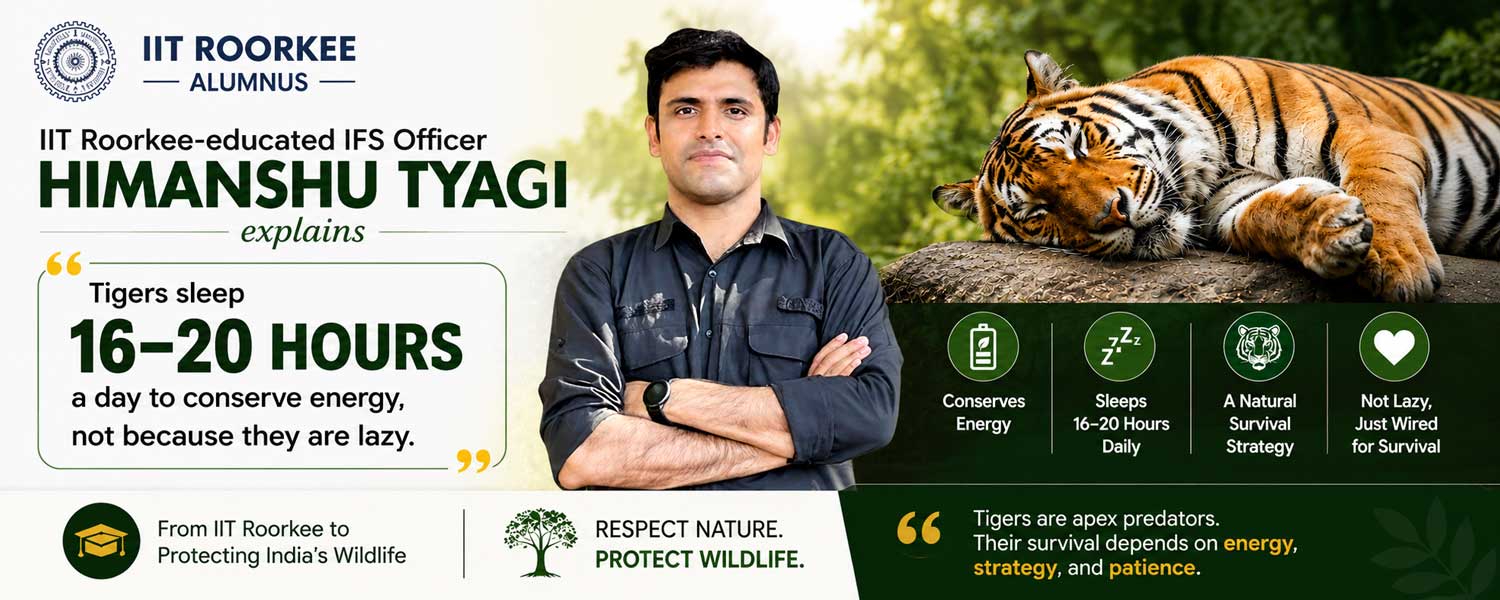
IIT Roorkee‑educated IFS officer Himanshu Tyagi explains that tigers sleep 16–20 hours a day to conserve energy, not because they are lazy.
Why tigers sleep so much
Tigers spend most of their day asleep, but it is not because they are lazy. According to Himanshu Tyagi, an IIT Roorkee gold‑medalist and Indian Forest Service (IFoS) officer, the answer lies in a simple biological principle: energy conservation. Tyagi recently shared his insights on his official X handle, explaining that tigers are among nature’s most efficient energy managers. His post has drawn widespread attention for making complex animal behaviour easy to understand.
“Tigers understand calorie math better than most of us do,” Tyagi wrote. He explained that tigers sleep and rest for 16 to 20 hours every day, allowing them to conserve energy that they later use for hunting, territorial patrols, and survival‑critical activities.
Energy‑efficient hunting and recovery
Tigers follow a polyphasic sleep pattern, meaning they alternate between deep sleep and light, alert dozing. This cycle allows them to maximise recovery while staying ready to respond to threats or opportunities. During their long rest periods, their bodies repair muscles, restore energy, and prepare for the next demanding hunt.
Hunting requires a short, intense burst of anaerobic energy. Tigers rely on stealth, strength, and explosive power to stalk and overpower large prey such as deer and wild boar. Tyagi noted that although this burst of activity is extremely energy‑intensive, the payoff can be substantial. A single successful kill of a large ungulate can sustain a tiger for up to seven days.
Saving energy through minimal movement
Because tigers can go days without needing to hunt again, conserving energy between hunts becomes essential. Tyagi explained that tigers are naturally calm and conflict‑averse outside of hunting and territorial defence. They avoid unnecessary fights, chases, and rough‑and‑tumble encounters, which preserves precious calories.
By minimising frequent movement, territorial skirmishes, and prolonged chases, tigers reduce their daily energy expenditure. This lifestyle means they can allocate energy only to critical tasks such as locating prey, making a decisive strike, defending territory, and reproducing.
Resting as an evolutionary strategy
Tyagi’s explanation shows that the tiger’s resting habits are not a sign of inactivity but an evolutionary strategy shaped by survival needs. In the wild, energy is a limited resource, and no movement is wasted. The tiger’s long sleep and rest periods help it balance high‑intensity bursts with extended recovery, making it a highly efficient predator.
“Every movement, every calorie, is accounted for,” Tyagi wrote. “They are one of nature’s most efficient energy managers.” His post underscores the idea that tigers are not lazy animals -they are highly strategic, energy‑conscious hunters whose biology is tuned to survive in a competitive ecosystem.
A public‑service lesson in wildlife science
By sharing this insight in simple, relatable language, Tyagi has turned an everyday observation – tigers sleeping all day – into a lesson in animal physiology, ecological energy use, and predator behaviour. His explanation has helped the public understand that what appears like idleness is, in fact, a well‑adapted, energy‑optimised survival strategy.
For conservationists and wildlife enthusiasts, Tyagi’s message also highlights the importance of protecting tiger habitats that allow these predators to move, rest, and hunt in balance. By preserving large, connected forests, India can support tigers’ natural energy‑management lifestyles and ensure their long‑term survival in the wild.
Disclaimer
The information in this article is based on available public sources and official statements as of the time of publication. While we aim for accuracy, we do not guarantee completeness or correctness. We advise readers to verify key details from official sources before making any decisions. The website (iitiimsamvaad.com) is not liable for any loss or damage arising from the use of this content. The authors are also not responsible for any such loss or damage.