

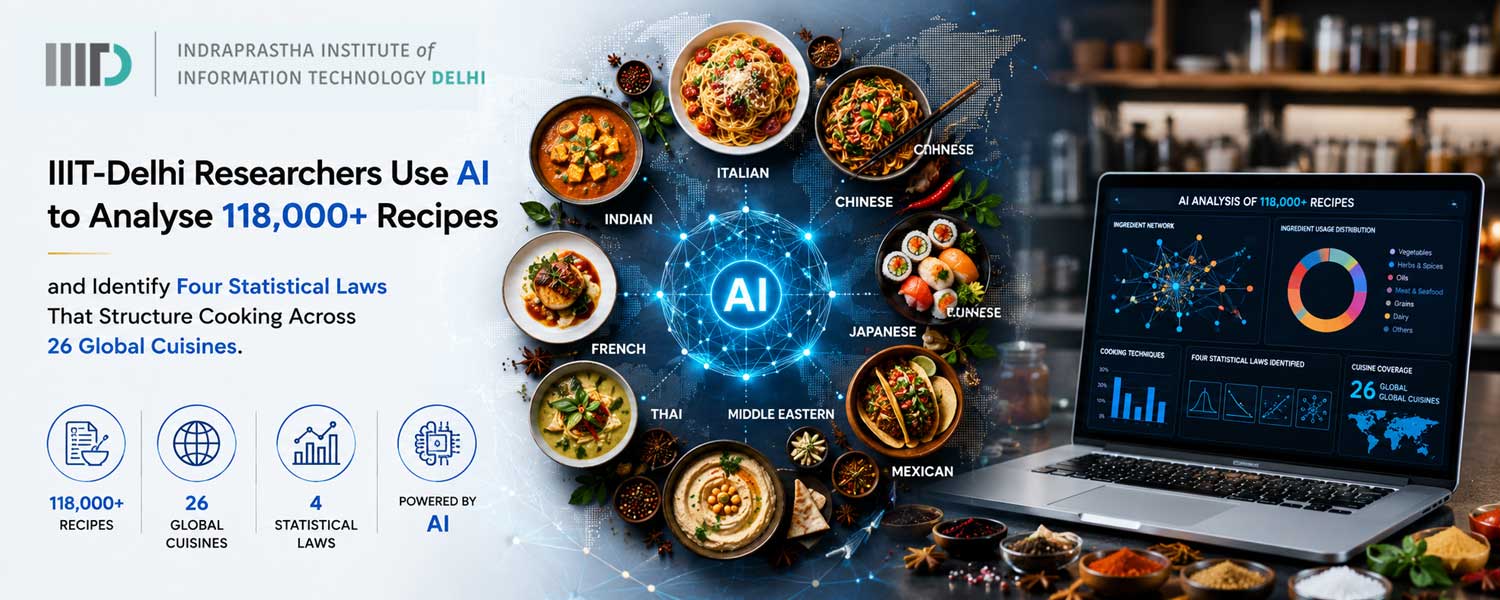
IIIT‑Delhi researchers use AI to analyse over 118,000 recipes and identify four statistical laws that structure cooking across 26 global cuisines.
AI reveals hidden patterns in recipes
Researchers at the Indraprastha Institute of Information Technology Delhi (IIIT‑Delhi) have used artificial intelligence to analyse more than 118,000 recipes from 26 cuisines and identified four statistical “laws” that appear to shape cooking worldwide. The team broke each recipe into ingredients, cooking steps, and kitchen tools, then applied computational methods to uncover frequency and diversity patterns underlying what looks like boundless culinary creativity.
“Our work shows that what appears as freeform improvisation in cooking actually follows deep statistical regularities,” said Prof. Ganesh Bagler, Professor of AI at IIIT‑Delhi and lead researcher on the project. “Every recipe is an expression within a larger, evolving system, much like a sentence in a language.”
The first law: Zipf’s Law in ingredients
One of the key patterns the researchers identified is Zipf’s Law in ingredient usage. Under this law, a small set of staple ingredients appears very frequently, while the majority of ingredients appear rarely. Common items such as salt, onion, butter, oil, and basic spices dominate the recipe corpus, functioning like high‑frequency words in a language.
In contrast, rare or region‑specific ingredients – such as certain specialty herbs, uncommon roots, or local spices—appear in only a small fraction of recipes. This distribution mirrors the way natural language is structured, where a handful of words appear constantly and the rest are used sparingly.
The second law: Slowing discovery of new ingredients
The study also uncovered a second statistical pattern related to ingredient discovery. As the number of recipes in the dataset increases, the rate of encountering entirely new ingredients slows down, similar to the way collecting trading cards becomes harder near completion. After a certain point, adding more recipes mainly re‑uses existing ingredients rather than introducing many new ones.
This pattern suggests that each cuisine operates within a bounded combinatorial space, even as chefs keep inventing new dishes. The repeated building blocks – core ingredients, fundamental techniques, and standard tools – form a stable foundation on which local creativity evolves.
Third and fourth statistical structures
Beyond ingredient frequency and discovery, the researchers identified additional statistical regularities in cooking steps and tool usage. The paper describes how certain high‑level operations – such as chopping, roasting, frying, and simmering – appear in predictable frequencies and sequences across cuisines, while more complex, multi‑step procedures remain relatively rare.
Similarly, the distribution of kitchen tools follows a pattern where a small set of core instruments – pots, knives, stoves, and basic utensils – are used in the vast majority of recipes, while specialised gadgets remain exceptional. Together, these four statistical “laws” indicate that culinary systems are highly constrained yet flexible, enabling diverse outcomes within a stable underlying structure.
Language‑like structure of cooking
The authors draw a direct analogy between recipes and language, noting that both share compressible, low‑dimensional structures. Just as we can analyse sentences using n-gram models, frequency counts, and language-model representations, we can view recipes as sequences of ingredient–tool–operation triplets that follow similar regularities.
This structural similarity raises the possibility of recipe‑language models – AI systems that learn these patterns and generate new, plausible recipes, recommend substitutes, or translate cooking styles across cultures. For example, a model could suggest vegetarian alternatives, adjust spice profiles, or adapt a technique from one cuisine to another while preserving flavour balance.
Implications for AI and food technology
From a computational perspective, the discovery of these statistical laws implies that culinary data may be amenable to compact representations and generative modelling, much like text and DNA sequences. If the observed patterns hold across larger and more diverse datasets, they could support tasks such as:
- Recipe generation and augmentation
- Ingredient and substitution recommendation
- Cross‑cultural step‑translation and technique mapping
However, the researchers note that practical utility will depend on reproducible code, open datasets, and standardised evaluation protocols. The current work presents conceptual and statistical findings but does not yet release model architectures, training configurations, or a public version of the recipe corpus.
A step toward science‑driven gastronomy
By mapping cultural artifacts like recipes to statistical regularities, the IIIT‑Delhi study joins a broader tradition in computational linguistics and network science that seeks to compress human‑generated systems into formal models. The team’s findings suggest that seemingly chaotic, culturally rich domains such as cooking may, in fact, be governed by universal structural principles – patterns that can guide both scientific understanding and AI‑driven innovation in food technology, nutrition, and gastronomy.
Disclaimer
The information in this article is based on available public sources and official statements as of the time of publication. While we aim for accuracy, we do not guarantee completeness or correctness. We advise readers to verify key details from official sources before making any decisions. The website (iitiimsamvaad.com) is not liable for any loss or damage arising from the use of this content. The authors are also not responsible for any such loss or damage.