
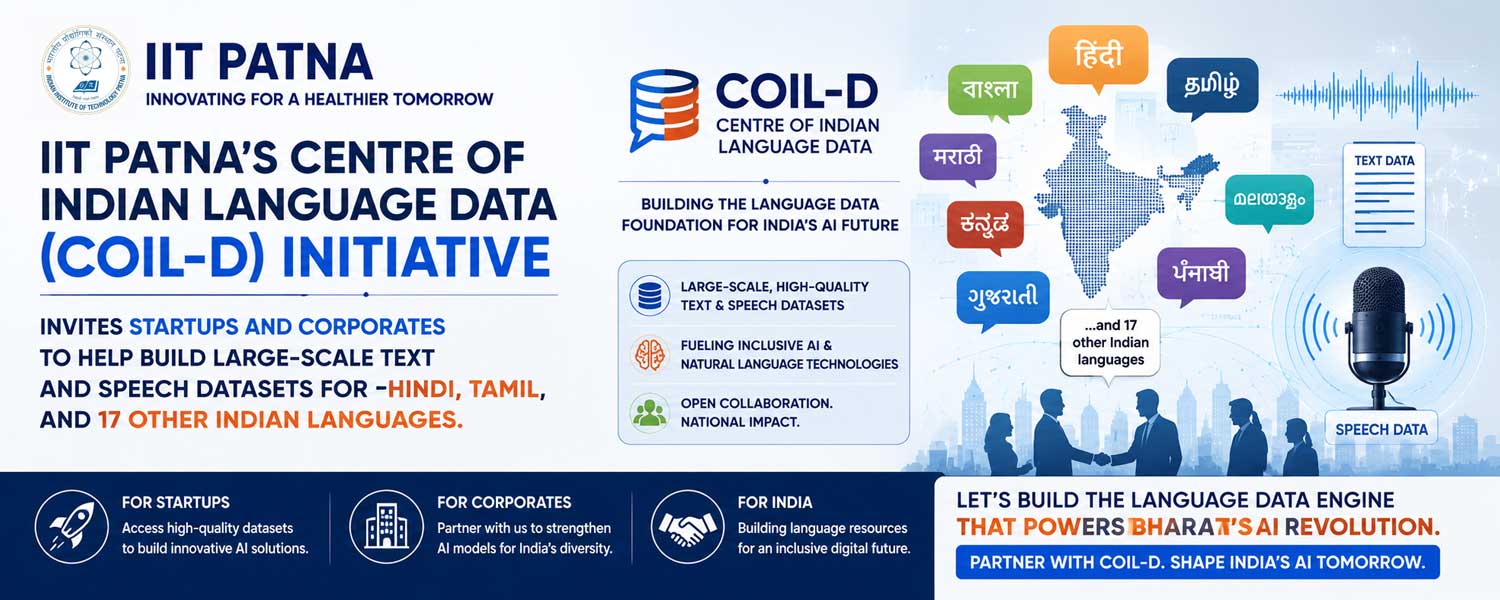
IIT Patna’s Centre of Indian Language Data (COIL‑D) initiative invites startups and corporates to help build large‑scale text and speech datasets for Hindi, Tamil, and 17 other Indian languages.
IIT Patna launches COIL‑D initiative
The Technology Innovation Hub (TIH) at IIT Patna has launched the Centre of Indian Language Data (COIL‑D) to create large‑scale language resources for artificial intelligence and natural language processing (NLP) applications. COIL‑D is soliciting partners – startups, corporates, and research groups – to co‑develop multilingual datasets, tools, and services that support India’s growing language‑technology ecosystem.
The initiative operates under an MoU between TIH IIT Patna and the COIL‑D chief principal investigator, which mandates the development of text and voice corpora, parallel corpora, and supporting technologies for translation and speech recognition. The project is funded by the Ministry of Electronics and Information Technology (MeitY) and aligns with the national Bhashini language‑technology platform. On Bhashini’s project pages, Dr. Asif Ekbal of IIT Patna appears as the COIL‑D chief investigator, overseeing the technical roadmap and vendor engagement.
Objectives and deliverables
COIL‑D aims to build a centralised repository of Indian‑language data that developers can use to train, benchmark, and deploy multilingual AI models. The TIH call for proposals lists concrete deliverables, including:
- Development of monolingual text and voice corpora for Hindi, Tamil, and 17 other Indian languages.
- Creation of parallel corpora aligned across source and target languages, especially for translation use cases.
- Design and refinement of technology stacks for text processing, speech recognition, and machine translation, with a focus on improving Hindi‑to‑Indian‑language and Tamil‑to‑Dravidian‑language translation quality.
By structuring these deliverables around standardised formats and evaluation protocols, COIL‑D intends to reduce fragmentation and duplication in data collection efforts. Startups and corporates can participate by submitting expressions of interest (EOIs) to the TIH, with the first‑cycle deadline set at 15 March 2025, as per the TIH announcement.
Technical framing: corpora and standards
Publicly available materials describe, Indian Language Data, COIL‑D as both a data repository and a resource‑creation engine for Indian languages. Alongside raw text and audio, the project emphasises annotation standards, metadata schemas, and licensing frameworks so that datasets can be reused consistently across research and industry projects.
In practice, this approach mirrors global patterns in large, government‑backed corpus initiatives, where clear annotation guidelines, open licensing, and benchmarked evaluation sets help maximise downstream utility. For AI practitioners, harmonised corpora and aligned parallel datasets significantly reduce the time and effort required to train machine‑translation and automatic speech recognition (ASR) systems for low‑resource Indian languages.
Role in the Bhashini ecosystem
COIL‑D sits within the broader Bhashini ecosystem, which the Government of India promotes as a national‑level language‑technology mission. Bhashini aims to support speech‑to‑text, text‑to‑speech, and machine‑translation services across India’s major languages, enabling digital access and public‑service delivery in regional tongues.
Within this framework, COIL‑D functions as a foundational data layer: it generates and curates the datasets that feed Bhashini‑aligned models and APIs. By centralising high‑quality, vetted corpora, the initiative helps level the playing field for startups and research groups that lack the resources to build language data from scratch. It also creates procurement and collaboration pathways for industry players to work directly with government‑backed infrastructure, accelerating the commercialisation of language‑technology products for Indian markets.
Industry implications and what to watch
From an industry‑practice perspective, COIL‑D’s success will depend heavily on three factors: data licensing terms, annotation quality, and technical interoperability. If the project releases datasets under clear, permissive licenses, practitioners can integrate them into both open‑source and commercial pipelines without legal uncertainty.
Observers should also track:
- The annotation schemas and metadata standards COIL‑D adopts, as these directly influence how easily teams can reuse data across tasks.
- The languages and dialects included in the corpora, especially coverage of low‑resource and regional variants.
- The publication of benchmarks or leaderboards that enable “apples‑to‑apples” model comparisons using COIL‑D data.
If TIH or Bhashini also release data‑access APIs, evaluation toolkits, or hosted model‑testing environments, that will further streamline how developers consume and benchmark models on Indian‑language datasets. For researchers and practitioners, COIL‑D represents a promising step toward a more unified, scalable, and sovereign Indian‑language data infrastructure that can power next‑generation AI and NLP applications across the country.
Disclaimer
The information in this article is based on available public sources and official statements as of the time of publication. While we aim for accuracy, we do not guarantee completeness or correctness. We advise readers to verify key details from official sources before making any decisions. The website (iitiimsamvaad.com) is not liable for any loss or damage arising from the use of this content. The authors are also not responsible for any such loss or damage.