

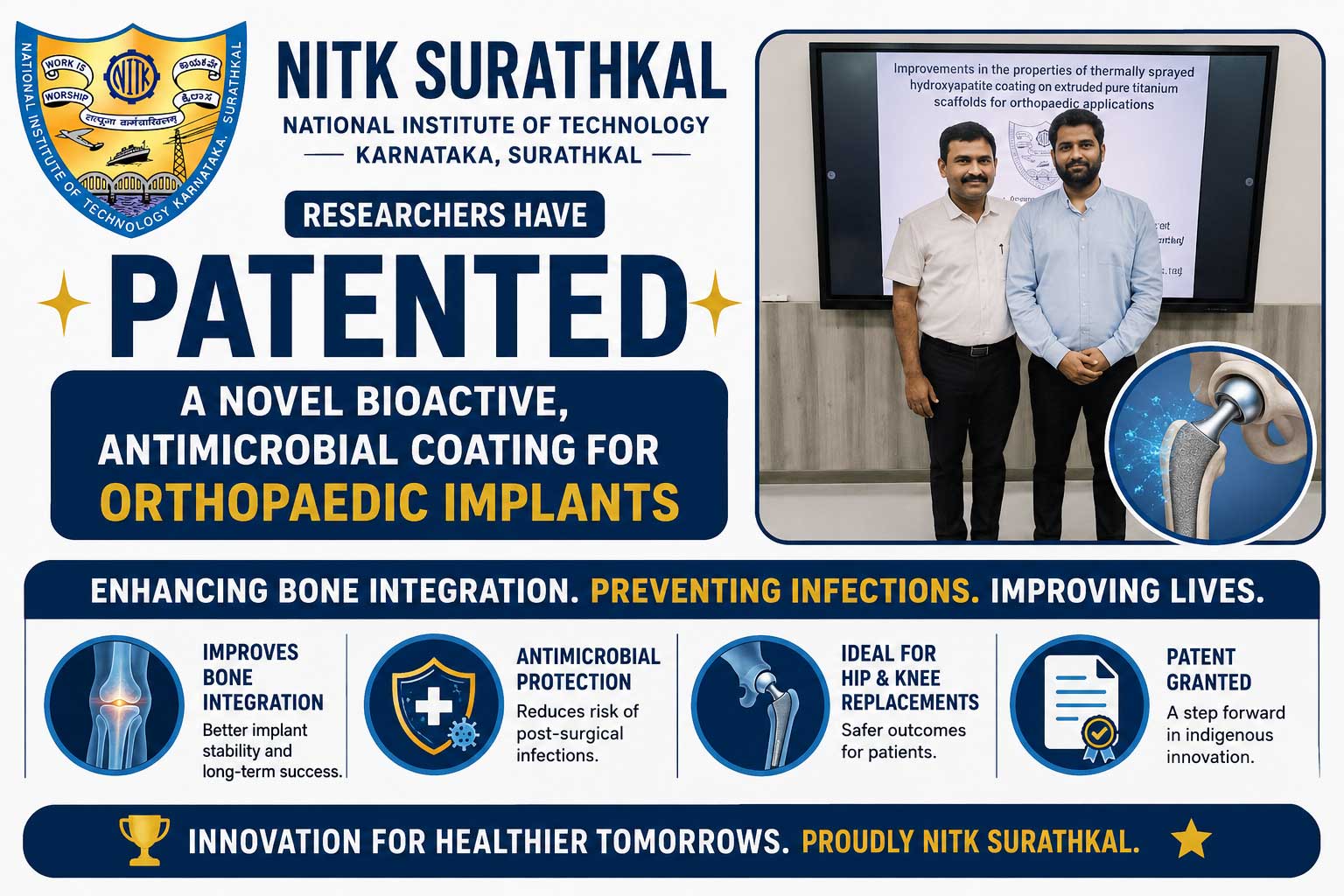
NITK Surathkal researchers have patented a novel bioactive, antimicrobial coating for orthopaedic implants that improves bone integration and prevents post-surgical infections in hip and knee replacements.
NITK Unveils Indigenous Orthopaedic Implant Coating
The National Institute of Technology Karnataka (NITK), Surathkal, has introduced a novel bioactive, durable, and antimicrobial coating for orthopaedic implants, particularly suited for hip and knee joint replacements. This indigenous breakthrough addresses critical challenges in orthopaedic surgery, including implant failure, infection, and poor bone integration.
The research team developed the coating using an optimised High Velocity Oxy-Fuel (HVOF) thermal spray method to apply a composite layer that offers localised antimicrobial defence together with improved mechanical durability, wear resistance, adhesion strength, and bone integration capabilities.
Advanced Coating Combats Infections and Enhances Durability
The coating actively combats bacterial growth to prevent common post-surgical infections, a major cause of implant failure and revision surgeries. By enhancing osseointegration – the process where bone grows into and bonds with the implant – the coating creates a firmer connection between implant and bone, ensuring long-term stability.
Early preclinical results indicate substantial improvements over traditional implants. These improvements could also translate into fewer revision surgeries, lower healthcare expenses, and better long-term patient well-being. The coating’s antimicrobial properties provide a protective shield around the implant, reducing the risk of infections that often require expensive and invasive treatments.
HVOF Thermal Spray Technology for Precision Application
The research team employed an optimised High Velocity Oxy-Fuel (HVOF) thermal spray method to apply the composite coating. This technique ensures uniform coverage, strong adhesion, and precise control over coating thickness, critical factors for implant performance and longevity.
The HVOF process bonds the composite layer firmly to the implant surface, creating a durable barrier that resists wear and corrosion while maintaining its antimicrobial activity over time. This precision application distinguishes the NITK coating from conventional methods that often struggle with consistency and durability.
From Lab to Market via Deep-Tech Startup
The research has also yielded several papers in international journals, secured a patent, and moved into the commercialisation phase through a dedicated deep-tech startup. Dr. Sudhakar C Jambagi, Associate Professor in the Department of Mechanical Engineering, guided the project with his PhD student Dr. Deep Shankar, who now leads the startup efforts.
Dr. Shankar’s leadership in the startup will drive technology transfer, manufacturing scale-up, and industry partnerships to bring the coating to patients in need. This transition from academic research to commercial product exemplifies the institute’s commitment to translating innovation into tangible societal impact.
Advancing Make in India in Biomedical Technology
This development reflects the spirit of Make in India by creating advanced, affordable biomedical technology domestically. The NITK coating reduces dependence on imported orthopaedic implants and coatings, strengthening India’s self-reliance in critical healthcare technologies.
By advancing the goals of healthier citizens and a developed nation, the project also aligns with national priorities in healthcare accessibility, affordability, and innovation. The coating’s potential to lower healthcare costs and improve patient outcomes makes it a significant contribution to India’s medical device ecosystem.
Impact on Orthopaedic Care and Patient Outcomes
The coating’s dual functionality – combating infections while enhancing bone integration – addresses two of the most pressing challenges in orthopaedic surgery. Fewer infections mean fewer revision surgeries, reduced hospital stays, and faster recovery times for patients. Stronger bone integration ensures implants last longer, reducing the need for replacements over a patient’s lifetime.
As the technology moves toward commercial deployment, it promises to transform orthopaedic care in India and potentially globally. The NITK team’s success also demonstrates how targeted research, advanced manufacturing techniques, and entrepreneurial initiative can converge to solve real-world healthcare problems.
#NITKSurathkal #OrthopaedicImplants #BioactiveCoating #AntimicrobialCoating #HVOFThermalSpray #MakeInIndia #BiomedicalTechnology #ImplantInnovation #DeepTechStartup #MedicalDevices
Disclaimer
The information in this article is based on available public sources and official statements as of the time of publication. While we aim for accuracy, we do not guarantee completeness or correctness. We advise readers to verify key details from official sources before making any decisions. The website (iitiimsamvaad.com) is not liable for any loss or damage arising from the use of this content. The authors are also not responsible for any such loss or damage.