
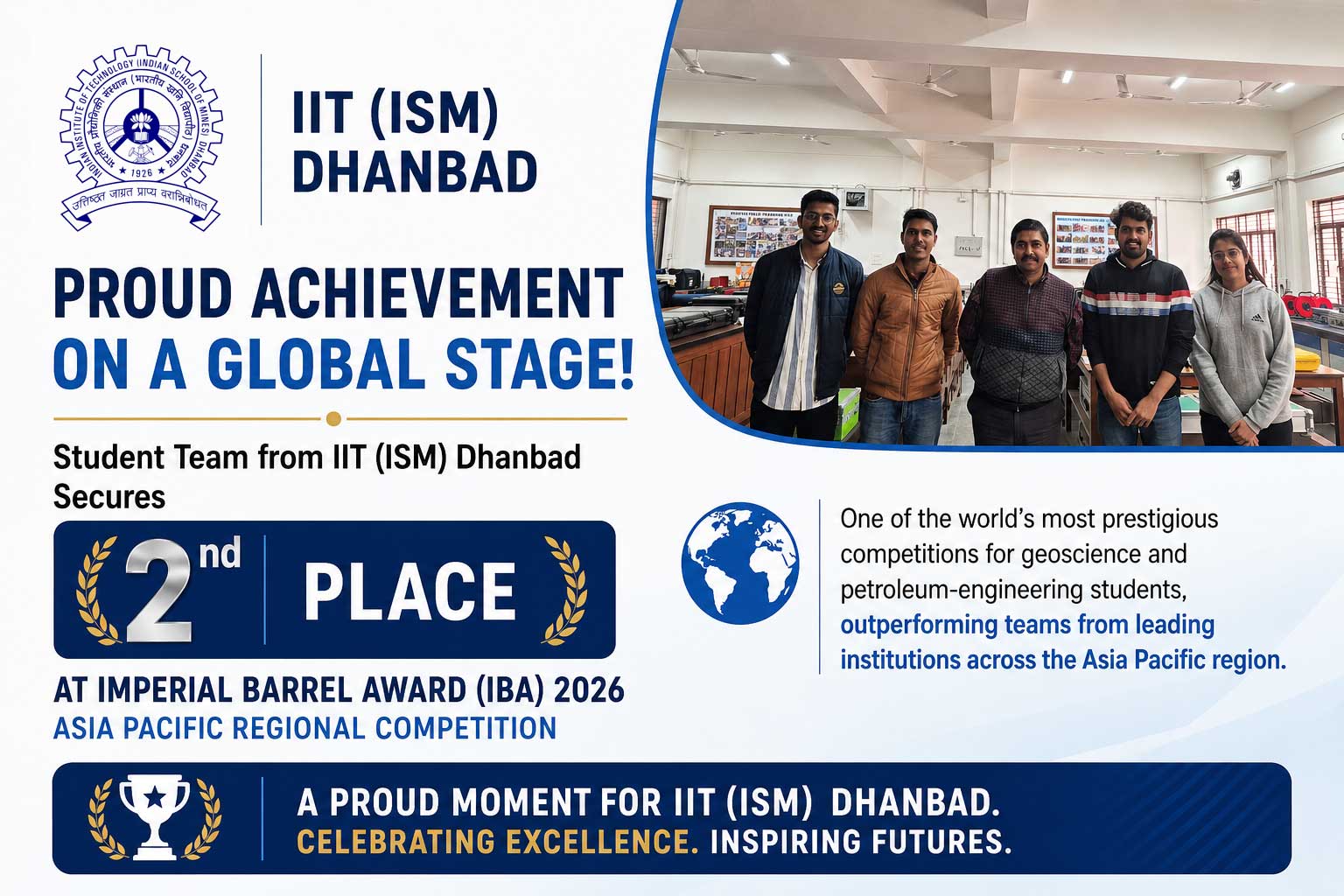
A student team from IIT (ISM) Dhanbad has secured second place at the Imperial Barrel Award 2026 Asia Pacific Regional Competition, a top global contest for geoscience and petroleum‑engineering students.
IIT (ISM) Dhanbad Shines at Global IBA Stage
A team from Indian Institute of Technology (ISM), Dhanbad, has finished in second place at the Imperial Barrel Award (IBA) 2026 Asia Pacific Regional Competition, cementing its position among the top petroleum‑exploration student teams globally. The IBA, organised by the American Association of Petroleum Geologists (AAPG), is widely regarded as the premier competition that simulates real‑world petroleum exploration workflows and challenges participants to integrate geoscience, engineering, and economic analysis.
The Asia Pacific regional event brought together top academic teams from across the region. Indonesia’s Institut Teknologi Bandung clinched first place, while another Indian institute, IIT Bombay, secured third, making it a strong showing for Indian geoscience and petroleum‑engineering education on the global stage.
Deepwater Hydrocarbon Study Wins Judges’ Praise
The IIT (ISM) Dhanbad team earned high marks from the judging panel for its detailed study on deepwater hydrocarbon systems in the Gulf of America. The project showcased a rigorous, end‑to‑end evaluation of a sediment‑hosted petroleum system, moving from basin‑scale assessment to individual prospect‑level analysis.
The team’s work featured advanced interpretation of 3D seismic data, prospect‑generation workflows, analog benchmarking against known fields, and volumetric risk assessment to quantify uncertainties in recoverable resources. Judges highlighted the clarity of the team’s technical arguments, the logical integration of geological and geophysical data, and the maturity of their risk‑and‑reward discussion, all of which mirror industry‑level exploration practices. By framing their presentation around realistic exploration‑decision criteria, the team demonstrated that it can confidently operate in professional‑grade exploration environments.
Student Team and Mentorship Framework
The IIT (ISM) Dhanbad contingent comprised Pareekshit Hegde, Padmini Pujapanda, Karthik H S, Gokul K, and Sachin Dhakad, all from the Departments of Applied Geophysics and Petroleum Engineering. The team combined diverse technical strengths, including seismic‑interpretation skills, reservoir‑characterisation knowledge, and competency in risk‑analysis tools, to deliver a cohesive, cross‑disciplinary exploration study.
Saurabh Datta Gupta of the Department of Applied Geophysics mentored the group, guiding them through data‑handling strategies, interpretation philosophies, and presentation‑design best practices. The mentorship also helped the students align their internal workflows with industry standards and sharpen their ability to translate complex technical findings into concise, decision‑oriented narratives for the competition jury.
Significance of the IBA for Future Geoscientists
The IBA is structured around a proprietary subsurface dataset that AAPG provides to participating universities each year. Students spend several weeks processing, interpreting, and integrating this dataset to assess a defined sediment‑rich basin or province, and then present a 25‑minute exploration‑appraisal report to a panel of industry judges. The competition therefore tests not only technical competence but also teamwork, time management, communication, and business‑acumen skills.
By securing second place at the Asia Pacific level, the IIT (ISM) Dhanbad team has demonstrated that its students can compete with – and outperform – peer institutions from resource‑rich and technologically advanced regions. The result also strengthens the institute’s reputation as a leading centre for petroleum geoscience, applied geophysics, and hydrocarbon‑exploration education in India and beyond.
For the participants, the experience offers a springboard into careers in the global energy sector, as the IBA is closely watched by exploration companies, service providers, and hydrocarbon‑focused research organisations. The exposure to real‑world data, workflow constraints, and jury‑style review processes prepares students to transition smoothly into roles in exploration, reservoir geoscience, and subsurface consulting.
Disclaimer
The information in this article is based on available public sources and official statements as of the time of publication. While we aim for accuracy, we do not guarantee completeness or correctness. We advise readers to verify key details from official sources before making any decisions. The website (iitiimsamvaad.com) is not liable for any loss or damage arising from the use of this content. The authors are also not responsible for any such loss or damage.