

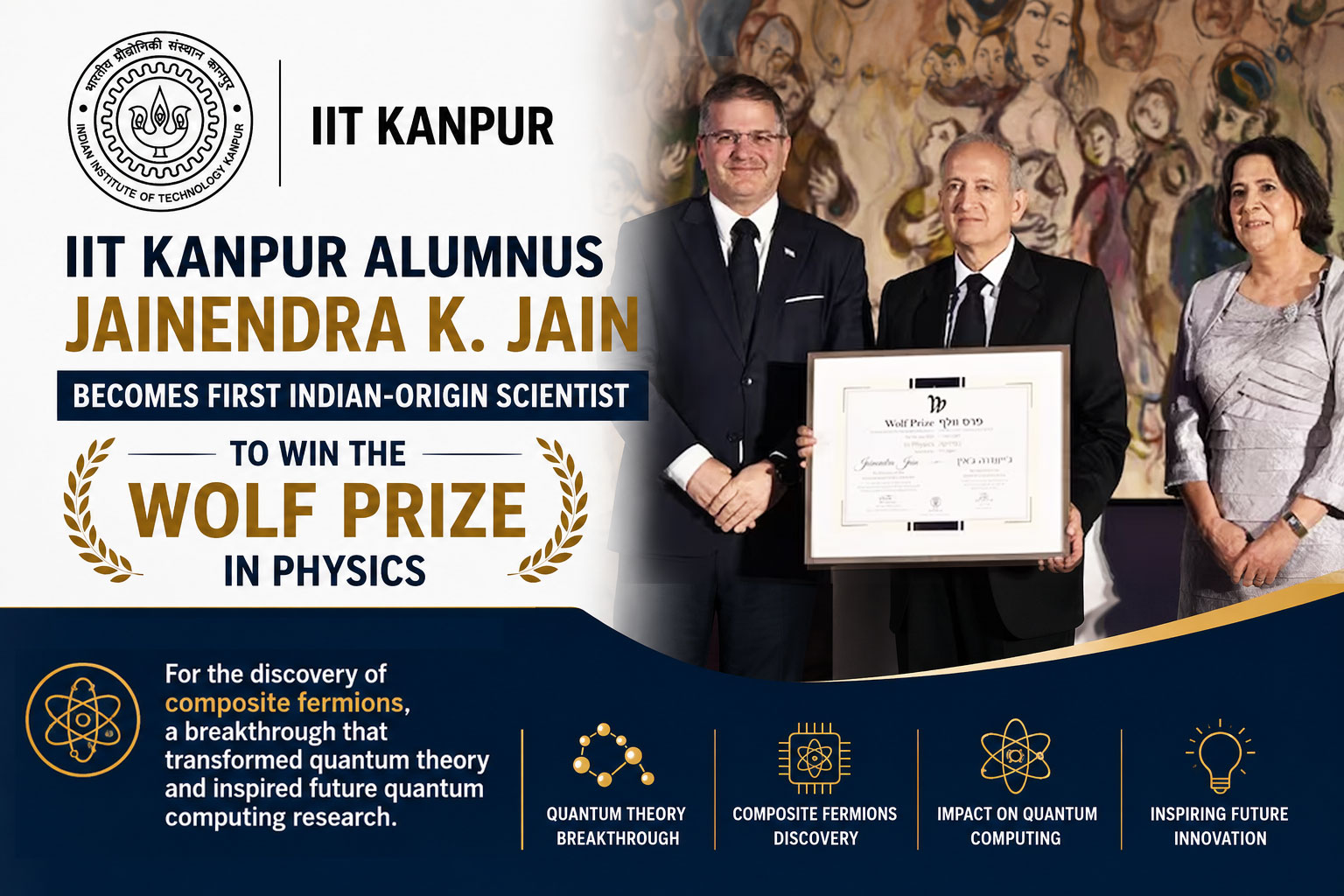
Jainendra K. Jain won the Wolf Prize in Physics for discovering composite fermions, a breakthrough that transformed quantum theory and inspired future quantum computing research.
A Historic Global Honour for an Indian-Origin Physicist
Professor Jainendra K. Jain, one of the world’s leading theoretical physicists and the founding director of the Lodha Theoretical Physics Institute, has won the prestigious Wolf Prize in Physics. The award marks a historic moment for the global scientific community because Jain has become the first person of Indian origin to receive this honour in physics. He received the award from Israeli President Isaac Herzog at a ceremony held at the Knesset in Jerusalem on June 18.
Jain’s achievement reflects not only individual brilliance but also the power of perseverance, scientific curiosity, and deep theoretical insight. His journey from a small town in Rajasthan to one of the highest recognitions in physics shows how talent can flourish even in difficult circumstances. For India, the award also stands as a proud moment, especially for students and researchers who see in Jain’s life a model of intellectual ambition and resilience.
From Sambhar to the Frontiers of Physics
Jain grew up in Sambhar, a small town near the Thar Desert in Rajasthan, and later became the Evan Pugh University Professor and Eberly Family Chair in Physics at Pennsylvania State University. His scientific path began with an early fascination for physics, sparked when he read about Satyendra Nath Bose and his work with Albert Einstein in a children’s magazine. That early curiosity eventually grew into a lifelong pursuit of fundamental questions about matter, energy, and the quantum world.
His academic journey took him from Maharaja College to IIT Kanpur and then to Stony Brook University, where he earned his PhD. In 1981, at just 21, he boarded his first flight to the United States to begin a new chapter of research and discovery. Over time, he built a reputation as one of the most influential thinkers in condensed matter physics.
The Discovery of Composite Fermions
Jain received the Wolf Prize for his discovery of composite fermions, a concept that revolutionized the understanding of the fractional quantum Hall effect. This effect had puzzled physicists for years because electrons in ultra-thin semiconductor layers, when exposed to strong magnetic fields, displayed electrical conductivity in precise fractional values rather than the expected whole-number patterns.
The breakthrough came in 1989 while Jain was working as a postdoctoral researcher at Yale University. According to Jain, the key insight emerged while he was doodling during a television commercial break. He realized that electrons could be understood as combining with tiny quantum vortices to form new particles, which he called composite fermions. This idea gave scientists a clear framework for explaining a phenomenon that had long resisted conventional theory.
His paper, published in Physical Review Letters in 1989, quickly became foundational. The fractional values predicted by his theory are now known as Jain sequences or Jain states. Composite fermions have since become a cornerstone of modern quantum physics and continue to shape research in condensed matter theory.
Why the Wolf Prize Matters
Established in 1978 by the Wolf Foundation, the Wolf Prize recognizes major contributions to science and the arts. In physics, it is widely regarded as one of the most prestigious honours in the field and is often seen as a precursor to the Nobel Prize. In fact, 27 previous Wolf Prize physics laureates later went on to receive Nobel recognition.
Jain’s selection places him among a rare group of scientists whose work has changed how humanity understands nature at its deepest levels. The award also highlights the enduring value of theoretical physics, a field that often works far ahead of practical application but ultimately lays the groundwork for future technologies.
A Life Marked by Resilience
Jain’s scientific rise was not easy. At the age of 12, he suffered a devastating family tragedy when a tram collided with his family’s car during a visit to Kolkata. His mother died from the injuries, and Jain himself was badly hurt, leaving him with a lifelong disability. Returning to Sambhar on crutches, his path toward higher education seemed uncertain.
His progress became possible in part through the Jaipur Foot prosthetic, developed by Dr. P.K. Sethi and craftsman Ram Chandra Sharma. That support helped him regain mobility and continue his studies. His life story shows how medical innovation and social support can change a person’s future, especially for a young student determined to keep learning.
Building the Future of Theoretical Physics in India
Today, Jain is helping build a stronger future for fundamental research in India through the Lodha Theoretical Physics Institute in Mumbai. The institute aims to become the country’s first fully privately funded centre devoted to theoretical physics. Jain has said he hopes the institute will create an environment where young scientists can pursue bold ideas, collaborate globally, and explore the deepest questions in physics.
That vision matters because India’s scientific future depends not only on applied technology but also on deep theoretical inquiry. Institutions like LTPI can help nurture a new generation of researchers who can contribute to both fundamental science and advanced technologies such as quantum computing.
A Legacy Beyond One Prize
Jain has authored or co-authored more than 250 scientific papers and wrote the influential book Composite Fermions, published by Cambridge University Press in 2007. He has also received major honours including the Oliver E. Buckley Prize, the Distinguished Alumnus Award from IIT Kanpur, and election to several major academies in the United States and India.
His Wolf Prize recognition is more than a personal milestone. It is a reminder that scientific excellence can emerge from modest beginnings, that perseverance matters as much as genius, and that one discovery can reshape an entire field. Jainendra K. Jain’s journey from Sambhar to the global stage now stands as one of the most inspiring stories in modern physics.
#JainendraKJain #WolfPrize #Physics #CompositeFermions #IITKanpur #IndianScientist #QuantumPhysics #LodhaInstitute #ScientificExcellence #IndianOriginScientist
Disclaimer
The information in this article is based on available public sources and official statements as of the time of publication. While we aim for accuracy, we do not guarantee completeness or correctness. We advise readers to verify key details from official sources before making any decisions. The website (iitiimsamvaad.com) is not liable for any loss or damage arising from the use of this content. The authors are also not responsible for any such loss or damage.