
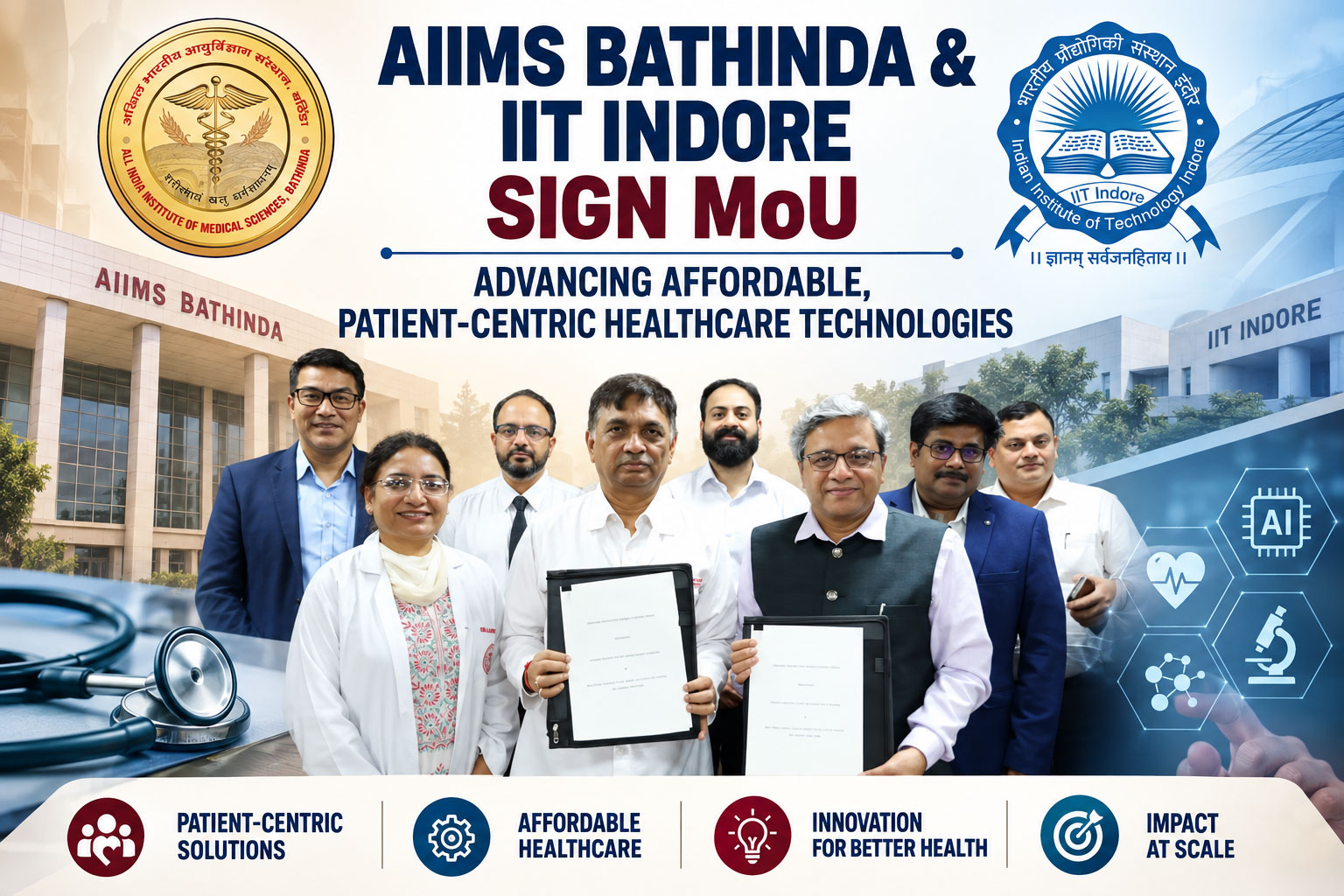
AIIMS Bathinda and IIT Indore sign MoU to combine clinical expertise with engineering capabilities for affordable, patient-centric healthcare innovation and technology translation.
A doctor–engineer partnership for healthcare innovation
The All India Institute of Medical Sciences (AIIMS) Bathinda has signed a memorandum of understanding (MoU) with the Indian Institute of Technology (IIT) Indore to promote healthcare innovation through interdisciplinary research, medical technology innovation, technology translation, and capacity building. The collaboration aims to establish a framework that combines the clinical expertise of AIIMS Bathinda with the engineering capabilities of IIT Indore to accelerate the development of innovative, affordable, and patient-centric healthcare technologies.
Under the partnership, the two institutions will collaborate on interdisciplinary research, prototype development, intellectual property (IP) generation, technology commercialization, faculty and student exchanges, and joint innovation initiatives focused on addressing real-world healthcare challenges. The MoU was formally signed under the leadership of Dr Ratan Gupta, Executive Director, AIIMS Bathinda, and Prof Suhas Joshi, Director, IIT Indore.
Bridging clinical needs with engineering solutions
Speaking on the occasion, Dr Gupta highlighted the importance of interdisciplinary collaboration among clinicians, researchers, and engineers in developing innovative and affordable healthcare technologies. He emphasised that many healthcare challenges require solutions that integrate medical insights with engineering design, materials science, electronics, data analytics and manufacturing.
Prof Joshi also reaffirmed IIT Indore’s commitment to working closely with AIIMS Bathinda to advance healthcare innovation through the partnership. He noted that IIT Indore’s strengths in design, manufacturing, sensors, AI and systems engineering can complement AIIMS Bathinda’s clinical expertise, patient data and real-world testing environments. Together, the institutions can also co-create technologies that are clinically relevant, technically robust and economically viable.
Focus areas and expected outcomes
The collaboration is expected to support the development of healthcare technologies by bringing together clinical and engineering expertise while promoting research, innovation, and technology translation. Potential focus areas include medical devices, diagnostics, assistive technologies, digital health platforms, AI-enabled decision support, remote monitoring systems and point-of-care solutions.
By working on joint projects, the partners can move ideas from concept to prototype, validate them in clinical settings, protect IP and explore commercialisation pathways. Faculty and student exchanges will also enable engineers to understand clinical workflows and clinicians to appreciate design constraints. Joint innovation initiatives can address regional health priorities, such as affordable devices for primary care, chronic disease management and rehabilitation.
Technology translation and commercialisation
A key objective of the MoU is to accelerate technology translation, the process of converting research outcomes into usable products and services. The partnership will facilitate IP generation, patent filing, licensing and industry collaborations to move promising technologies from the lab to the market.
IIT Indore’s Lab-to-Market (L2M) Program, run by the IITI DRISHTI CPS Foundation, already supports prototype-ready medical technologies with funding, IP support and commercialisation assistance. The program also provides non-dilutive funding of up to INR 150 lakhs for technologies with Technology Readiness Level (TRL) 6 or above, along with technology development support, IP protection and market validation. AIIMS Bathinda’s involvement can help identify clinically validated technologies that are ready for scaling and commercial deployment.
Capacity building and academic exchange
The MoU also emphasises capacity building through faculty and student exchanges, joint courses, workshops and training programmes. Engineers can spend time in clinical departments to observe procedures, understand unmet needs and co-design solutions with clinicians. Clinicians can engage with engineering labs to learn about prototyping, testing and regulatory requirements for medical devices.
Such exchanges can create a common language between doctors and engineers, reducing miscommunication and accelerating innovation. They can also prepare students for careers in biomedical engineering, health technology assessment, clinical research and med-tech entrepreneurship. Over time, the partnership can build a pipeline of professionals who understand both healthcare delivery and technology development.
Aligning with national priorities
The collaboration aligns with national priorities such as Atmanirbhar Bharat, Make in India and the push for affordable, indigenous medical technologies. By developing solutions locally, the partners can reduce dependence on imported devices, lower costs and tailor products to Indian healthcare settings.
The partnership also supports the government’s focus on strengthening the med-tech ecosystem, improving access to quality healthcare and promoting innovation in public institutions. AIIMS Bathinda’s role as a tertiary care centre and IIT Indore’s engineering capabilities create a strong foundation for translating research into impact.
Broader context of AIIMS Bathinda’s med-tech initiatives
AIIMS Bathinda has been actively building its med-tech innovation ecosystem. The institute recently partnered with the Blockchain for Impact (BFI) Foundation to establish a MedTech Validation and Incubation Center at AIIMS Bathinda. The center is also envisioned as a translational hub for medical devices, AI-enabled diagnostics and digital health technologies, supporting clinical validation, regulatory readiness and structured incubation of early-stage MedTech ventures.
The IIT Indore MoU complements these efforts by adding engineering depth, prototype development support and access to funding programs such as the Lab-to-Market initiative. Together, these partnerships can create a comprehensive pathway from idea to validated product to commercial deployment.
A model for academia–clinician collaboration
The AIIMS Bathinda–IIT Indore partnership demonstrates how medical and engineering institutions can work together to solve real-world healthcare problems. By combining clinical insights with engineering capabilities, the partners can develop technologies that are not only innovative but also affordable, scalable and patient-centric.
As India expands its healthcare infrastructure and seeks to improve access to quality care, such collaborations will play a crucial role. They can help convert research into products, train a new generation of clinician–engineers and support the growth of a domestic med-tech industry. The MoU marks the beginning of a long-term journey toward affordable, indigenous and patient-focused healthcare innovation.
#AIIMSBathinda #IITIndore #HealthcareInnovation #MedicalTechnology #InterdisciplinaryResearch #TechnologyTranslation #MedTech #AffordableHealthcare #PatientCentricCare #BiomedicalEngineering
Disclaimer
The information in this article is based on available public sources and official statements as of the time of publication. While we aim for accuracy, we do not guarantee completeness or correctness. We advise readers to verify key details from official sources before making any decisions. The website (iitiimsamvaad.com) is not liable for any loss or damage arising from the use of this content. The authors are also not responsible for any such loss or damage.