
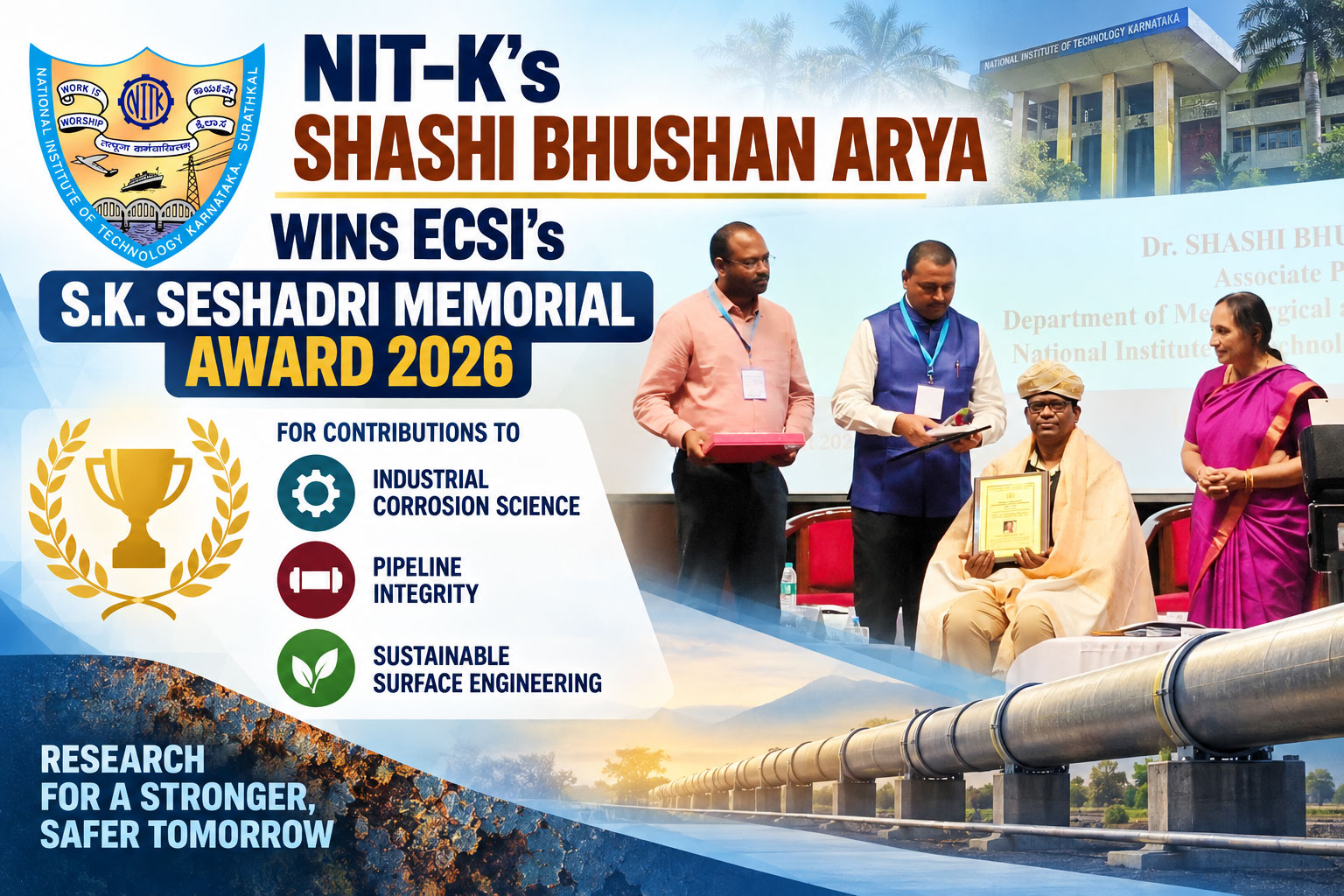
NIT-K’s Shashi Bhushan Arya wins ECSI’s S.K. Seshadri Memorial Award 2026 for his work on industrial corrosion science, pipeline integrity and sustainable surface engineering.
Recognition for excellence in corrosion science
Shashi Bhushan Arya, associate professor in the Department of Metallurgical and Materials Engineering at the National Institute of Technology-Karnataka (NIT-K), Surathkal, received the S.K. Seshadri Memorial Mascot National Award–2026, conferred by the Electrochemical Society of India (ECSI). The award recognises his contributions to industrial corrosion science, corrosion prevention, corrosion monitoring, pipeline integrity, and sustainable surface engineering technologies.
The award committee selected Mr. Arya for his sustained research on corrosion in critical industrial infrastructure, particularly petroleum pipelines, along with his work in corrosion monitoring, protective coatings, and surface engineering. The honour carries a cash prize of ₹25,000 and highlights his impact on both academic research and industrial practice.
Ceremony at India’s premier science institute
The award presentation took place during the 33rd National Symposium on Electrochemical Science and Technology (NSEST–2026), held at the JRD Tata Auditorium, Indian Institute of Science (IISc), Bengaluru, on Friday and Saturday. Shubha V. Iyengar, Padma Shri awardee and former distinguished scientist at CSIR-National Aerospace Laboratories (CSIR-NAL), Bengaluru, presented the award.
The symposium brought together leading researchers, academicians and industry experts in electrochemical science and technology. By hosting the award ceremony at IISc, ECSI underscored the national importance of corrosion research for infrastructure reliability, safety and sustainability.
Focus on petroleum pipeline corrosion
As part of the award programme, Mr. Arya delivered a lecture titled “Flow-Driven Internal Corrosion of Petroleum Pipelines: Mechanisms, Monitoring, and Mitigation,” addressing the interaction between fluid flow and corrosion inside petroleum pipelines and approaches to improve the reliability and service life of pipeline infrastructure, a NIT-K release said.
In his talk, he explored how fluid dynamics influence internal corrosion rates, localised attack and deposit formation in pipelines that transport crude oil, refined products and multiphase flows. He discussed mechanisms such as erosion–corrosion, under-deposit corrosion and microbiologically influenced corrosion, which often act together in real operating conditions.thehindu+1
Monitoring and mitigation strategies
Mr. Arya outlined practical strategies to monitor and mitigate flow-driven internal corrosion. He highlighted the role of corrosion coupons, electrochemical probes, ultrasonic thickness measurements and inline inspection tools in tracking corrosion rates and identifying vulnerable sections.
He also discussed the use of protective coatings, corrosion inhibitors, material selection and flow management to reduce corrosion risk. By combining monitoring data with mechanistic models, operators can predict remaining life, plan maintenance and avoid unplanned shutdowns or leaks.
His work supports safer and more reliable operation of petroleum pipelines, which form a critical part of India’s energy infrastructure. Reducing corrosion-related failures helps prevent environmental damage, economic losses and safety hazards.
Sustainable surface engineering technologies
Beyond pipelines, Mr. Arya’s research extends to sustainable surface engineering technologies. He develops eco-friendly coatings, corrosion-resistant alloys and surface modification techniques that reduce reliance on toxic chemicals and extend component life.
These technologies find applications in oil and gas, chemical processing, marine structures and power generation. By improving corrosion resistance, industries can lower maintenance costs, reduce material consumption and decrease their environmental footprint.
His emphasis on sustainability aligns with global efforts to make industrial processes cleaner and more resource-efficient while maintaining high performance and safety standards.
Building research capacity at NIT-K
At NIT-K, Mr. Arya leads research projects that involve undergraduate students, postgraduate scholars and industry partners. He supervises work on corrosion testing, coating development, failure analysis and field trials in collaboration with public sector units and private companies.
Through these projects, students gain hands-on experience with electrochemical techniques, surface characterisation and real-world problem solving. The award reinforces NIT-K’s growing reputation in materials engineering and corrosion science.
It also encourages young researchers to pursue careers in this critical area, where India needs strong domestic expertise to support its expanding infrastructure and energy sectors.
Aligning with national priorities
The ECSI award aligns with national priorities such as Atmanirbhar Bharat, Make in India and the push for indigenous technologies in critical sectors. Corrosion control directly supports these goals by extending the life of pipelines, plants and structures, reducing imports of replacement components and improving operational safety.
India’s rapid industrialisation and urbanisation increase demand for reliable infrastructure. Corrosion-related failures can cause significant economic losses and environmental damage. Research like Mr. Arya’s helps address these challenges through science-based solutions.
The award also reflects ECSI’s commitment to recognising and promoting high-quality research in electrochemical science and technology across Indian institutions.
A model for academia–industry collaboration
Mr. Arya’s work demonstrates how academic research can deliver tangible benefits to industry. By focusing on real-world problems such as pipeline corrosion, he bridges the gap between laboratory studies and field applications.
His collaborations with industry partners ensure that research outcomes remain relevant and scalable. At the same time, his publications and lectures advance fundamental understanding of corrosion mechanisms and mitigation strategies.
This model of engaged scholarship can inspire other researchers to align their work with national needs while maintaining scientific rigour.
Looking ahead
With this recognition, Mr. Arya plans to expand his research on flow-driven corrosion, smart monitoring systems and sustainable coatings. He aims to develop predictive models that integrate fluid dynamics, electrochemistry and materials science to forecast corrosion under complex operating conditions.
He also intends to strengthen training programmes for students and professionals in corrosion engineering. By building a skilled workforce, India can better manage its infrastructure assets and reduce corrosion-related risks in the long term.
The ECSI award marks a significant milestone in his career and reinforces the importance of corrosion science in India’s industrial and technological development.
#NITK #ShashiBhushanArya #ECSIAward #CorrosionScience #PipelineIntegrity #SurfaceEngineering #MaterialsEngineering #IndustrialCorrosion #NSEST2026 #SustainableTechnology
Disclaimer
The information in this article is based on available public sources and official statements as of the time of publication. While we aim for accuracy, we do not guarantee completeness or correctness. We advise readers to verify key details from official sources before making any decisions. The website (iitiimsamvaad.com) is not liable for any loss or damage arising from the use of this content. The authors are also not responsible for any such loss or damage.