
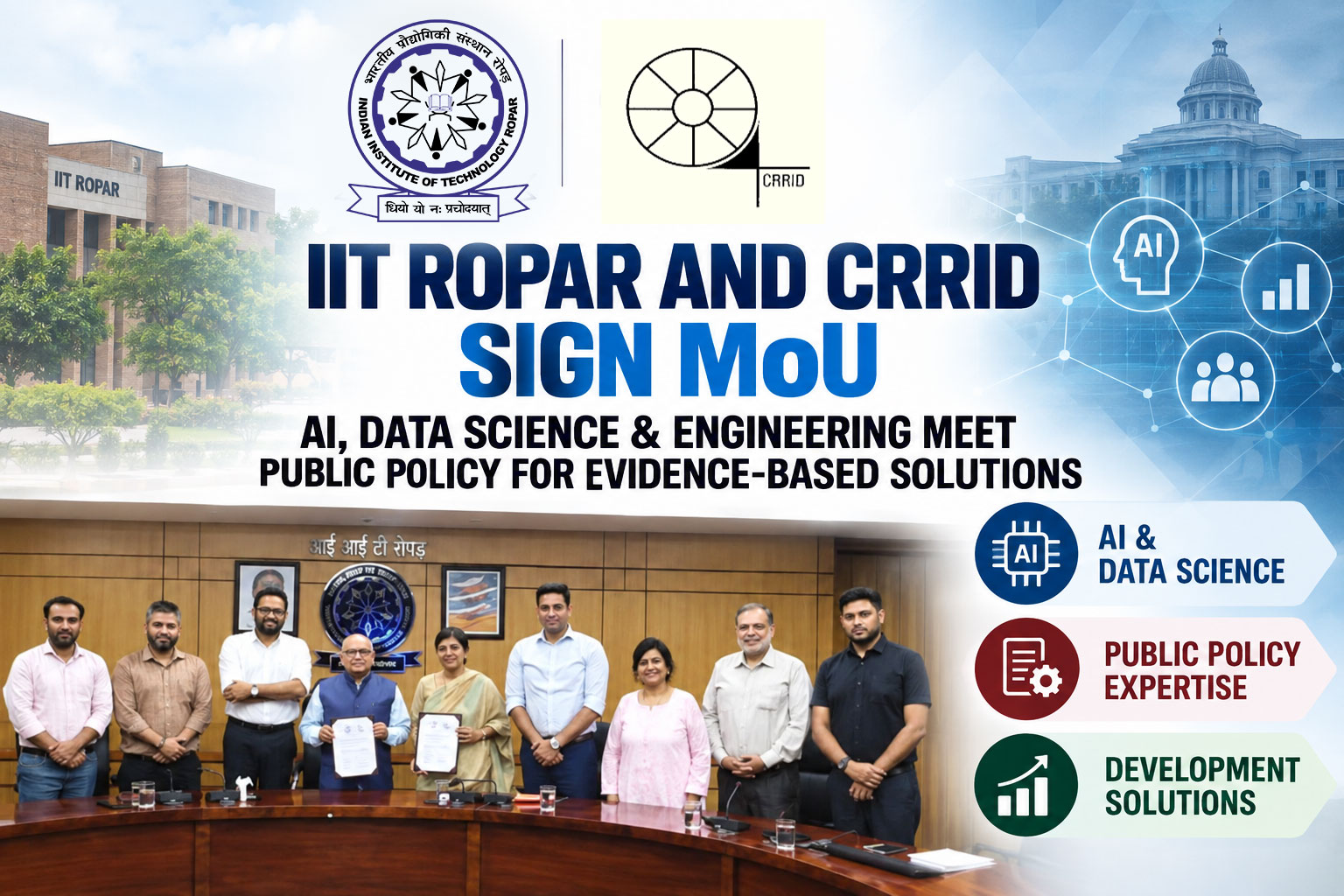
IIT Ropar and CRRID sign MoU to combine AI, data science and engineering with public policy expertise for evidence-based governance and development solutions.
A strategic partnership for tech-enabled governance
IIT Ropar and the Centre for Research in Rural and Industrial Development (CRRID), Chandigarh, on Tuesday signed an MoU to establish a broad framework for collaboration in research, technology, public policy, academic activities and capacity building. The MoU was inked by Indian Institute of Technology Ropar Director Rajeev Ahuja and Centre for Research in Rural and Industrial Development (CRRID) governing body Chairperson Vini Mahajan, in the presence of Rupnagar Deputy Commissioner Aaditya Dachalwal, according to a statement.
The partnership brings together CRRID’s long-standing expertise in social science research, development policy and government-facing assignments with IIT Ropar’s strengths in engineering, artificial intelligence (AI), data science and emerging technologies, it said. A key focus of the collaboration will be the use of AI and data-driven approaches for better public policy and governance.
AI and data for evidence-based policy
The two institutions will explore the design and deployment of AI-enabled solutions to support evidence-based policy formulation, improve implementation and monitoring of public programmes, and strengthen rigorous impact assessment of government schemes, it said. The collaboration will span areas including rural and industrial development, agriculture, health, sustainability, urban governance, public finance, MSMEs and other emerging development challenges.
It will also explore the responsible application of AI, machine learning, geospatial technologies, digital systems and engineering solutions to these sectors. By combining advanced analytics with ground-level policy insights, the partners aim to create tools that help governments design, implement and evaluate programmes more effectively.
Joint research, policy solutions and proposals
Under the MoU, CRRID and IIT Ropar will be able to undertake joint and sponsored research projects; jointly develop and test technology-enabled policy solutions; prepare proposals for the government, multilateral institutions, foundations and industry; and produce joint research publications, policy papers and reports. The partnership also provides for conferences, policy roundtables, workshops, executive education and capacity-building programmes.
Particular emphasis will be placed on building capabilities among government and public sector personnel in areas such as public policy, AI, data governance, technology adoption and programme evaluation, the statement said. These activities will help bridge the gap between technical innovation and policy practice, ensuring that new tools align with administrative realities and citizen needs.
Academic engagement and talent development
The two institutions will also facilitate academic engagement through faculty and researcher exchanges, internships and research attachments, and mentoring or co-supervision of undergraduate, postgraduate and doctoral research, subject to the academic rules of the respective institutions. This component will enable students and young researchers to work on real-world policy problems using cutting-edge technologies.
By involving students in policy-oriented projects, the collaboration will nurture a new generation of professionals who understand both technology and governance. Such talent will be critical as India scales up digital public infrastructure and data-driven decision-making across sectors.
Leadership perspectives on the collaboration
“This MoU brings together IIT Ropar’s strengths in AI, data science and engineering with CRRID’s deep experience in public policy and rural development. Technology works best when it is rooted in ground realities. This partnership will help us build AI-driven solutions that are practical, responsible and genuinely useful for governance and public service delivery,” Ahuja said.
Mahajan pointed to the necessity of bridging the traditional divide between technology and public policy. “CRRID brings deep understanding of institutions, communities and public programmes, while IIT Ropar brings cutting-edge capabilities in technology, artificial intelligence and data science,” she said. Their comments underscore the complementary nature of the partnership and its potential to generate high-impact solutions.
CRRID’s role and expertise
The CRRID Chandigarh is an autonomous social science and policy research institution engaged in research, policy analysis, programme evaluation, training and government-facing assignments in areas including rural and industrial development, agriculture, population and health and public finance. Its experience with state and central governments positions it well to translate research into actionable policy recommendations.
By partnering with IIT Ropar, CRRID can enhance its analytical toolkit with AI, machine learning and geospatial methods. This combination can improve the precision of policy targeting, the timeliness of monitoring and the rigor of impact evaluation.
Potential application areas
The collaboration can support a wide range of applications. In agriculture, AI and remote sensing can help map crop patterns, predict yields, detect pest outbreaks and optimise input use. Data analytics can strengthen disease surveillance, track programme coverage and identify gaps in service delivery, in health secctor.
In urban governance, digital systems can improve traffic management, waste collection and utility planning. For MSMEs, data-driven tools can assist with credit assessment, market access and compliance. Across these domains, the partners will emphasise responsible AI, data privacy and ethical use of technology.
Capacity building for government and public sector
A major component of the MoU focuses on training government and public sector personnel in public policy, AI, data governance, technology adoption and programme evaluation. Workshops, executive education programmes and policy labs can equip officials with the skills to interpret data, use AI tools and design evidence-based interventions.
Such capacity building will help administrations move from intuition-driven to data-driven decision-making. It will also create a common language between technologists and policymakers, reducing miscommunication and accelerating implementation.
A model for academia–policy collaboration
The IIT Ropar–CRRID partnership demonstrates how technical institutes and policy research organisations can work together to solve complex development challenges. By combining engineering and AI capabilities with social science insights, the collaboration can produce solutions that are both innovative and context-aware.
As India expands its digital public infrastructure and invests in AI for public good, such models will become increasingly important. They can also help ensure that technology serves citizens, improves governance and supports sustainable development.
Looking ahead
With this MoU, IIT Ropar and CRRID set the stage for joint projects, policy prototypes and training initiatives that can influence governance at local, state and national levels. The success of the partnership will also depend on sustained engagement, clear project pipelines and active involvement of government stakeholders.
If executed well, the collaboration can deliver tangible improvements in policy design, programme implementation and public service delivery. It can also position the region as a hub for tech-enabled policy innovation, attracting further partnerships and investments.
IITRopar #CRRID #AIforPolicy #DataDrivenGovernance #PublicPolicy #RuralDevelopment #TechEnabledSolutions #CapacityBuilding #EvidenceBasedPolicy #DigitalGovernance
Disclaimer
The information in this article is based on available public sources and official statements as of the time of publication. While we aim for accuracy, we do not guarantee completeness or correctness. We advise readers to verify key details from official sources before making any decisions. The website (iitiimsamvaad.com) is not liable for any loss or damage arising from the use of this content. The authors are also not responsible for any such loss or damage.