
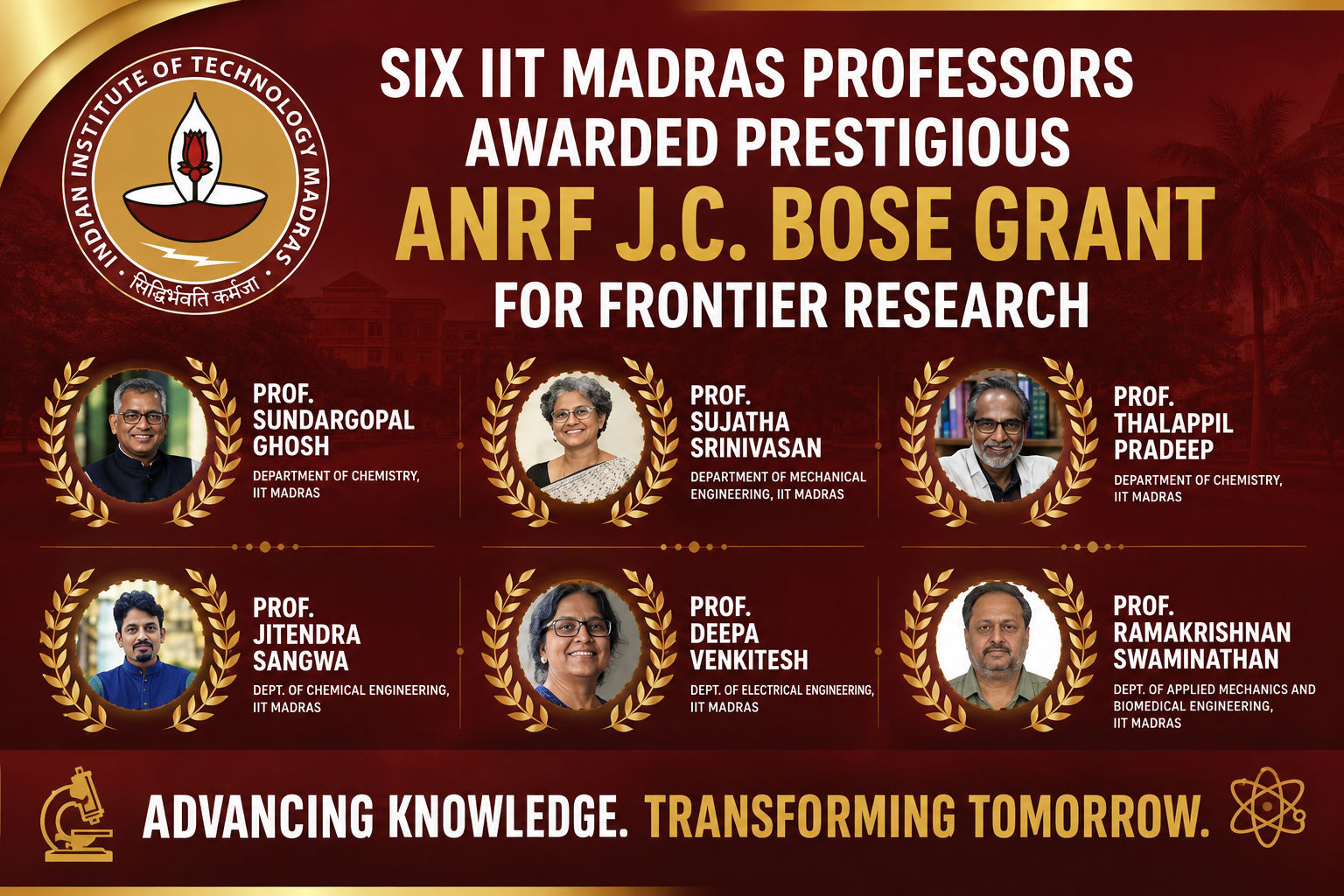
Six IIT Madras faculty members receive ANRF J.C. Bose Grant, securing ₹25 lakh annually for five years to advance frontier research in engineering, chemistry and biomedical technologies.
Recognising senior research excellence
Six faculty members from the Indian Institute of Technology Madras (IIT Madras) have been offered the Anusandhan National Research Foundation (ANRF) J.C. Bose Grant, one of India’s prestigious research recognitions for senior scientists and engineers. The awardees span mechanical engineering, chemistry, electrical engineering, chemical engineering and applied mechanics with biomedical engineering, reflecting the institute’s breadth in high-impact research.
Congratulating the awardees, Prof V Kamakoti, Director of IIT Madras, said the selections demonstrate the high quality of research and development in critical and emerging technologies at the institute. The ANRF J.C. Bose Grant also recognises active senior scientists and engineers in India for their outstanding research performance and contributions. It aims to encourage leading researchers to pursue cutting-edge scientific and engineering work through enhanced extra-mural funding.
Structure and purpose of the grant
The highly competitive, individual-specific grant provides ₹25 lakh annually for five years to support frontier research. The funding covers human resources, consumables, travel, contingency, equipment and other research-related expenses, along with institutional overhead support. This long-term, stable funding enables accomplished researchers to undertake ambitious, high-impact projects that may require sustained effort and risk-taking.
The ANRF J.C. Bose Grant is open to scientists and engineers aged between 45 and 65 years working in recognised academic and research institutions across India. Awardees are selected based on outstanding research achievements, including publications, patents, technology transfer, research outcomes, grants and other indicators of scientific excellence. The grant is designed to enable accomplished researchers to pursue ambitious, high-impact research in frontier areas of science and engineering.
Prof Sujatha Srinivasan: Prosthetics and assistive technologies
Prof Sujatha Srinivasan, Professor of Mechanical Engineering and Head of the TTK Centre for Rehabilitation Research and Device Development (R2D2) and the National Center for Assistive Health Technologies (NCAHT) at IIT Madras, has made significant contributions to prosthetics, assistive and rehabilitation technologies. Her team has developed affordable assistive devices suited to Indian lifestyles, including the commercially deployed NeoFly-NeoBolt system, Standing Wheelchair, Kadam prosthetic knee and lightweight YD One wheelchair. She also holds several Indian, US and international patents relating to prosthetics and assistive technologies for movement disability.
Her work addresses a critical gap in accessible, affordable rehabilitation devices. By designing products that consider local constraints, user needs and manufacturing ecosystems, her team has translated laboratory research into real-world solutions. The grant will support further development of next-generation assistive technologies and rehabilitation systems.
Prof Thalappil Pradeep: Clean water and nanomaterials
Prof Thalappil Pradeep, Institute Professor and Deepak Parekh Institute Chair Professor, is internationally recognised for pioneering research in clean water technologies, nanomaterials, microdroplets and ice chemistry. A recipient of the Padma Shri, Vigyan Shri, Eni Award and VinFuture Prize, and a fellow of ten global academies, his affordable water purification technologies have enabled access to safe drinking water for millions across India. He has also founded the International Centre for Clean Water at IIT Madras Research Park to accelerate the translation of laboratory research into societal technologies. This is the third five-year term for his JC Bose award (it was JC Bose Fellowship earlier).
His research combines fundamental chemistry with scalable engineering solutions. The grant will also allow his team to continue developing low-cost, high-impact water technologies and advance understanding of nanomaterials and interfacial phenomena.
Prof Deepa Venkitesh: Optical communications and photonics
Prof Deepa Venkitesh, Marti Annapurna Gurunath Chair Professor of Engineering and Applied Sciences in the Department of Electrical Engineering, is the Project Lead for the Advanced Optical Communication Testbed, a major academia–industry consortium initiative funded by the Department of Telecommunications, Government of India. The consortium has set up the country’s first field testbed with multicore fibers at IIT Madras and is actively working on standardisation of these fibers in addition to developing several indigenous solutions in the domain of optical fiber communication. She has made notable contributions in high-capacity optical communications, microwave photonics and optical signal processing. She is also a recipient of the Abdul Kalam Technology Innovation National Fellowship, author of several papers and patents and serves as the Associate Editor of the IEEE Journal of Lightwave Technology.
Her work supports India’s push for high-speed, high-capacity communication networks. The grant will enable further research on advanced optical systems, multicore fibers and photonic technologies critical for future data infrastructure.
Prof Jitendra S. Sangwai: Carbon capture and energy engineering
Prof Jitendra S. Sangwai, Professor in the Department of Chemical Engineering at IIT Madras, focuses on carbon capture, utilization and sequestration (CCUS), gas hydrates, and upstream oil and gas engineering. He has published over 200 journal papers, holds an h-index of 60 with nearly 11,000 citations, and has filed 43 patents and is a recipient of the National Geoscience Award and several other national honours, and has also been recognised among the top 3% of Highly Cited ACS Authors from India. He serves as an Associate Editor of Energy & Fuels and is also a Fellow of the Indian National Academy of Engineering (INAE) and the National Academy of Sciences, India (NASI).
His research addresses pressing challenges in energy transition and climate change. The grant will support advanced studies on CCUS technologies, gas hydrates and sustainable energy systems.
Prof Ramakrishnan Swaminathan: Biomedical instrumentation and medical devices
Prof Ramakrishnan Swaminathan has undertaken impactful research in medical device design and biomedical instrumentation to analyse brain and muscle functions. Throughout his career, he has worked to enhance the diagnostic relevance of medical equipment through measurements, models, and informatics. He is one of the most sought-after international collaborators and has authored over 550 research articles while guiding more than 50 research scholars. He is a strong advocate of global harmonization of medical device regulations and standards and has represented the country in related forums.
His work bridges engineering and clinical needs, improving diagnostic tools and medical technologies. The grant will facilitate further development of biomedical devices, instrumentation and standards for healthcare applications.
Prof Sundargopal Ghosh: Transition metal boron chemistry
Prof Sundargopal Ghosh, from the Department of Chemistry, conducts pioneering research in transition metal boron chemistry. His extensive work investigates the synthesis, structural frameworks, electronic bonding, and chemical reactivity of various boron-containing molecular systems. These investigations have substantially progressed the field of boron-rich chemistry, particularly concerning catalysis and the activation of small molecules. A prolific researcher, he has authored more than 325 papers in high-impact, peer-reviewed international journals. His academic excellence has been honoured with the IIT Madras Institute Research and Development Award. He is also a distinguished Fellow of the Indian National Science Academy, the Indian Academy of Sciences, and the National Academy of Sciences, India.
His fundamental research advances understanding of boron-rich molecular systems with potential applications in catalysis and materials. The grant will support continued exploration of novel boron-containing compounds and their reactivity.
Strengthening frontier research at IIT Madras
The six grants collectively provide ₹1.25 crore per awardee over five years, along with institutional overhead support. This funding will also help these researchers continue frontier research and develop technologies addressing healthcare, clean water, climate and advanced engineering challenges in India.
By supporting senior scientists with sustained funding, the ANRF J.C. Bose Grant strengthens India’s research ecosystem. It also enables long-term projects, mentorship of young researchers and translation of fundamental discoveries into practical solutions. The recognition of six IIT Madras faculty members underscores the institute’s role as a hub for high-quality, societally relevant research.
#IITMadras #ANRF #JCBoseGrant #FrontierResearch #Prosthetics #CleanWater #OpticalCommunications #CarbonCapture #BiomedicalDevices #BoronChemistry
Disclaimer
The information in this article is based on available public sources and official statements as of the time of publication. While we aim for accuracy, we do not guarantee completeness or correctness. We advise readers to verify key details from official sources before making any decisions. The website (iitiimsamvaad.com) is not liable for any loss or damage arising from the use of this content. The authors are also not responsible for any such loss or damage.