

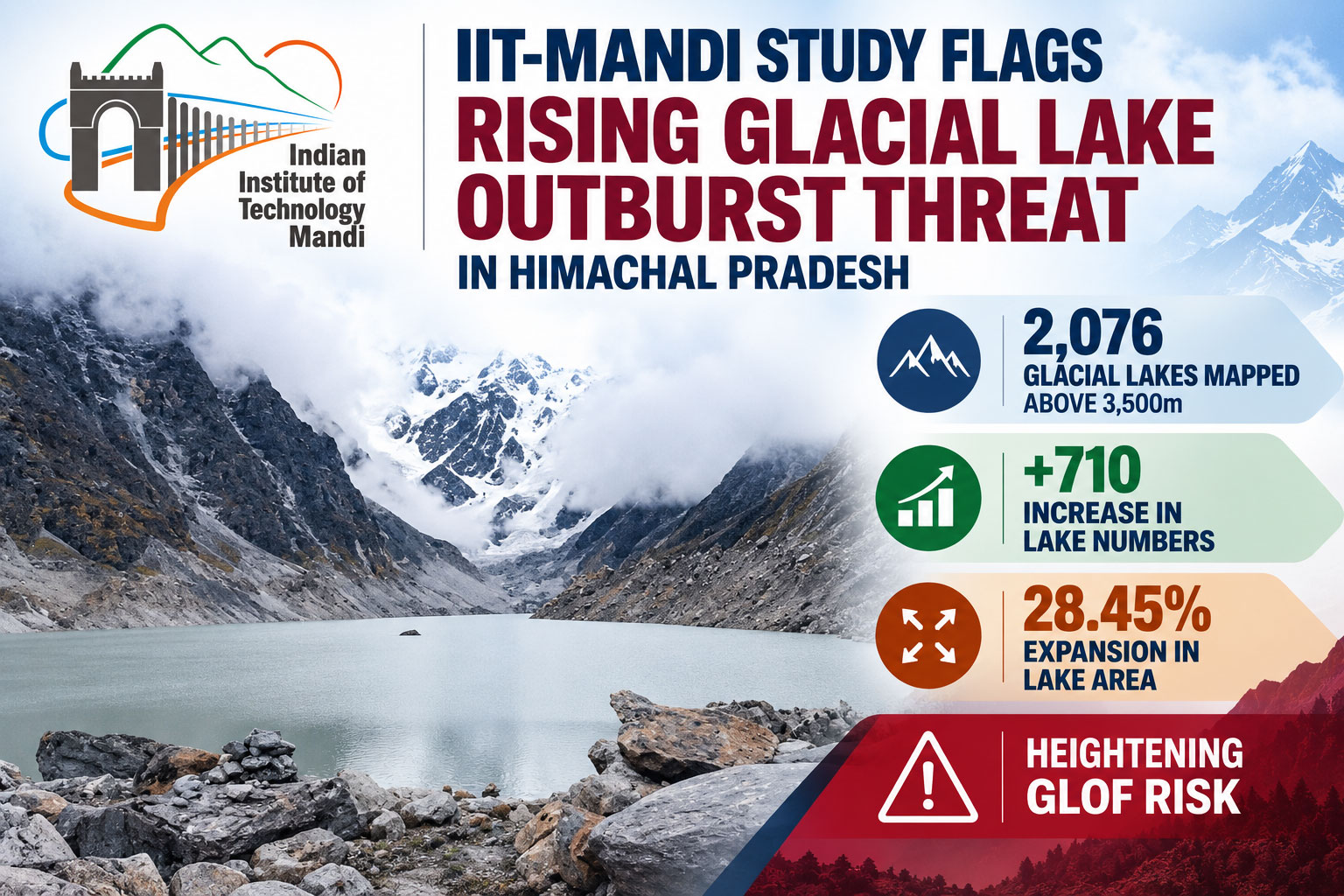
IIT-Mandi maps 2,076 glacial lakes above 3,500m in Himachal; lake numbers rise by 710 and area expands 28.45%, heightening GLOF (Glacial Lake Outburst Floods) risk.
Accelerating glacial change in Himachal
Rapid glacier retreat, expanding glacial lakes, thawing permafrost and rising tourism are emerging as interconnected threats to the fragile Himalayan ecosystem, a study by researchers at the Indian Institute of Technology, Mandi, has found. The study mapped 2,076 glacial lakes located above 3,500 metres in Himachal Pradesh in 2025, 710 more than those recorded in 2015.
The cumulative area of the lakes has also increased by 28.45 per cent over the past decade, underscoring the growing risk of Glacial Lake Outburst Floods (GLOFs) in the state. Gepang Gath lake in Lahaul-Spiti district expanded around 2,44,000 square metres due to melting glacier. Kasang lake in Kinnaur grew by nearly 1,50,000 square metres, while Kalikund in Kangra and Chamba districts expanded by around 1,20,000 square metres.
Assessing GLOF susceptibility with multiple methods
The researchers assessed GLOF susceptibility using three methods, analytic hierarchy process (AHP), technique for order preference by similarity to ideal solution (TOPSIS) and integrated entropy-AHP (EAHP), using the same 10 parameters. The assessment showed that the choice of algorithm can significantly influence which lakes are identified as priorities for monitoring.
Under AHP, nine lakes were classified as having “very high” susceptibility and 435 as “high”, while TOPSIS identified five lakes as “very high”. The EAHP placed more than 72 per cent of the mapped lakes in the “high or very high” categories. The researchers said lake area and volume were important indicators of GLOF susceptibility, but other factors, including permafrost degradation, moraine-dam characteristics and glacier-lake connectivity, also played a crucial role.
Nine lakes flagged as very high risk
Five lakes, Samudra Tapu, Gepang Gath and Chandratal in Lahaul and Spiti, Kashang in Kinnaur and Kalikund in Kangra, were classified as “very high” susceptibility under the 2025 assessment. Samudra Tapu, one of the largest, covers 164.46 hectares and has an estimated volume of 69.79 million cubic metres. Gepang Gath covers 110.84 hectares and holds around 39.86 million cubic metres of water.
The study identified nine lakes, Kalikund, Chandratal, Vasuki, Surai, Kya Tso, Yoche, Samudra Tapu, Kasang and Gepang Gath, located in high-altitude regions of Chamba and Lahaul-Spiti as particularly vulnerable, capable of acting like “water bombs” if their natural barriers fail. More than 15 bridges, several inhabited areas and educational and healthcare institutions fall within the potential hazard zones of these lakes, the study warned.
Downstream exposure and infrastructure at risk
The study also assessed downstream exposure to identify lakes where high GLOF susceptibility coincides with vulnerable infrastructure and population. Yoche and Gepang Gath in Lahaul and Spiti, Kalikund in Kangra and Surai in Chamba emerged as particularly important due to the presence of settlements, bridges, health facilities, schools and hydropower infrastructure downstream.
Beas and Sutlej river basins face massive flood threat from these vulnerable glacial lakes, with potential impacts on villages, roads and power projects. The researchers emphasised that GLOF risk assessments must integrate both hazard susceptibility and downstream exposure to prioritise monitoring and early warning systems effectively.
Thawing permafrost adds another layer of hazard
The researchers flagged thawing permafrost as an additional hazard. As permanently frozen ground melts, the overlying terrain can become unstable, increasing the possibility of landslides and other natural hazards. Permafrost melting was cited as a contributing factor in the recent flash flood incident in Nepal, which claimed more than 1,000 lives.
In Himachal, warming temperatures and erratic precipitation patterns accelerate permafrost degradation in high-altitude zones. This destabilises slopes around glacial lakes and increases the likelihood of moraine dam failures, rockfalls and debris flows that can trigger or amplify GLOFs.
Tourism, pollution and black carbon effects
Increasing tourism and year-round connectivity in high-altitude areas, particularly Lahaul and Spiti, could further aggravate the problem. Dust and carbon-rich deposits accumulating on snow and glaciers can darken their surface, increase solar energy absorption and potentially accelerate melting.
Vehicle emissions, construction dust and waste from tourist facilities contribute to black carbon deposition on glaciers. This reduces albedo, speeds up melt and feeds more water into glacial lakes. The study called for stricter environmental regulations in sensitive zones and better waste management to limit this feedback loop.
Comparison with NDMA’s critical lake list
Prof Shukla said while the National Disaster Management Authority had identified four lakes in Himachal Pradesh as critical for GLOF susceptibility, the IIT-Mandi study identified around nine potentially critical lakes. India’s surveillance of glacier-related risks now covers hundreds of high-altitude water bodies across six states and UTs monitored by two agencies.
Of these 195 lakes, 67 are classified Category A, or very high risk, and include Sikkim’s South Lhonak Lake, Himachal Pradesh’s Gepang Gath, and Bram Sar in Jammu and Kashmir. The IIT-Mandi findings suggest that Himachal’s risk profile may be larger than previously recognised and warrants updated prioritisation.
Research team and methodology
The research was conducted by Dericks P Shukla, Founding Chairperson and Professor, School of Civil and Environmental Engineering, IIT-Mandi, along with researchers Bhawna Pathak, Gunika Gupta, Sheikh Nawaz Ali, Pratima Pandey and Reet Kamal Tiwari. The team used satellite imagery, digital elevation models and field-based parameters to map lakes and assess susceptibility.
By applying three complementary multi-criteria decision-making methods, the study highlighted how methodological choices affect risk rankings. This insight can help disaster management agencies refine their monitoring strategies and allocate resources more effectively.
Implications for policy and early warning systems
The findings carry significant implications for state and national disaster management policies. Authorities can use the lake susceptibility and exposure maps to plan early warning systems, evacuation routes and infrastructure reinforcement in high-risk valleys. The Lahaul-Spiti administration already plans to install an early warning system at the 4,070-metre-high Ghepan glacial lake to continuously monitor its water level and other critical parameters.
Scaling such systems to other critical lakes, integrating real-time data with community preparedness programmes and enforcing land-use norms in hazard zones can reduce GLOF impacts. The study also underscores the need for coordinated action on climate mitigation, tourism management and glacier monitoring across the Himalayan region.
IITMandi #GlacialLakes #GLOF #HimachalPradesh #Permafrost #ClimateChange #DisasterRisk #EarlyWarning #TourismImpact Himalayas
Disclaimer
The information in this article is based on available public sources and official statements as of the time of publication. While we aim for accuracy, we do not guarantee completeness or correctness. We advise readers to verify key details from official sources before making any decisions. The website (iitiimsamvaad.com) is not liable for any loss or damage arising from the use of this content. The authors are also not responsible for any such loss or damage.