
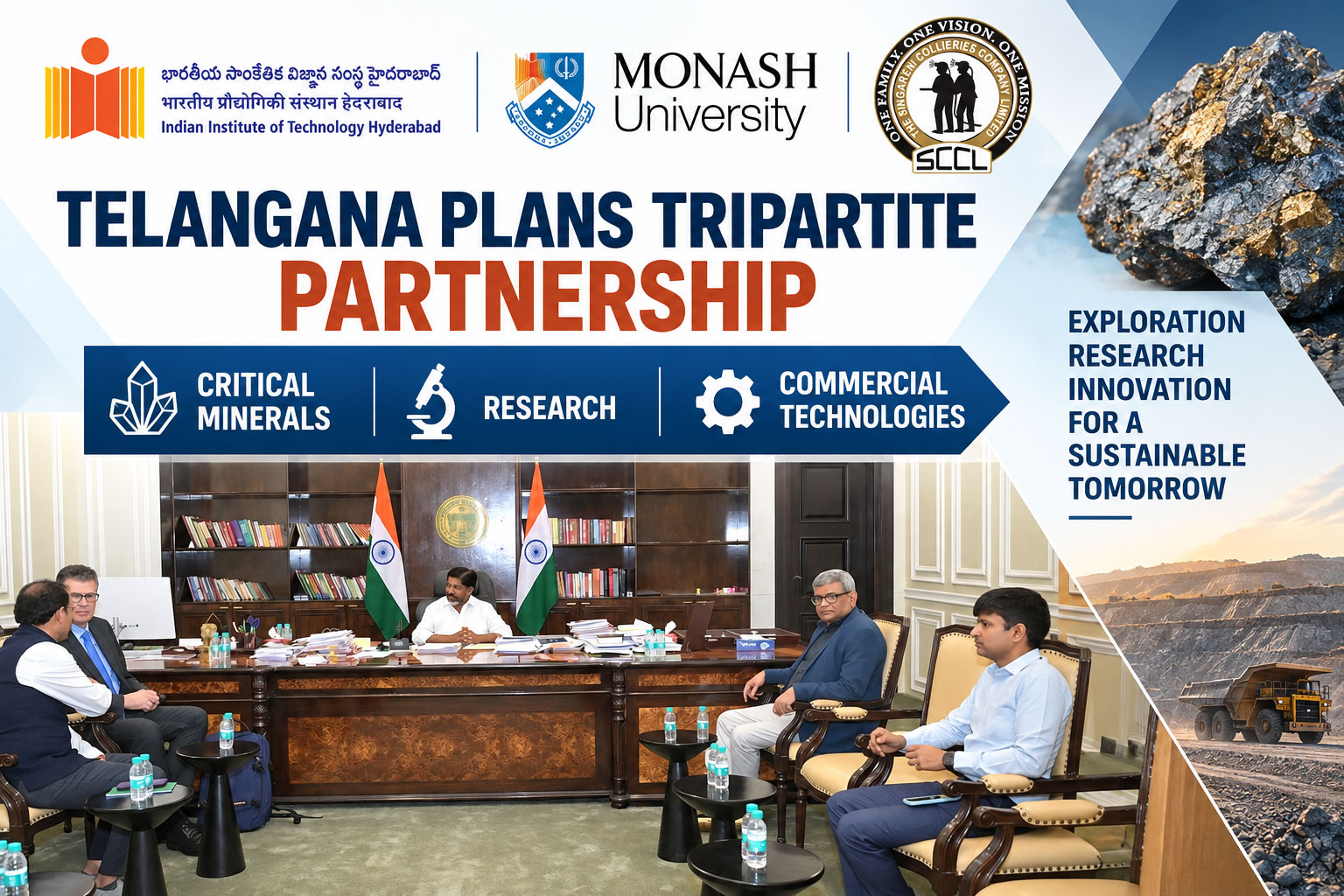
Telangana proposes a tripartite partnership among Monash University, IIT Hyderabad and SCCL to advance critical minerals exploration, research and commercial technologies.
A strategic push for critical minerals research
Telangana has taken a significant step towards promoting long-term research and institutional collaboration in the fields of exploration of critical minerals and advanced mineral technologies with a joint partnership between Monash University, Melbourne, Australia, IIT Hyderabad, and Singareni Collieries Company Limited (SCCL). Deputy Chief Minister M. Bhatti Vikramarka held a meeting with the Dean (Engineering) of Monash University and senior officials of SCCL and IIT Hyderabad here on Tuesday with a focus on accelerating research in the critical minerals sector through a joint partnership.
He stated that the importance of critical minerals was growing rapidly as the country was expanding its renewable energy sector. Telangana, he said, would not remain merely a consumer of critical minerals but would also emerge as a key partner across the entire value chain. He suggested that the academic partnership should not be limited to research alone, but should also focus on developing technologies that could be scaled up for commercial applications.
Tripartite model: academia, industry and government
By bringing together Monash University, IIT Hyderabad, and Singareni, the partnership the State government was planning to focus on mineral exploration, mineral extraction, processing and refining technologies as well as methods for recovering critical minerals from waste, the Deputy Chief Minister said. The collaboration would help address the shortage of raw materials required for key sectors such as renewable energy, electric vehicles, battery storage systems and electronics.
Asking the officials to prepare an action plan for the proposed collaboration at the earliest, Mr. Vikramarka made it clear that the State Government would extend all its support and cooperation to transform Telangana into a centre for critical minerals research and innovation. He also stressed the need to strengthen the Centre of Excellence at IIT Hyderabad and develop it into a platform for advanced research and technological development.
Monash University’s invitation to SCCL
The move follows an invitation from Monash University to SCCL to explore collaboration in Australia’s critical minerals sector. A delegation from Monash University met top executives of the Singareni Collieries Company Ltd (SCCL) and invited the coal mining company to explore opportunities for collaboration in Australia, particularly in the area of unearthing critical mineral resources.
They observed that there is a growing global demand for critical minerals and stated that Monash University is prepared to provide technical expertise in advanced technologies, environmentally sustainable mining practices and commercially viable strategic business initiatives in this sector. The delegates stressed the need to move beyond raw mineral extraction and create additional value through processing and refining.
SCCL officials presented the company’s plans to enter the critical minerals space and noted that it has recently begun exploring gold and copper deposits in Karnataka. Dr Buddaprakash said SCCL is examining global opportunities in this sector and that possibilities for cooperation with Monash University in research, technology and skill development would be explored. He added that a high-level Singareni team will soon visit Australia to study the opportunities.
Focus areas: exploration to recycling
The proposed tripartite partnership will cover the full value chain, from exploration and extraction to processing, refining and recycling. The collaborators plan to work on advanced exploration techniques, sustainable mining methods, hydrometallurgical and pyrometallurgical processing, and technologies to recover critical minerals from mine waste, tailings and industrial by-products.
They will also focus on developing skills and training programmes for engineers, geologists and technicians in critical minerals. By combining Monash University’s research strengths, IIT Hyderabad’s technical expertise and SCCL’s mining experience, the partnership aims to create commercially viable and environmentally responsible solutions.
Addressing raw material shortages for clean energy
The collaboration would help address the shortage of raw materials required for key sectors such as renewable energy, electric vehicles, battery storage systems and electronics. Critical minerals like lithium, cobalt, nickel, rare earth elements, vanadium and titanium form the backbone of batteries, motors, power electronics and grid storage technologies.
India currently imports most of these materials, which creates supply chain risks and cost pressures. By developing domestic exploration, processing and recycling capabilities, Telangana and India can also reduce dependence on imports, improve resource security and support the growth of local manufacturing in clean energy and electric mobility.
Strengthening IIT Hyderabad’s Centre of Excellence
Deputy Chief Minister Bhatti Vikramarka emphasised the need to strengthen the Centre of Excellence at IIT Hyderabad and develop it into a platform for advanced research and technological development in critical minerals. The Centre can also host joint labs, pilot plants and testing facilities for new extraction and processing technologies.
It can also serve as a hub for industry engagement, startup incubation and policy research. By anchoring the partnership at IIT Hyderabad, the State government also aims to build a sustainable ecosystem that attracts talent, investment and international collaborations in this strategic area.
Broader context: Telangana’s critical minerals push
Telangana has already begun allocating critical mineral blocks to public sector enterprises. NLC India received a Letter of Intent from the Telangana Government for composite licences covering the Govindpur and Parvathapur blocks for vanadium, titanium and aluminous laterite. These developments signal the State’s intent to become a key player in India’s critical minerals sector.
The proposed tripartite partnership also complements these efforts by adding research, technology and skills dimensions. Together, they can help Telangana move from resource identification to value-added processing and manufacturing.
A model for international academic–industry collaboration
The Telangana–Monash–IIT-H–SCCL initiative demonstrates how State governments can facilitate international academic–industry partnerships in strategic sectors. By aligning research priorities with industrial needs and policy goals, such collaborations can accelerate technology development and commercialisation.
As India scales up its renewable energy and electric vehicle ambitions, secure and sustainable supply chains for critical minerals will become increasingly important. This partnership positions Telangana at the forefront of that transition.
#Telangana #CriticalMinerals #MonashUniversity #IITHyderabad #SCCL #MineralExploration #CleanEnergy #ElectricVehicles #ResearchPartnership #ValueChain
Disclaimer
The information in this article is based on available public sources and official statements as of the time of publication. While we aim for accuracy, we do not guarantee completeness or correctness. We advise readers to verify key details from official sources before making any decisions. The website (iitiimsamvaad.com) is not liable for any loss or damage arising from the use of this content. The authors are also not responsible for any such loss or damage.