
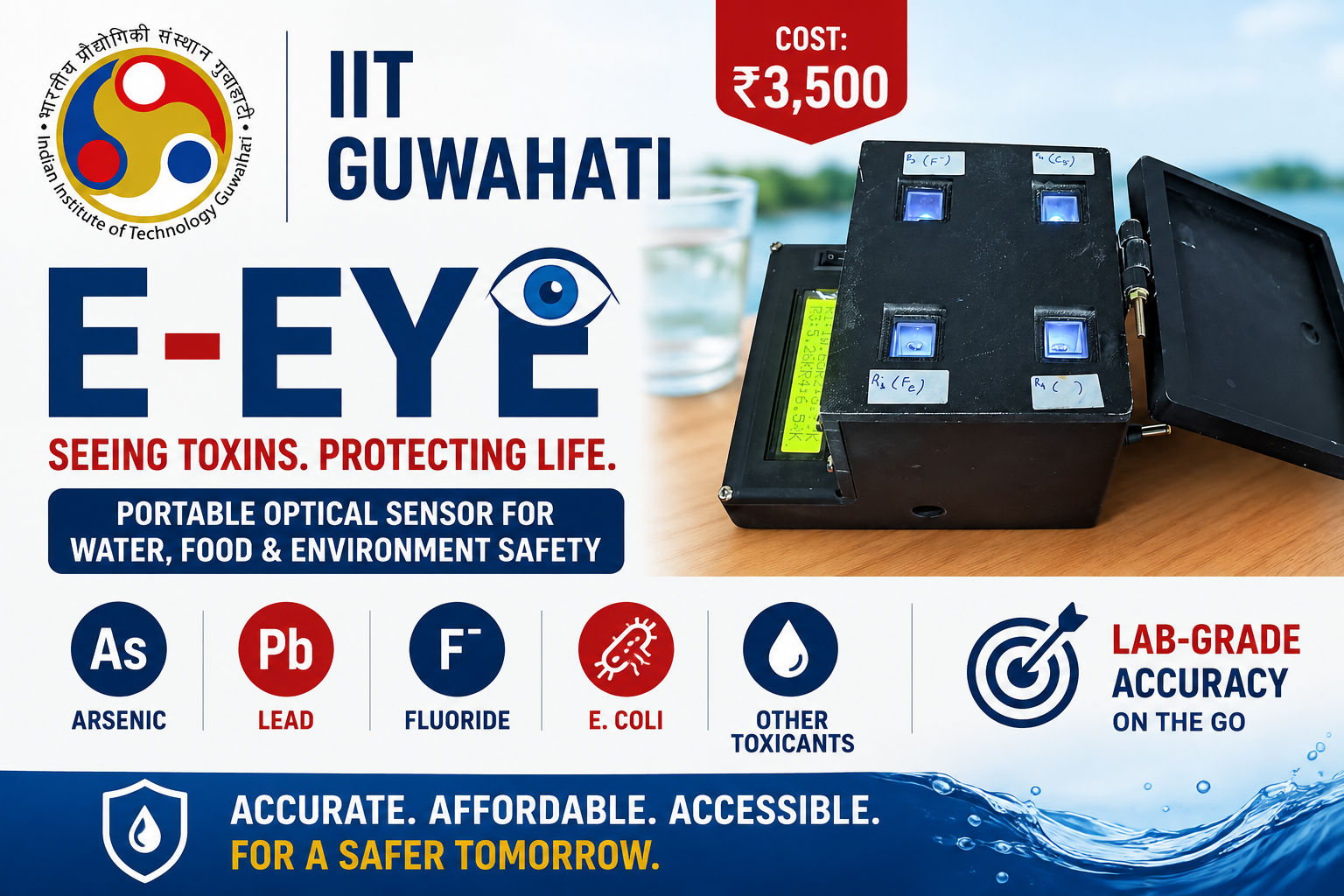
IIT Guwahati researchers create ‘E-Eye’, a Rs 3,500 portable optical sensor that detects arsenic, lead, fluoride, E. coli and other toxicants in water, food and environmental samples with lab-grade accuracy.
A portable ‘electronic eye’ for water quality
Researchers at IIT Guwahati have developed an optical sensing device that can instantly detect multiple toxicants in water and other biological samples. The innovation, aligned with the Centre’s Jal Jeevan Mission, aims to address the challenge of ensuring safe drinking water through quick and accurate quality monitoring.
To address the issue, the research team has developed a portable point-of-care testing device named ‘E-Eye’, which functions as an electronic eye to detect toxicants on-site while maintaining high accuracy and transmitting data wirelessly to water treatment facilities. Unlike conventional laboratory-based expensive instruments, E-Eye is designed for direct field deployment and can detect water contaminants at the source.
How E-Eye works
E-Eye works through a chemical reaction that produces a coloured compound, with the intensity of the colour indicating the concentration of toxicants. Using optical principles, the device analyses water samples, converts sensor output into digital data and displays the toxicant concentration. The device operates on the Beer–Lambert law and combines optical sensing with digital electronics to generate accurate quantitative measurements.
“The device operates on the Beer-Lambert law and combines optical sensing with digital electronics to generate accurate quantitative measurements. Our device has been able to successfully detect toxicants such as arsenic, lead, iron, chromium, fluoride and Escherichia coli bacteria,” said Prof Tapas K Mandal, from the Department of Chemical Engineering at IIT Guwahati.
During laboratory tests, the research team found that results are comparable to those of standard UV-Visible and Atomic Absorption Spectrophotometers (AAS), while offering advanced digital integration functionality. The team has tested more than 2,700 samples with the developed device and recorded accurate results.economictimes.
Low cost and wide applicability
The E-Eye device has been developed at a cost of around Rs 3,500, with a per-sample testing cost of around Rs 2. The cost of the device can be reduced further through large-scale industrial production. This low cost makes it suitable for deployment in rural areas, schools, community water points and small industries that cannot afford expensive laboratory equipment.
Other than water quality monitoring, the device is capable of analysing toxicants in environmental samples, biological samples, vegetables, food products, tea and herbal products, soil, and milk as well. This versatility allows agencies to use a single platform for multiple testing needs, from drinking water safety to food quality and environmental monitoring.
Supporting Jal Jeevan Mission and regulatory agencies
Prof Harshal B Nemade, from the Department of Electronics and Electrical Engineering at IIT Guwahati, said E-Eye has significant application potential across government departments, industries and private enterprises. “It can support agencies under the Ministry of Jal Shakti in water quality monitoring, assist food and herbal product manufacturers, and help industries monitor liquid effluents containing heavy metals, bacteria and odour-causing compounds,” Nemade said.
The device can support the Jal Jeevan Mission’s goal of providing safe tap water to rural households by enabling on-site testing and rapid response to contamination. It can also help state pollution control boards, public health departments and municipal bodies monitor water sources, distribution networks and treatment plants more effectively.
Research team and publication
The findings of the research have been published in the IEEE Sensors Journal in a paper co-authored by Prof Tapas K Mandal and Prof Harshal B Nemade, along with research scholars Shrikant Kashyap, Smriti Sachan and Neha Majee from IIT Guwahati, Maitrayee Bhuyan from KIIT Bhubaneswar and Humayun Kabir from Ramakrishna Mission Residential College, Kolkata.
The research was supported by a grant from the Ministry of Electronics and Information Technology (MeitY). The team’s work demonstrates how optical sensing, digital electronics and low-cost design can combine to create a practical solution for a critical public health challenge.
From lab to land: startup and technology transfer
Supported by the MeitY research grant, the research team has established a startup, ENVIONIX Labs Pvt Ltd, to commercialise the developed technology. Additionally, the team plans to collaborate with an industry partner to initiate technology transfer and bring this innovation from lab to land.
Commercialisation will enable wider deployment of E-Eye through manufacturing partners, distribution networks and service providers. It can also support integration with mobile apps, cloud platforms and data analytics tools for large-scale water quality monitoring programmes.
Next steps: solar power and cloud connectivity
As the next step, the team is working on integrating solar panels into the developed technology to make it self-sustaining and enable cloud connectivity for remote monitoring and data management. Solar integration can make the device suitable for off-grid locations where electricity supply is unreliable or unavailable.
Cloud connectivity will allow users to upload test results in real time to central dashboards. Authorities can then track water quality trends, identify contamination hotspots and trigger alerts when toxicant levels exceed safe limits. This capability can transform E-Eye from a standalone tester into a node in a larger, data-driven water safety network.
Broader impact on public health and environment
By enabling rapid, low-cost detection of toxicants, E-Eye can help prevent exposure to harmful substances such as arsenic, lead, chromium and fluoride, which cause serious health problems. It can also detect bacterial contamination such as E. coli, which indicates faecal pollution and potential disease risk.
The device’s ability to test food, tea, herbal products and milk expands its relevance beyond water. Manufacturers can use it to screen raw materials and finished products. Regulators can use it for spot checks and surveillance. Communities can use it to verify the safety of local water sources and food supplies.
A scalable model for field-deployable sensing
E-Eye demonstrates how academic research can produce field-deployable solutions that balance accuracy, cost and usability. Its optical sensing approach, digital readout and wireless data transmission offer a template for other low-cost diagnostic devices. Future versions may incorporate additional sensors, multi-analyte detection and AI-based interpretation to further enhance performance.
As India expands its focus on safe drinking water, food safety and environmental monitoring, devices like E-Eye can play a crucial role. They can also empower communities, support regulators and enable industries to take responsibility for the quality of the resources they use and release.
#IITGuwahati #EEye #WaterQuality #OpticalSensing #ToxicantDetection #JalJeevanMission #LowCostDevice #ENVIONIXLabs #MeitY #PublicHealth
Disclaimer
The information in this article is based on available public sources and official statements as of the time of publication. While we aim for accuracy, we do not guarantee completeness or correctness. We advise readers to verify key details from official sources before making any decisions. The website (iitiimsamvaad.com) is not liable for any loss or damage arising from the use of this content. The authors are also not responsible for any such loss or damage.