

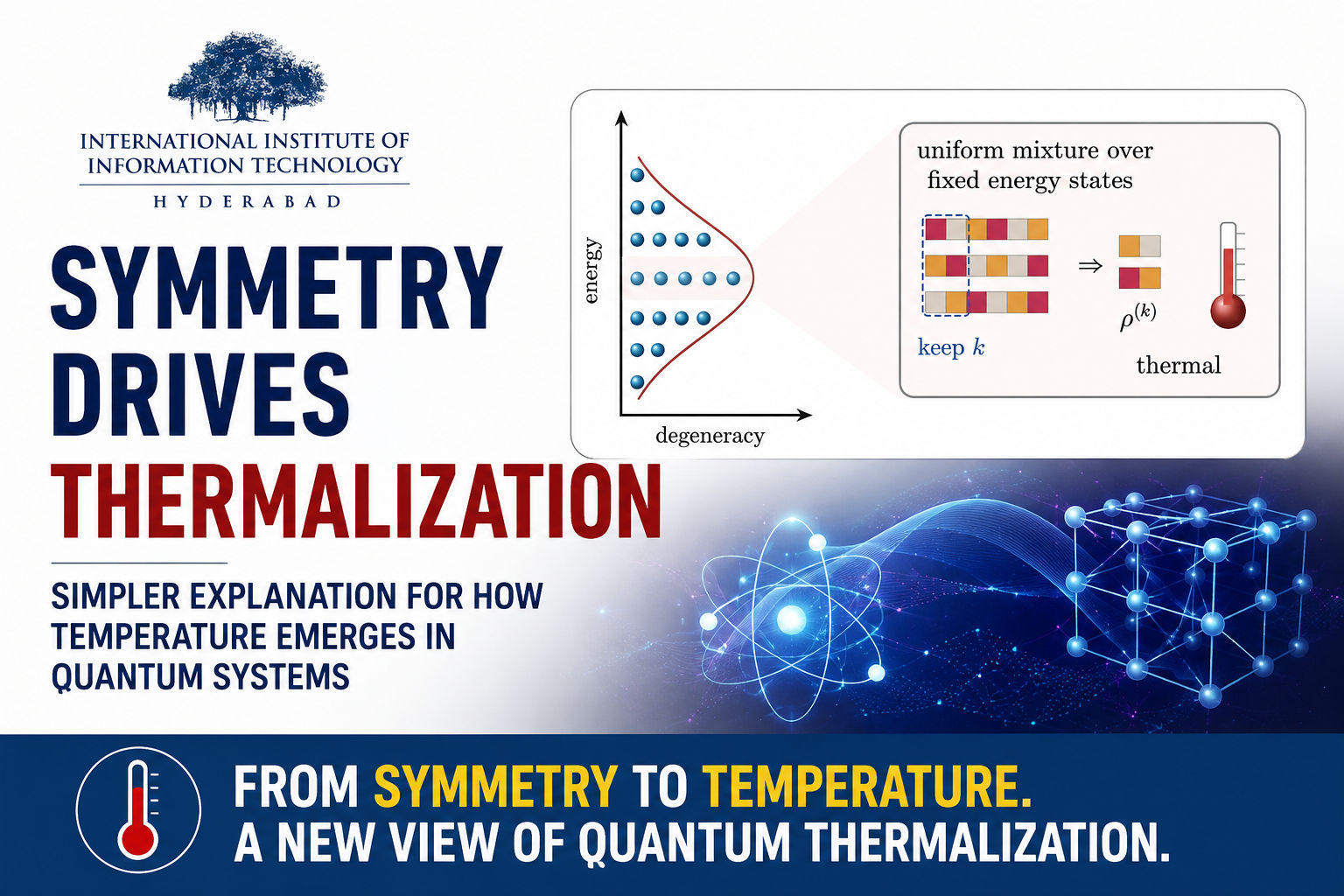
IIIT Hyderabad researchers show that symmetry alone can drive thermalization in quantum systems, offering a simpler explanation for how temperature emerges without invoking randomness or chaos.
A new explanation for thermalization
For decades, physicists have explained thermal behaviour in quantum systems using ideas such as randomness, chaos and statistical arguments. New research from the International Institute of Information Technology (IIIT) Hyderabad points to a different possibility: that symmetry by itself may be enough to make temperature emerge.
Dr Uttam Singh, Assistant Professor at the Centre for Quantum Science and Technology at IIIT Hyderabad, and Prof Nicolas J Cerf of the Université libre de Bruxelles have offered a simple explanation to a phenomenon that has puzzled physicists for long: why a large quantum system eventually starts to look as though it has a temperature. Their paper, “Symmetry-driven thermalization via finite de Finetti theorems,” has been accepted for publication in Physical Review Letters, the American Physical Society journal known for results of broad significance across physics.
The mystery of thermal behaviour in quantum systems
The laws governing quantum systems are reversible and conserve energy. Nothing in those basic rules seems to say that a system should eventually settle into a familiar thermal state. “And yet, when we look at just a small part of a large system, that is exactly what usually happens,” remarks Dr Singh. He adds that physicists have traditionally explained this using ideas such as randomness, chaos and statistics. The thinking is that in a very large system, thermal states are so common that a small part of the system is overwhelmingly likely to look thermal.
The researchers’ new work suggests there may be a simpler explanation. They prove that symmetry alone can be enough to make small parts of an isolated quantum system behave thermally, that is, acquire a definite temperature. This result challenges the conventional view that thermalization necessarily requires some form of randomness or chaotic dynamics.
An everyday analogy without quantum mechanics
Dr Singh illustrates the idea with an example that needs no quantum mechanics at all. Imagine a hundred people in a room holding a hundred rupees between them, with nobody allowed to hold more than four. You know the total and nothing else. Knowing the total, by itself, tells you very little: everyone could simply be holding one rupee each, and there would be nothing thermal about that room at all.
But now suppose money is moving around constantly, for example a rupee handed from one person to another, three-way cycles, any rearrangement that neither creates nor destroys a rupee, and you can never tell which one just happened. Then a description that would change under some reshuffle is one you cannot honestly hold onto. “Everybody holds one” fails immediately: a single rupee changing hands destroys it. Exactly one description survives, and once you have it, you can walk up to any three people, ask what they are carrying, and find the same pattern a thermal system shows: many with little, few with much. The symmetry forces every arrangement with the right total to count equally, and then the pattern with the most ways of happening simply swamps the rest. That pattern is the thermal one. Nobody traded. Nothing evolved.
How symmetry shapes quantum systems
The quantum version is the same story with energy in place of money. Imagine a huge system made up of many tiny pieces, constantly exchanging energy with one another. We may not know exactly what is happening to every individual piece, but we do know one important thing: the total energy stays the same. On its own that is not enough, just as in the example of the room.
What the researchers show is that the total energy together with a symmetry, the demand that the description be unchanged by every energy-preserving operation, places such strong restrictions on the system that its smaller parts are naturally pushed towards thermal behaviour. In other words, the system does not need to be random or chaotic to look thermal. The symmetry itself can do the job. Dr Singh and Prof Cerf also show that this is not just a mathematical possibility. They describe a kind of energy-conserving process that naturally develops the required symmetry over time.
Implications for physics and quantum theory
The result offers a new way of thinking about one of the most familiar phenomena in physics. Temperature may not always need randomness or chaos to emerge. Sometimes, the rules imposed by symmetry may be enough. This insight can influence how physicists understand thermalization in isolated quantum systems, quantum many-body dynamics and the foundations of statistical mechanics.
According to Dr Singh, the systems treated so far are ones whose parts trade energy but do not otherwise interact, so that the total is simply the sum of what each piece carries. “Nature is rarely so obliging. For example, in a solid, the atoms are bound to their neighbours, and some of the energy is stored in those bonds rather than in any single atom, so a small region can no longer be cleanly separated from what surrounds it. Whether symmetry alone still suffices there is a harder question of significant importance, and one worth exploring,” he muses.
From mathematical proof to physical insight
The paper uses finite de Finetti theorems, which relate permutation symmetry to approximate mixtures of product states, to establish the result. These theorems have found applications in quantum information, many-body physics and the study of entanglement. By applying them to thermalization, the researchers connect symmetry constraints directly to the emergence of thermal states in subsystems.
The work does not claim that randomness and chaos are irrelevant in all situations. Instead, it shows that symmetry provides an alternative, and in some cases sufficient, route to thermal behaviour. This broadens the conceptual toolkit available to physicists studying how quantum systems approach equilibrium.
Opening new questions for research
The finding raises several follow-up questions. Can symmetry-driven thermalization explain experimental observations in specific quantum platforms such as cold atoms, trapped ions or superconducting circuits? How does the mechanism interact with other known routes to thermalization, such as eigenstate thermalization or integrability breaking? And can the approach be extended to systems with interactions that store energy in bonds rather than in individual particles?
Addressing these questions will require both theoretical work and experimental tests. If symmetry-driven thermalization proves robust in more realistic models, it could reshape how physicists think about the foundations of temperature, entropy and equilibrium in quantum mechanics.
A simpler foundation for a familiar phenomenon
By showing that symmetry alone can drive thermalization, Dr Singh and Prof Cerf offer a simpler foundation for a phenomenon that appears in laboratories and textbooks every day. Their result reminds us that sometimes the most familiar behaviours arise not from complexity but from the constraints imposed by fundamental symmetries.
As quantum technologies mature, understanding how and when quantum systems thermalize will become increasingly important. This work adds a new perspective to that understanding and opens fresh avenues for research at the intersection of quantum information, many-body physics and statistical mechanics.
#IIITHyderabad #QuantumThermalization #Symmetry #PhysicalReviewLetters #QuantumSystems #StatisticalMechanics #DeFinettiTheorems #ThermalBehaviour #QuantumPhysics #ResearchBreakthrough
Disclaimer
The information in this article is based on available public sources and official statements as of the time of publication. While we aim for accuracy, we do not guarantee completeness or correctness. We advise readers to verify key details from official sources before making any decisions. The website (iitiimsamvaad.com) is not liable for any loss or damage arising from the use of this content. The authors are also not responsible for any such loss or damage.