
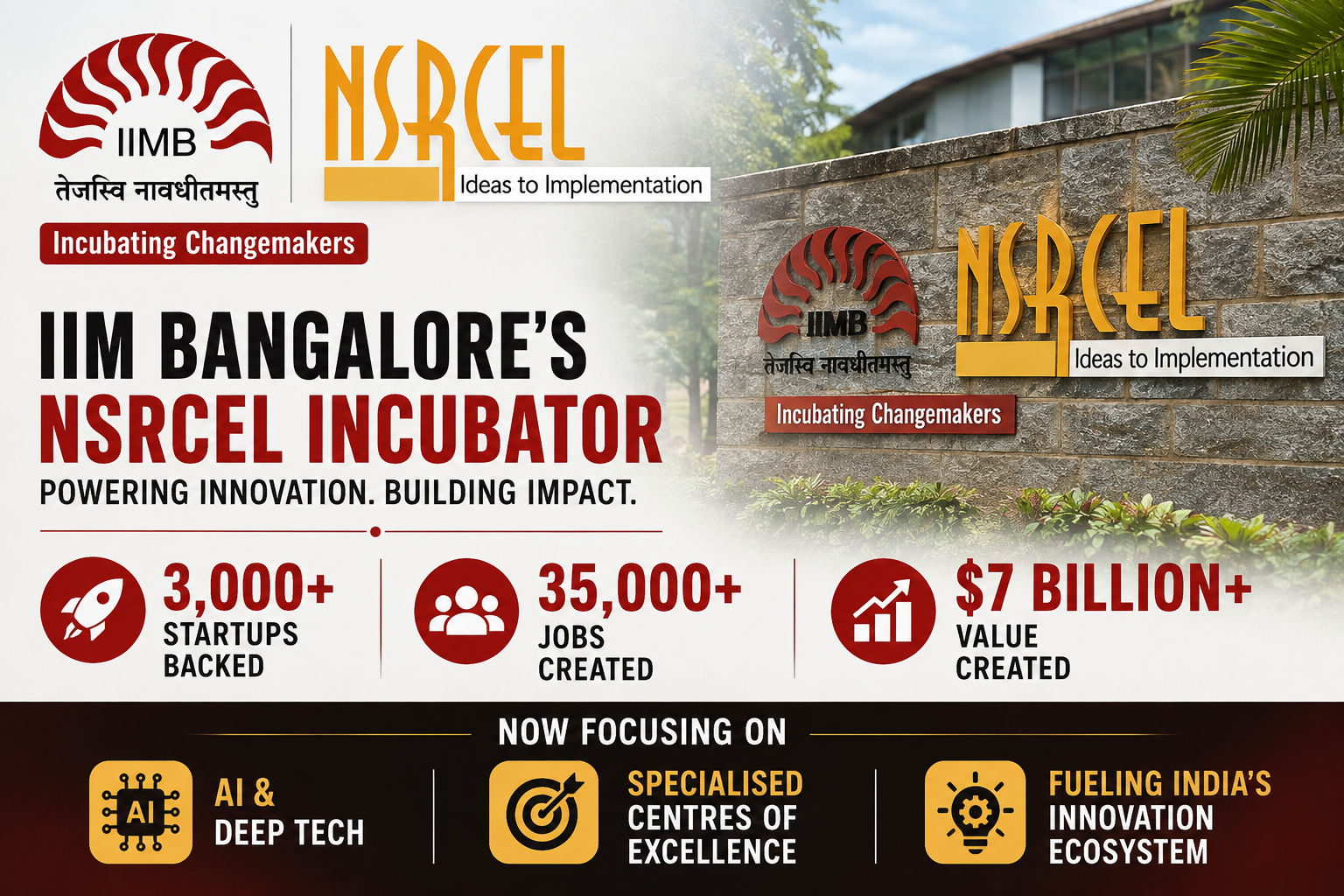
IIM Bangalore’s NSRCEL incubator backs 3,000+ startups, creates 35,000 jobs and $7 billion value, and now focuses on AI, deep tech and specialised Centres of Excellence.
Two decades of startup impact
More than 3,000 startups incubated at the Nadathur Sarangapani Raghavan Centre for Entrepreneurial Learning (NSRCEL), the entrepreneurship arm of the Indian Institute of Management Bangalore, have created over $7 billion in enterprise value since the centre’s founding in 2000. Those startups have also generated more than 35,000 jobs, according to the institute.
As NSRCEL enters its next phase, the incubator plans to focus on artificial intelligence, deep technology and global partnerships as it looks to expand its reach. It aims to introduce AI-enabled learning pathways offering round-the-clock, personalised support for entrepreneurs, to increase engagement from about 238,000 entrepreneurs to more than one million.
From academic incubator to multifaceted ecosystem
The arm has evolved from a traditional academic incubator into a multifaceted ecosystem, bridging management theory and venture scaling. In 2024–2025 (FY25) alone, the incubator supported more than 720 ventures across 24 states through a hybrid digital–physical model, while expanding partnerships with government agencies and corporate backers, including Hindustan Unilever, Goldman Sachs and Capgemini.
“Our vision is to create a future-ready incubator that adapts to the evolving needs of entrepreneurs,” said Rasika Prashant, CEO, NSRCEL. That adaptability is built on what NSRCEL describes as an “open architecture” model. The incubator draws on a network of more than 100 mentors and a “startup kit” of over 116 product and service providers to support founders.
It has also expanded partnerships to strengthen the broader startup ecosystem, including the SBI Foundation Leap (i-Cube) initiative, to build incubation capacity in underserved regions such as Northeast India. It also has a partnership with Deloitte India to develop modules on governance, taxation and mergers and acquisitions.
Shift to hyper-specialised Centres of Excellence
During FY25, NSRCEL shifted its strategy toward building hyper-specialised Centres of Excellence (CoEs). That shift is most visible in NSRCEL’s new sector-specific centres. One flagship initiative is a FinTech Centre of Excellence, approved by the Karnataka government with a five-year commitment of Rs 13.24 crore. Of this, over Rs 8 crore has been earmarked for incubation and acceleration, while Rs 5 crore will support skilling and training through IIMBx.
Alongside fintech, sustainability has become a second pillar. NSRCEL has positioned itself as a hub for sustainability and circular economy startups, aligning with IIM Bangalore’s net-zero commitments. Its portfolio includes Angirus IND, which makes bricks from 100 per cent recycled plastic; WeVOIS, an Internet-of-Things-driven waste-management startup that has raised Rs 36 crore in Series A funding; and Hala Mobility, an electric-mobility platform that has secured Rs 51 crore in a pre-Series A round.
Investor interest and national exposure
The commercial potential of NSRCEL-backed startups has also been reflected in investor interest and national exposure. Several startups backed by the arm have appeared on Shark Tank India, including Chokhat Home and Tickle Your Art, which secured equity investments, and Klimate, known for its wearable personal cooling technology.
Several portfolio companies also attracted fresh capital in 2024–2025. The Energy Company raised $2 million to expand its battery intelligence and electric vehicle solutions, while FluxGen secured Rs 28 crore in a funding round led by investors including Rainmatter by Zerodha. Circular economy startup Ukhi raised $1.2 million, and medtech venture Anatomech received an Indian patent for its KUE compression sleeve.
Women entrepreneurs drive impact
NSRCEL has also expanded its efforts to support women entrepreneurs through dedicated incubation and training programmes. During 2024–2025, its Women Startup Programme supported 341 founders from the ideation stage to proof of concept, while the Goldman Sachs 10,000 Women initiative worked with 391 entrepreneurs to help them scale their businesses.
In partnership with the National Commission for Women, the incubator has also supported a cumulative 1,470 women entrepreneurs across the country. Its Swavalambane programme, launched in 2022 with Karnataka’s State Rural Livelihood Promotion Society, has helped rural women entrepreneurs by providing funding access, mentorship and business development support. The inaugural cohort drew more than 40,000 applications from 26 districts, with 150 ventures selected for incubation.
Social ventures and Tier-III/IV reach
NSRCEL’s social entrepreneurship platform, Impact Orbit, has supported 131 technology-enabled social ventures since its launch in 2017 with Capgemini, focusing on education, employability and the environment. The programme has expanded to Tier-III and Tier-IV cities across more than 20 states, with women leading 42 per cent of the ventures. Collectively, the startups have created more than 14,000 jobs and reached over 2.3 million people, according to an independent impact assessment released in November 2024.
AI-enabled learning and global partnerships
As it moves into its next phase, NSRCEL is betting that AI and specialised sector support, rather than scale alone, will define its next 25 years. The incubator plans to use AI-enabled learning tools to offer personalised, on-demand guidance to founders at different stages. It also aims to deepen global partnerships to help Indian startups access international markets, capital and talent.
By combining sector-specific CoEs, AI-driven support and a strong mentor network, NSRCEL seeks to increase the survival and scaling rates of early-stage ventures. The focus on fintech, sustainability, women-led businesses and social impact reflects both market opportunities and national priorities.
A model for university-linked incubation
NSRCEL’s journey shows how a university-linked incubator can evolve from a small academic programme into a national startup platform. Its open architecture model, hybrid delivery and partnerships with government, corporates and investors have helped it scale impact without losing focus on founder needs.
As India’s startup ecosystem matures, incubators like NSRCEL will play a critical role in converting ideas into viable businesses. By emphasising AI, deep tech and sector specialisation, NSRCEL aims to stay relevant in a rapidly changing landscape while continuing to create jobs, enterprise value and social impact.
#NSRCEL #IIMBangalore #StartupIncubator #FinTechCoE #CircularEconomy #WomenEntrepreneurs #DeepTech #AIForStartups #SocialVentures #Entrepreneurship
Disclaimer
The information in this article is based on available public sources and official statements as of the time of publication. While we aim for accuracy, we do not guarantee completeness or correctness. We advise readers to verify key details from official sources before making any decisions. The website (iitiimsamvaad.com) is not liable for any loss or damage arising from the use of this content. The authors are also not responsible for any such loss or damage.