

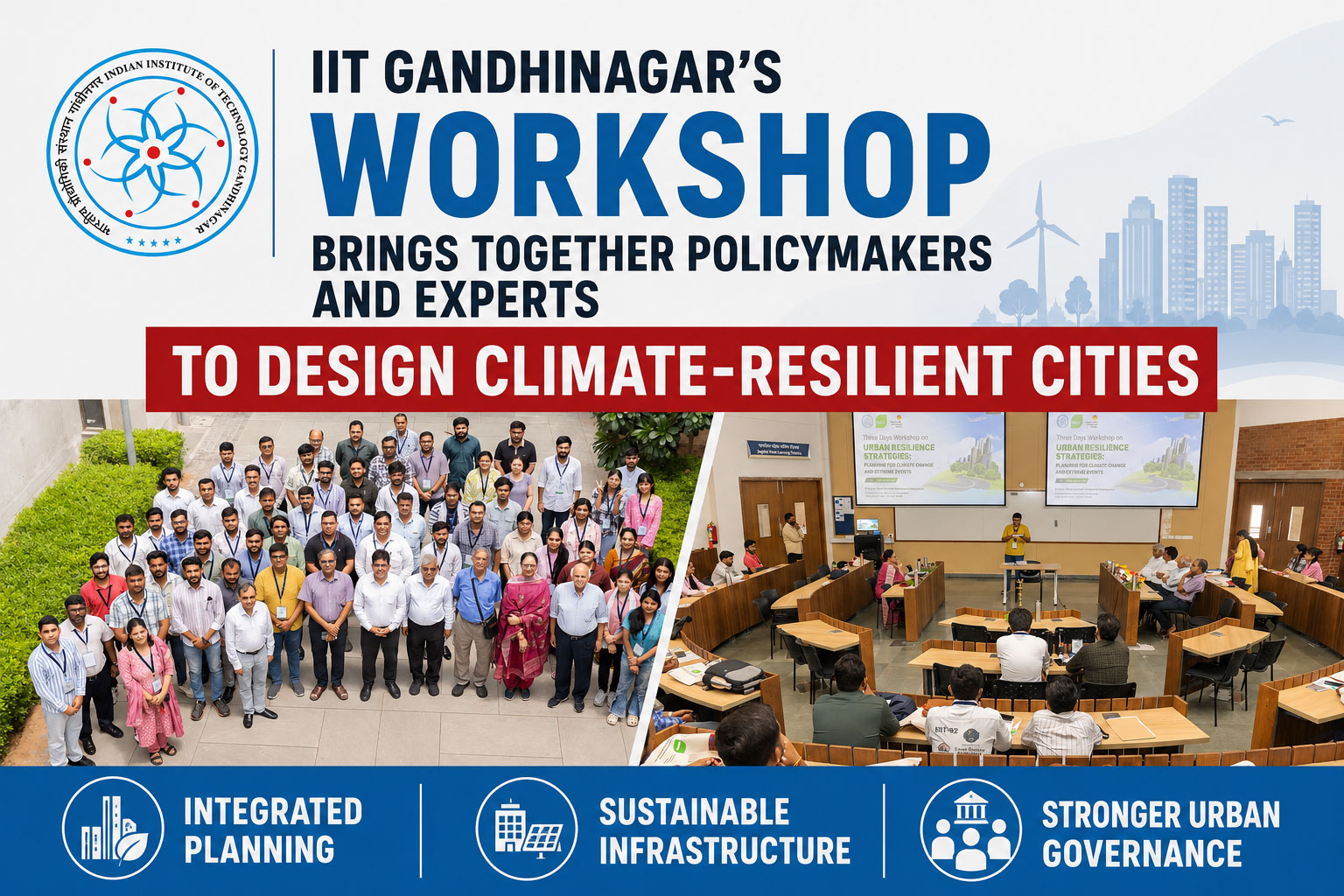
IIT Gandhinagar’s workshop brings policymakers and experts together to design climate-resilient cities through integrated planning, sustainable infrastructure and stronger urban governance.
Urban resilience takes centre stage
IIT Gandhinagar has brought climate resilience to the centre of urban planning through a three-day workshop on “Urban Resilience Strategies: Planning for Climate Change and Extreme Events.” Organised by the Dr. Kiran C. Patel Centre for Sustainable Development and supported by the Gujarat Urban Development Institute, the programme runs from June 23 to 25 and focuses on how Indian cities can withstand climate shocks while continuing to grow sustainably. The workshop arrives at a time when heatwaves, flooding and extreme rainfall are placing new pressure on urban systems.
A shared response to a growing challenge
The workshop has assembled policymakers, engineers, architects, researchers, development professionals and students to work on a common problem: how to build cities that are not just larger and smarter, but also safer and more adaptive. Participants are discussing disaster preparedness, governance, infrastructure design and long-term urban sustainability. The gathering reflects a broader shift in urban thinking, where resilience is no longer treated as a specialised topic but as a foundation for development.
Why this matters now
Climate change has turned extreme weather from an exception into a recurring test for cities. Urban centres now face stronger floods, harsher heat, water stress, air pollution and infrastructure disruption more often than before. As cities expand, they concentrate people, assets and services, which means climate shocks can affect more lives and cause larger economic losses. The workshop at IIT Gandhinagar responds to this reality by arguing that urban resilience must become part of everyday planning rather than an afterthought.
Leadership from GUDI and IITGN
Inaugurating the event, Dr. I.P. Gautam, IAS (Retd.), Director General of GUDI, said cities can no longer treat climate change as a future issue. He stressed that resilience depends on integrated planning, strong institutions, sustainable infrastructure and active community participation. His remarks framed urban resilience as a governance challenge as much as a technical one, because cities need institutions that can plan, respond and adapt over long periods.
Dr. Gautam also emphasised that resilience must go beyond disaster response. Instead of waiting for floods or storms to expose weaknesses, cities must design systems that remain functional under stress. That means preparing drainage systems, roads, public transport, water supply and emergency services in ways that support both growth and safety.
Embedding sustainability in planning
Dr. Vijay Anadkat, Senior Fellow at WRI India, highlighted Gujarat’s urban transformation and pointed to a crucial transition. He noted that large investments are already flowing into smart city and climate resilience projects, but sustainability can no longer sit apart from mainstream development. It must shape urban planning, infrastructure creation and public service delivery from the start.
That point matters because many cities still treat climate action as a separate environmental initiative. The workshop’s message is different. It argues that resilience must be built into housing, mobility, drainage, public spaces and service networks. If planners integrate sustainability from the beginning, they reduce long-term damage and avoid costly retrofits later.
Science, policy and practice
Prof. Vimal Mishra, Dean of Research and Development at IIT Gandhinagar, called attention to the gap between scientific research and policy implementation. He noted that cities are major engines of opportunity, but they are also becoming more vulnerable to heatwaves, flooding and extreme weather. Urban resilience, he argued, is essential not only for protecting people but also for maintaining critical city functions such as transport, health services, energy and water systems.
Other experts, including Prof. R.N. Singh and Prof. Sharad K. Jain, added disciplinary depth to the conversation. Their participation reflects the workshop’s broad approach, which brings together geophysics, civil engineering, urban planning and policy analysis. This mix allows participants to connect scientific evidence with design choices and governance reforms.
Learning through field exposure
The programme goes beyond lectures and panels. Participants are taking part in technical sessions, interactive discussions and field visits that show how resilience works in practice. Topics include climate adaptation, disaster risk reduction, air quality management, governance mechanisms and nature-based solutions. The workshop also includes visits to the Ahmedabad Municipal Corporation’s BRTS Control Room and IITGN’s AI Resilience and Command Centre, giving participants a practical view of how cities monitor and manage urban systems.
These field visits matter because resilience depends on operational capacity as much as on theory. A control room can help planners track disruptions, respond to emergencies and coordinate services faster. Similarly, AI-enabled monitoring can strengthen situational awareness and improve decision-making during climate-related events.
Nature-based and technology-driven solutions
One of the workshop’s strengths lies in its balance between nature-based and technology-driven approaches. Resilient cities need both. Green spaces, wetlands and permeable surfaces can reduce flooding and heat stress, while digital tools can improve forecasting, monitoring and coordination. The workshop encourages participants to think across these domains rather than choosing one over the other.
That integrated mindset is especially important for Indian cities, which face rapid urbanisation alongside climate risk. A city that grows without resilience may become more fragile over time. A city that plans with resilience in mind can protect lives, reduce losses and sustain growth more effectively.
A roadmap for the future
The IIT Gandhinagar workshop offers more than a discussion platform. It creates a roadmap for climate-resilient and inclusive urban development. By bringing together government, research and practice, the programme shows how cities can prepare for environmental uncertainty while continuing to support livelihoods and growth.
Its larger lesson is clear: the cities of the future will not be judged only by how fast they expand, but by how well they withstand shocks, serve citizens and adapt to change. IIT Gandhinagar’s initiative pushes that vision forward with urgency, evidence and collaboration.
#IITGandhinagar #UrbanResilience #ClimateAdaptation #SustainableCities #ClimateChange #DisasterPreparedness #UrbanPlanning #NatureBasedSolutions #SmartCities #ClimateResilientIndia
Disclaimer
The information in this article is based on available public sources and official statements as of the time of publication. While we aim for accuracy, we do not guarantee completeness or correctness. We advise readers to verify key details from official sources before making any decisions. The website (iitiimsamvaad.com) is not liable for any loss or damage arising from the use of this content. The authors are also not responsible for any such loss or damage.