

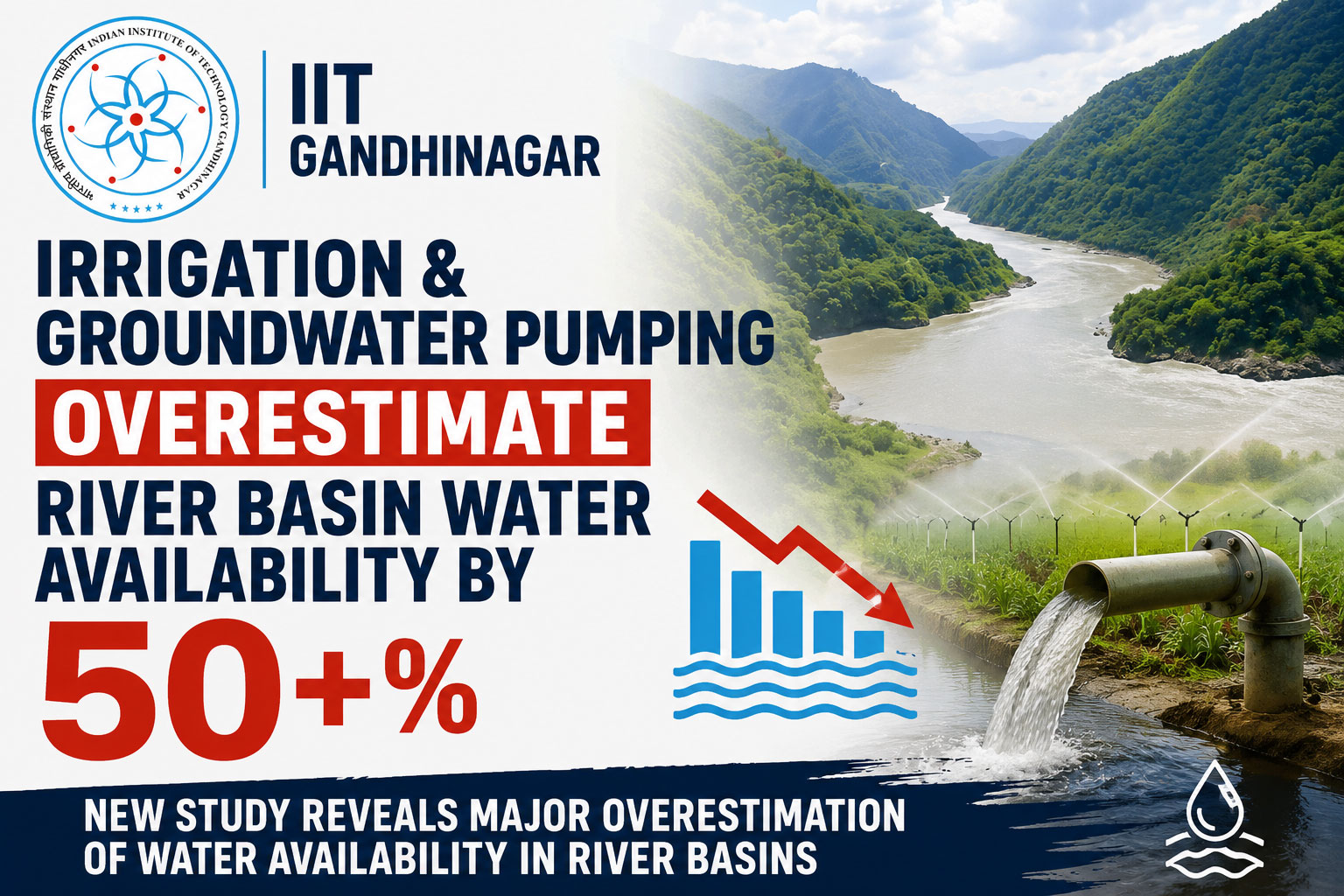
IIT Gandhinagar researchers found irrigation and groundwater pumping can overestimate river basin water availability by over 50 percent, especially in heavily irrigated regions across India.
Human Activity Is Reshaping India’s Water Balance
A new study by researchers at the Indian Institute of Technology Gandhinagar has found that human-induced moisture losses can cause a serious overestimation of water availability in India’s river basins. The researchers said that ignoring the effect of irrigation and groundwater pumping can inflate estimates of available water by more than 50 percent in some basins.
The study is important because it shows that water availability is not controlled by rainfall and river flow alone. Human activity now plays a major role in how much water actually remains in a basin. That means planners, farmers, and policymakers need to look beyond traditional hydrological models if they want an accurate picture of water stress.
Evapotranspiration Drives Hidden Water Losses
The researchers focused on evapotranspiration, the process through which water evaporates from land and is used by plants. This process naturally occurs in all river basins, but irrigation and groundwater pumping can intensify it significantly. When farmers apply water to fields, much of it returns to the atmosphere through evaporation and plant uptake instead of remaining available for streams, reservoirs, or aquifers.
According to the study, human activities such as irrigation and groundwater pumping substantially increase evapotranspiration in India. However, many models still overlook this effect. That omission leads to a distorted understanding of how much water remains for agriculture, cities, and ecosystems.
The study, published in the Journal of Geophysical Research: Atmospheres, examined human-induced evapotranspiration across 12 river basins during 2003-2020. The researchers used satellite observations from the Gravity Recovery and Climate Experiment, along with results from five hydrological models, to estimate the scale of the problem.
Dry Season Losses Are Especially High
The study found that human-induced evapotranspiration becomes more prominent during the dry season, when water stress is already high. In irrigation-intensive basins, it contributed 30 to 50 percent of total evapotranspiration. That is a substantial share, showing that human intervention can dominate water loss during the months when water is most needed.
The highest human-induced evapotranspiration occurred during summer in basins such as Brahmani in Odisha, Pennar in Andhra Pradesh, Krishna, Mahanadi, and Narmada. The researchers also found that this kind of water loss remained consistently high across most of the river basins they studied. That pattern suggests that human pressure on water resources is not temporary or seasonal alone, but persistent throughout the year.
This finding matters because dry-season water availability often determines whether a region can sustain crops, drinking water supply, and hydropower generation. If water loss is underestimated, governments may overcommit water resources and worsen shortages.
Some Basins Show Major Overestimation
The study warns that failing to account for human-induced evapotranspiration leads to large errors in estimating available water. In the Indus, Mahi, and Pennar basins, the researchers found more than 50 percent overestimation in total available water. In the Brahmani, Ganga, Godavari, Krishna, Tapi, Narmada, and Mahanadi basins, the overestimation ranged from 30 to 40 percent.
These are not small deviations. They can affect irrigation planning, reservoir operations, inter-state water sharing, and long-term water policy. When authorities rely on inflated estimates, they may assume more water exists than is actually usable.
The annual water availability was especially reduced in basins with very high irrigation intensity, meaning more than half of agricultural land depends on irrigation. The Krishna basin showed a 64.7 percent reduction, Mahi 63.6 percent, Godavari 57.6 percent, and Pennar 74.6 percent. These reductions were linked to heavy use of groundwater and surface-water-based irrigation.
Why the Findings Matter for Policy
The study highlights a key weakness in current water planning: hydrological models often treat human intervention as secondary. In reality, irrigation intensity, groundwater withdrawal, and land-use decisions directly shape the water cycle. That means planners must integrate human behaviour into water assessments rather than treating it as an external factor.
The researchers said that integrating irrigation intensity, groundwater dynamics, and human interventions into hydrological models would improve estimates of available water. Such models would offer a more realistic basis for policy decisions, especially in regions facing chronic scarcity.
This has major implications for India, where many basins already face rising demand, groundwater depletion, and climate variability. A basin that appears water-rich on paper may actually be under severe stress once human-induced losses are counted.
A Warning for Water-Scarce Regions
India’s water challenges are becoming more complex because agriculture still depends heavily on irrigation, and groundwater remains a critical source in many states. The IIT Gandhinagar study shows that these very practices can silently reduce available water by increasing evapotranspiration. In other words, the act of supplying water to farms can also reduce the amount of water left in the system.
That makes the research especially valuable for drought planning, agricultural policy, and river basin management. It suggests that sustainability efforts must focus not only on how much water enters a basin, but also on how much human activity removes from it.
The study delivers a clear message: India cannot manage water effectively unless it accounts for the full impact of irrigation and groundwater pumping. Better modelling, better monitoring, and more realistic planning will be essential for protecting future water security.
#WaterAvailability #IITGandhinagar #Evapotranspiration #GroundwaterPumping #Irrigation #RiverBasins #WaterSecurity #Hydrology #IndiaWaterStudy #ClimateResearch
Disclaimer
The information in this article is based on available public sources and official statements as of the time of publication. While we aim for accuracy, we do not guarantee completeness or correctness. We advise readers to verify key details from official sources before making any decisions. The website (iitiimsamvaad.com) is not liable for any loss or damage arising from the use of this content. The authors are also not responsible for any such loss or damage.