
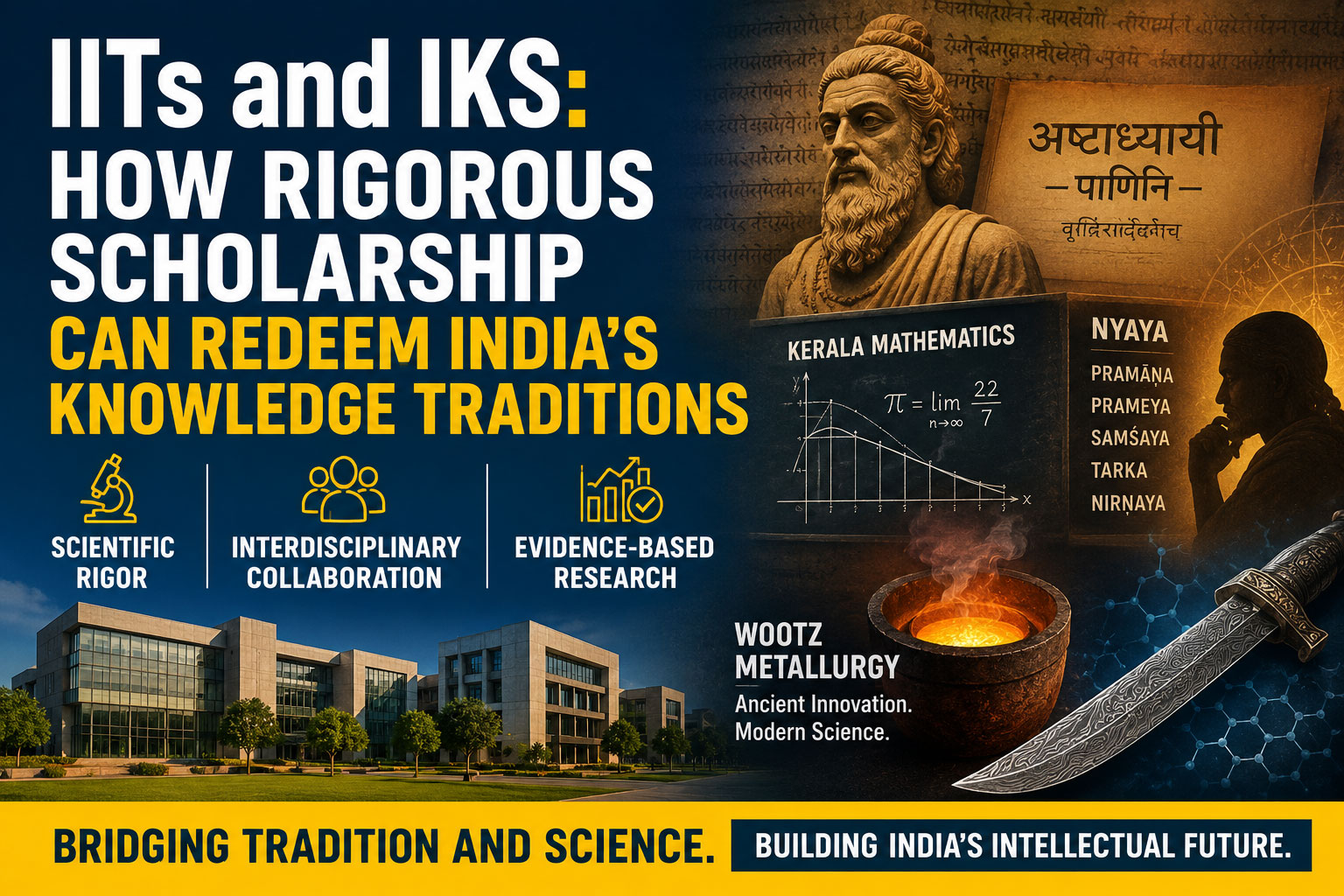
IITs can transform contested IKS agendas into rigorous, verifiable research – bridging Panini, Nyaya, Kerala mathematics and wootz metallurgy with scientific rigor, interdisciplinary collaboration, and evidence-based methods.
India’s Intellectual Heritage Deserves Scientific Inquiry
India possesses one of the world’s richest intellectual traditions. From Panini’s linguistic framework and Nyaya’s logical reasoning to Kerala’s mathematical innovations and the advanced metallurgy of wootz steel, Indian civilization has produced knowledge that continues to inspire scholars worldwide. These traditions represent centuries of systematic observation, experimentation, and intellectual exploration.
Today, the challenge is not whether these knowledge systems deserve attention, but how modern institutions can study them with scientific discipline. India’s premier engineering institutions – the IITs – are uniquely positioned to transform Indian Knowledge Systems (IKS) from subjects of historical interest into rigorous fields of interdisciplinary research capable of generating new knowledge and innovation.
IITs Can Bridge Ancient Wisdom and Modern Science
The National Education Policy (NEP) 2020 has encouraged universities to integrate Indian Knowledge Systems into education and research. Several IITs, including IIT Kharagpur, IIT Gandhinagar, IIT Bombay, IIT Kanpur, and IIT Mandi, have established dedicated IKS centres to explore India’s scientific and intellectual traditions.
The real opportunity lies in asking modern scientific questions about traditional knowledge. Instead of accepting historical claims without examination, researchers can convert them into testable hypotheses. Engineers, materials scientists, linguists, historians, computer scientists, and philosophers can work together to validate, refine, or even challenge traditional ideas through empirical research.
This approach neither glorifies nor dismisses India’s heritage. It simply applies the universal principles of scientific inquiry. When engineers, historians, linguists and materials scientists collaborate, they turn tradition into verifiable science: reconstructing ancient alloys, formalising grammatical rules for computational linguistics, and testing historical mathematical methods for numerical insights.
A Foundation Built on Testable Knowledge
The most valuable components of IKS already stand on remarkably structured foundations. Panini’s grammar offers one of history’s most sophisticated rule-based linguistic systems and has influenced modern computational linguistics. Nyaya philosophy developed rigorous methods of logic, inference, and debate centuries before many comparable Western frameworks. The Kerala School anticipated important mathematical concepts later associated with calculus. Ancient Indian metallurgists produced high-carbon wootz steel that fascinated blacksmiths across Asia and Europe.
Each of these represents a research domain where modern science can investigate, reproduce, validate, and expand upon historical knowledge. Some observers have expressed concerns that Indian Knowledge Systems could drift toward unverified claims if academic standards weaken. Such concerns should encourage stronger research practices rather than discourage exploration altogether.
IITs Are Already Demonstrating the Right Model
Several IITs have begun translating traditional knowledge into measurable scientific research. Materials scientists at IIT Kharagpur and IIT Bombay have used advanced microscopy, metallurgical analysis, and laboratory reconstruction to study ancient steel samples and reproduce microstructures resembling historic wootz steel. Their work contributes not only to archaeology but also to modern materials engineering.
Researchers at IIT Kanpur and IIT Bombay have incorporated Paninian grammatical principles into computational linguistics, improving natural language processing for Indian languages. These efforts strengthen artificial intelligence while preserving linguistic heritage.
Other IITs have initiated carefully designed studies on yoga, meditation, neuroscience, and human physiology using modern medical protocols, ethical review systems, and measurable biological indicators. Such research moves discussions from anecdotal belief toward reproducible scientific evidence. These examples demonstrate how rigorous methodology transforms historical knowledge into contemporary scholarship.
Scientific Method Must Guide Every IKS Project
For Indian Knowledge Systems to earn lasting academic credibility, every research project must satisfy the highest standards of scientific investigation. Researchers should begin with clearly defined hypotheses and pre-registered research designs. Independent control groups, transparent datasets, reproducible methodologies, and peer-reviewed publication should become standard practice. External advisory committees comprising historians, scientists, philosophers of science, and domain experts can provide additional quality assurance.
Projects involving extraordinary claims should naturally face proportionately higher standards of evidence. Independent replication and open scrutiny strengthen research rather than weaken it. Scientific rigor protects both institutional credibility and India’s intellectual heritage.
Interdisciplinary Research Creates the Greatest Value
The greatest strength of Indian Knowledge Systems lies in their interdisciplinary nature. Traditional water management systems can combine hydrology, remote sensing, environmental engineering, archaeology, and social anthropology to evaluate their relevance under contemporary climate conditions. Ancient architectural principles can collaborate with structural engineering, thermal science, and sustainable urban design to improve energy-efficient buildings.
Ayurveda-inspired research can integrate classical textual analysis with molecular biology, pharmacology, chemistry, and controlled clinical trials to identify active compounds and evaluate therapeutic potential. When multiple disciplines converge, traditional knowledge becomes a source of measurable innovation rather than cultural symbolism.
Traditional Knowledge Can Inspire Modern Innovation
Scientific validation often reveals unexpected value hidden within traditional practices. For example, Researchers at IIT Roorkee recently reported laboratory findings indicating that Ayurvedic cow urine distillate demonstrated significant antiviral activity against the Chikungunya virus under controlled experimental conditions, with optimized formulations showing substantial reductions in viral load. Such findings do not ask society to accept traditional claims without question. Instead, they encourage scientists to isolate active compounds, investigate mechanisms, conduct further validation, and determine whether promising laboratory observations translate into safe and effective medical applications.
This represents the ideal relationship between tradition and science – where evidence, not assumption, determines future progress.
Local Knowledge Can Generate Global Solutions
Many traditional Indian practices evolved through centuries of adaptation to local environmental conditions. As climate change, resource scarcity, and sustainable development become global priorities, these historical solutions deserve renewed investigation. Traditional agricultural methods may improve soil health and water conservation. Indigenous building techniques may reduce energy consumption in extreme climates. Historic water harvesting systems may strengthen climate resilience in drought-prone regions.
By studying these systems scientifically, IITs can produce innovations with international relevance while addressing India’s own developmental challenges. Knowledge that originates locally can contribute globally.
Rigorous IKS Research Can Attract Global Talent
Young researchers increasingly seek meaningful problems with real societal impact. Indian Knowledge Systems offer an exceptional combination of historical depth, scientific complexity, and practical relevance. Well-designed interdisciplinary projects encourage collaboration among engineers, scientists, linguists, historians, AI researchers, and healthcare professionals. Publications in respected international journals, open datasets, and reproducible findings will enhance India’s research reputation and encourage collaborations with leading global universities.
Rather than contributing to brain drain, a strong IKS research ecosystem can position India as an international destination for frontier interdisciplinary scholarship.
The Future Lies in Evidence, Not Assumptions
India does not need to choose between celebrating its civilizational heritage and practicing modern science. The two can strengthen one another when institutions uphold evidence, transparency, and intellectual honesty. The IITs possess the expertise, infrastructure, and global credibility to lead this transformation. By converting traditional knowledge into testable research questions, applying rigorous scientific methods, publishing reproducible results, and welcoming open academic debate, they can create a model that other universities around the world may follow.
Indian Knowledge Systems should not remain confined to museums or ideological debates. They should enter laboratories, research journals, classrooms, and innovation ecosystems. When evidence guides inquiry, India’s intellectual traditions become not relics of the past, but foundations for discoveries that shape the future.
A Hypothesis Worth Scientific Investigation
One possible interpretation is that traditional societies may not have viewed cow urine solely as a substance to be consumed directly. Instead, they may have understood it as part of a larger ecological cycle. In pre-industrial landscapes, where soil remained porous and groundwater recharge occurred naturally, organic matter – including animal waste and urine – would percolate through multiple layers of soil, sand, clay, minerals, and microorganisms before reaching underground aquifers.
This natural filtration process is remarkably sophisticated. Soil acts as a biological and chemical reactor, removing pathogens, breaking down organic compounds, adsorbing contaminants, and allowing beneficial minerals to interact with dissolved substances. By the time water reaches an aquifer, it has undergone extensive physical, chemical, and biological transformation.
The interpretation
From this perspective, references in traditional literature to the medicinal qualities associated with cows may have reflected an ecological understanding rather than a literal recommendation. The health benefits may have been linked to landscapes enriched by cattle-based agriculture, healthy soils, microbial diversity, and naturally recharged groundwater rather than to untreated cow urine itself.
Modern urbanisation has significantly altered this natural cycle. Vast expanses of concrete and asphalt prevent rainwater infiltration, reduce groundwater recharge, and disconnect biological processes that once occurred beneath the soil. If traditional ecosystems contributed to water quality through complex interactions among vegetation, soil microbes, minerals, and grazing animals, those conditions have largely disappeared in modern cities.
This interpretation suggests an interesting scientific question rather than a conclusion: Did cattle-integrated ecosystems historically influence groundwater chemistry or microbiology in ways that benefited human health? Such a question can be investigated using hydrogeology, soil science, microbiology, environmental chemistry, and public health. Researchers could compare groundwater from traditional grazing landscapes with water from areas lacking such ecological conditions, while controlling for geology, land use, and contamination.
#IKS #IITs #IndianKnowledgeSystems #Panini #KeralaSchool #WootzSteel #InterdisciplinaryResearch #ResearchIntegrity #DecolonisingScholarship #ResponsibleInnovation
Disclaimer
The information in this article is based on available public sources and official statements as of the time of publication. While we aim for accuracy, we do not guarantee completeness or correctness. We advise readers to verify key details from official sources before making any decisions. The website (iitiimsamvaad.com) is not liable for any loss or damage arising from the use of this content. The authors are also not responsible for any such loss or damage.