

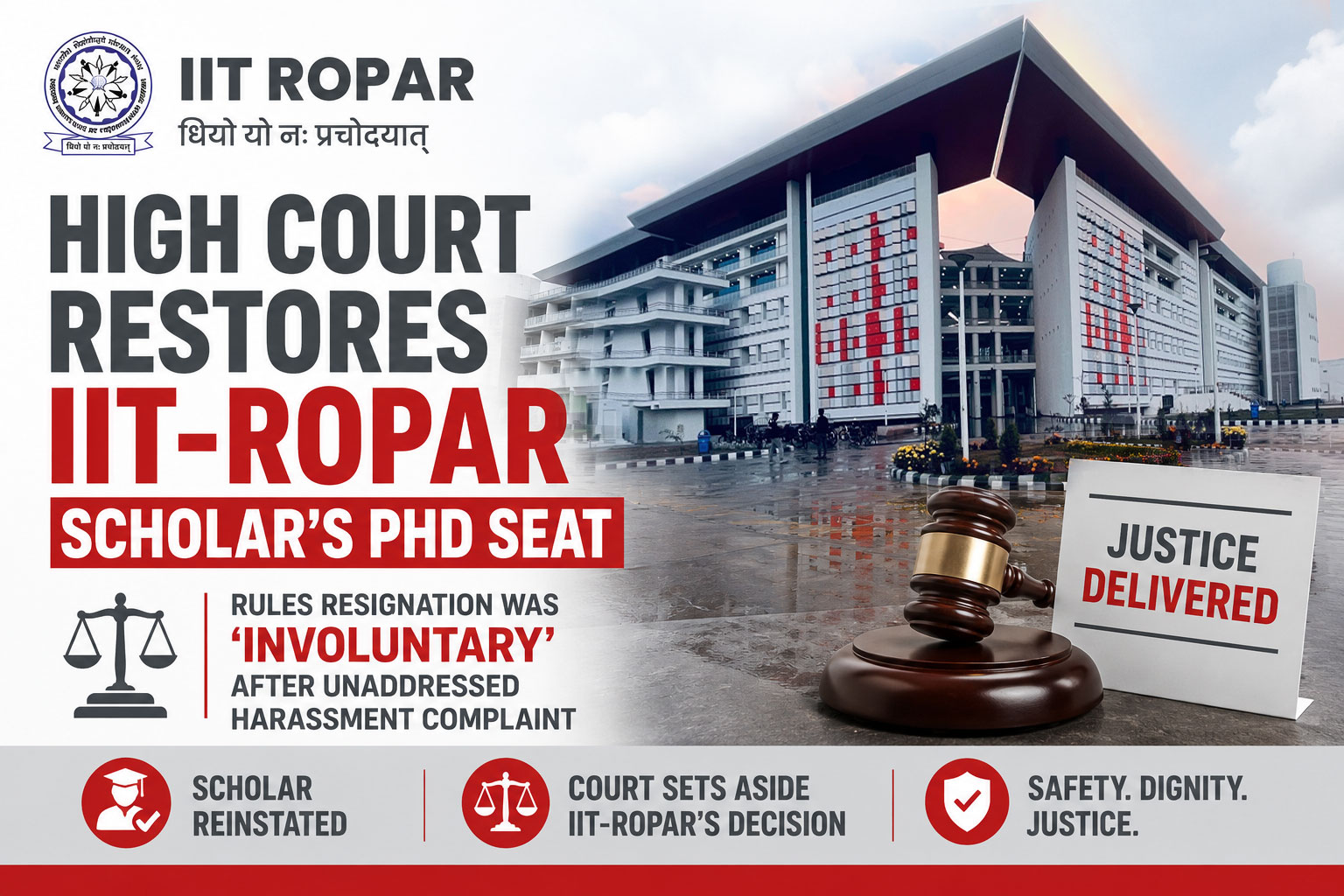
Punjab and Haryana High Court sets aside IIT‑Ropar’s acceptance of a research scholar’s resignation, directing the institute to reinstate her after finding resignation tendered under compelling circumstances.
A court reverses a same‑day resignation acceptance
The Punjab and Haryana High Court has set aside IIT‑Ropar’s decision to accept a PhD scholar’s resignation and ordered the institute to allow her to resume her doctoral programme. Justice Kuldeep Tiwari found that the resignation, submitted on November 22, 2025 and accepted the same day, could not be treated as voluntary because it followed an unaddressed harassment complaint and was accepted with “lightning speed.” The court concluded that the resignation was tendered under compelling circumstances rather than being a resignation simpliciter.
Sequence of events leading to the petition
The petitioner, a PhD scholar in Chemistry at IIT‑Ropar, alleged that harassment from faculty members began in October 2025. On November 21, 2025, she emailed a complaint to the institute’s Director seeking action against specific faculty members; the complaint stated she had “experienced multiple incidents of harassment” and alleged that the harassment had escalated to the point of being sent to PGI. When she submitted her resignation the next day, it expressly cited “continued misbehavior and misconduct” and stated she felt “compelled to resign” due to undue harassment affecting her and her elderly father.
Court records show that the institute’s internal process moved quickly: the supervisor recommended acceptance, the Head of Department endorsed it, and the competent authority approved the resignation on the same day the petitioner tendered it. The scholar then filed a writ petition challenging the acceptance as unlawful, arguing the resignation was involuntary and resulted from the institute’s failure to address her complaint.
Legal findings: resignation under compelling circumstances
Justice Tiwari examined whether the resignation amounted to a free and voluntary act. The court noted the petitioner had not received any disciplinary notice nor faced any inquiry that might justify immediate separation. Crucially, the court observed that the institute never redressed the complaint she filed on November 21 and never contended, after any inquiry, that her allegations were false. Given the absence of remedial action and the rapid acceptance of resignation, the court held the institute appeared “in a hurry to get rid of the petitioner.”
Characterising the resignation as submitted “under compelling circumstances,” the court concluded it could not be treated as a voluntary relinquishment of the scholar’s seat. Justice Tiwari therefore declared the acceptance order of November 22, 2025, null and void and issued a mandamus directing IIT‑Ropar to permit the petitioner to continue her PhD programme forthwith.
Affidavit and undertakings considered
Before the court, the petitioner filed an affidavit undertaking that, if permitted to resume studies, she would not file complaints by email or otherwise against anyone within the institute and would focus on her academic work. The court accepted this undertaking and made it a condition of reinstatement. At the same time, Justice Tiwari clarified that the institute retained the right to initiate appropriate disciplinary action if she violated the undertaking in future.
Institute’s defense and court’s response
IIT‑Ropar opposed the writ petition, arguing that the petitioner had a habit of filing complaints against faculty, guides and fellow students. The institute also highlighted subsequent developments, including the petitioner securing admission at CSIR–Indian Institute of Integrative Medicine in Jammu and emails she reportedly sent there. The court, however, rejected these subsequent events as irrelevant to the legality of the resignation’s acceptance. Justice Tiwari noted that such developments did not alter the fact that the resignation was accepted without any antecedent inquiry or opportunity for redress.
Remedial tone and directions to the institute
Beyond quashing the acceptance order, the court issued a pointed directive urging IIT‑Ropar’s Director to “sympathetically consider the circumstances” and to “try to create an atmosphere allowing the petitioner to resettle and complete her studies.” The Bench also appreciated advocate Amit Kumar Goyal, who assisted the court as free legal aid counsel on short notice.
Balancing institutional autonomy and scholar protections
The judgement underscores the judiciary’s willingness to scrutinise institutional actions where grievance mechanisms appear ineffective or where procedural fairness is absent. While higher education institutes have internal processes to manage student conduct and administration, the court emphasised that institutions must not allow procedural shortcuts to substitute for proper grievance redressal. Acceptance of a resignation immediately after a criminal or harassment complaint, without inquiry or interim measures, raised red flags that prompted judicial intervention.
Limits and conditions of reinstatement
Although the court ordered reinstatement, it tempered the relief with conditions aimed at restoring academic normalcy and preventing further conflict. The petitioner’s affidavit undertaking functions as a behavioral covenant; the institute retains the right to take disciplinary action if she breaches the undertaking. This dual approach seeks to protect the scholar’s right to pursue research while enabling the institute to manage campus discipline and order.
Wider implications for campus grievance mechanisms
The case highlights systemic issues around how institutions respond to harassment allegations and the pressure complainants may face. The court’s finding that an unaddressed complaint effectively coerced a resignation should prompt institutes to re-evaluate grievance redressal timelines and interim protections. Ensuring transparent, timely, and fair inquiry processes may prevent situations where complainants feel forced to exit academic programmes.
Conclusion: a directive to act fairly and promptly
By setting aside the resignation acceptance and directing immediate reinstatement, the Punjab and Haryana High Court sent a clear message: institutions must handle complaints with care and cannot expedite exits where grievances remain unresolved. The judgement balances the scholar’s right to continue her academic career with the institute’s authority to enforce discipline—while insisting on procedural justice and remedial engagement to enable the scholar’s resettlement and completion of her PhD.
#IITRopar #PhDReinstatement #CampusJustice #HarassmentComplaint #PunjabHaryanaHighCourt #AcademicRights #HigherEducationLaw #StudentSafety #GrievanceRedressal #LegalPrecedent
Disclaimer
The information in this article is based on available public sources and official statements as of the time of publication. While we aim for accuracy, we do not guarantee completeness or correctness. We advise readers to verify key details from official sources before making any decisions. The website (iitiimsamvaad.com) is not liable for any loss or damage arising from the use of this content. The authors are also not responsible for any such loss or damage.