

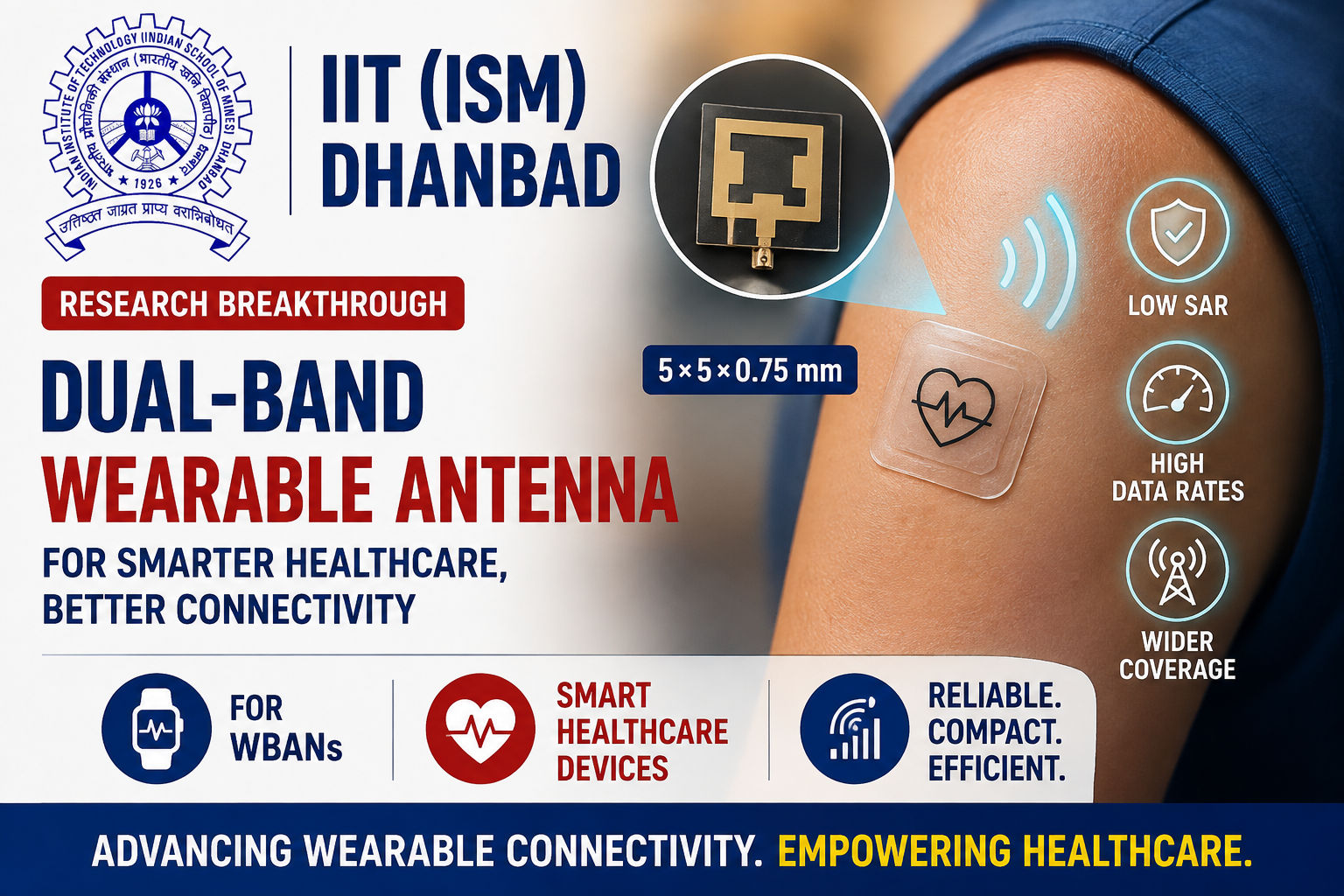
IIT (ISM) Dhanbad researchers develop a 5×5×0.75 mm dual-band wearable antenna with low SAR, high data rates and wider coverage for WBANs and smart healthcare devices.
A tiny antenna with big potential
A team of researchers at IIT (ISM) Dhanbad has developed an ultra-compact wearable antenna that can significantly improve the performance of future healthcare devices, smart wearables and wireless body communication systems. The institute said the antenna measures just 5 × 5 × 0.75 mm, yet delivers high-speed data transmission and wider wireless coverage.
The study, carried out by Prof Ravi Kumar Gangwar and research scholar Nibash Kumar Sahu of the Department of Electronics Engineering, introduces this miniature antenna designed for Wireless Body Area Networks (WBANs). The breakthrough has been reported in the prestigious IEEE Transactions on Microwave Theory and Techniques, underscoring its significance for microwave engineering and wearable communications.
Enhancing Wireless Body Area Networks
Despite its tiny size, the antenna can deliver high-speed data transmission and wider wireless coverage, making it suitable for Wireless Body Area Networks that connect wearable medical sensors, fitness trackers and other smart devices. WBANs rely on compact, efficient antennas to maintain reliable links between devices worn on or near the body.
The antenna operates in two frequency bands. One band supports reliable communication among devices worn on the body, enabling continuous monitoring and data exchange between sensors. The other band enables faster data transmission over longer distances, allowing wearables to communicate with external gateways, smartphones or cloud platforms. This dual-band operation addresses a key requirement in next-generation wearable systems, where devices must balance on-body reliability with off-body connectivity.
Safe and efficient wearable technology
The researchers also found that the antenna has a low Specific Absorption Rate (SAR), meaning it transfers only a very small amount of electromagnetic energy to the human body. SAR measures how much radio-frequency energy is absorbed by tissue when a device operates close to the body. A low SAR value is crucial for prolonged use, especially in medical and healthcare applications where devices may remain in contact with skin for extended periods.
The fabricated prototype closely matched simulation results, demonstrating the practicality of the design for real-world applications. This agreement between simulation and measurement increases confidence that the antenna can be integrated into commercial wearable products without major redesign. It also suggests that the design can scale across different substrates and form factors while maintaining performance.
Design goals and research motivation
“Wearable technologies are becoming an integral part of healthcare and everyday life. Our goal was to develop a compact antenna that offers high data rates, wider coverage and safe operation without compromising performance,” Prof Gangwar said. He added that the work addresses key challenges in next-generation wearable communication systems and could support applications ranging from remote patient monitoring to advanced wireless healthcare devices.
The researchers believe the innovation could contribute to future medical monitoring systems, smart wearable electronics and high-speed wireless communication technologies. As wearables become more sophisticated, they require antennas that can handle higher data rates, support multiple bands and operate safely in close proximity to the human body. This antenna aims to meet those requirements within an extremely small footprint.
Why size matters in wearables
In wearable devices, every millimetre counts. Space constraints limit the size of antennas, batteries, sensors and processors. A smaller antenna frees up room for other components, enables slimmer designs and improves user comfort. However, shrinking an antenna often reduces its bandwidth, efficiency or gain. The IIT Dhanbad team’s design seeks to overcome this trade-off by achieving strong performance in a 5 × 5 × 0.75 mm package.
Such compact antennas can support a wide range of applications. In healthcare, they can enable continuous monitoring of vital signs, glucose levels, cardiac activity and other parameters. They can support real-time tracking of movement, heart rate and performance metrics, in fitness and sports. In consumer electronics, they can power smartwatches, augmented-reality glasses and other connected devices that require reliable wireless links.
Implications for future wearable systems
The antenna’s dual-band operation and low SAR make it particularly suitable for WBANs that combine on-body sensor networks with off-body connectivity. On-body links can transmit data between sensors on different parts of the body, while off-body links can send aggregated data to a smartphone or cloud server. This architecture supports applications such as remote patient monitoring, elderly care, rehabilitation and chronic disease management.
The design also aligns with broader trends in wearable technology, including flexible electronics, textile antennas and body-centric communications. Future iterations could integrate the antenna with flexible substrates, stretchable circuits or smart fabrics to improve comfort and durability. Researchers may also explore multi-antenna configurations for diversity, beamforming or spatial multiplexing to further enhance reliability and data rates.
From laboratory to real-world deployment
The close match between simulation and prototype measurements suggests that the antenna can move towards real-world deployment with relatively low risk. Device manufacturers can also incorporate the design into wearables that require compact, dual-band antennas with low SAR. Regulatory bodies can evaluate the antenna’s compliance with safety standards for human exposure to electromagnetic fields.
Further work may focus on testing the antenna in diverse scenarios, such as different body positions, movement patterns and environmental conditions. Researchers may also study how the antenna performs when integrated with other components, such as batteries, displays and sensors, inside a complete wearable device. These steps will help translate the laboratory breakthrough into practical products.
Supporting India’s wearable and health-tech ecosystem
The development adds to India’s growing capabilities in wearable technology, microwave engineering and health-tech innovation. It demonstrates how academic research can address real-world constraints in size, safety and performance. As India expands its electronics manufacturing and digital health initiatives, such innovations can support domestic startups, med-tech companies and research institutions.
By publishing in a top-tier journal and demonstrating a working prototype, the IIT Dhanbad team has positioned the antenna for further development and potential technology transfer. Collaborations with industry partners could accelerate the path from research to product, enabling faster adoption in healthcare and consumer wearables.
#IITDhanbad #WearableAntenna #WBAN #HealthcareDevices #LowSAR #DualBandAntenna #MicrowaveEngineering #SmartWearables #WirelessCommunication #ElectronicsEngineering
Disclaimer
The information in this article is based on available public sources and official statements as of the time of publication. While we aim for accuracy, we do not guarantee completeness or correctness. We advise readers to verify key details from official sources before making any decisions. The website (iitiimsamvaad.com) is not liable for any loss or damage arising from the use of this content. The authors are also not responsible for any such loss or damage.