
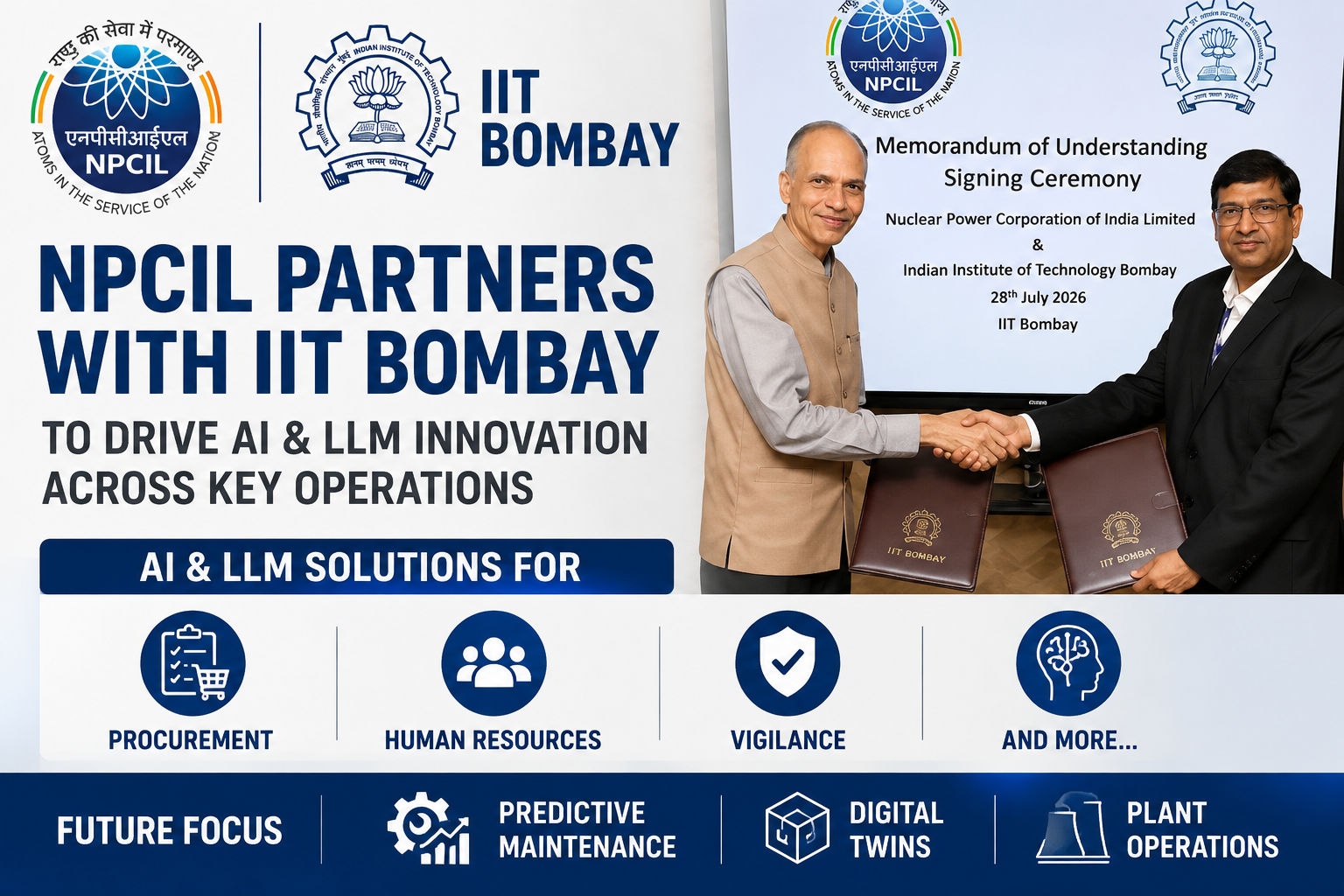
NPCIL partners with IIT Bombay to implement AI and LLM-based solutions in procurement, HR, vigilance and later in predictive maintenance, digital twins and plant operations.
A strategic push for AI in nuclear power
The Nuclear Power Corporation of India Limited (NPCIL) has signed a Memorandum of Understanding (MoU) with IIT Bombay to drive the implementation of Artificial Intelligence (AI) technologies across the organisation. The collaboration marks the beginning of a strategic partnership to accelerate the adoption of AI across NPCIL’s operations, starting with smart tools for procurement, contracts and materials management, human resources and vigilance.
The idea is simple: NPCIL wants to make its work smarter, faster and safer by using modern AI tools. In the beginning, both sides will focus on Large Language Model (LLM)-based solutions. These will be used in areas that handle a lot of paperwork and decisions every day. The goal is to reduce routine work and help people take better decisions.
Where they will start: LLM-based solutions
Under the MoU, the two organisations will initially work on developing and deploying Large Language Model-based solutions for various key functions within NPCIL. The initial focus areas include procurement, contracts and materials management (CMM), human resources and vigilance.
The adoption of LLM-based technologies is expected to help streamline processes, improve access to information and support more informed decision-making across these functions. For example, AI tools can assist in drafting and reviewing contracts, analysing procurement documents, answering HR policy queries and flagging potential vigilance concerns based on patterns in data.
By automating repetitive tasks and providing intelligent assistance, NPCIL aims to free up staff for higher-value work while improving consistency and compliance. The collaboration will be led by Prof Manjesh Kumar Hanawal and Wg Cdr Rohan Chandak (Retd.) from IIT Bombay’s Technocraft Centre for Applied Artificial Intelligence (TCA2I), with a focus on developing AI-driven solutions, undertaking collaborative research, facilitating knowledge exchange, supporting workforce upskilling and strengthening organisational capabilities for the effective adoption of AI technologies.
What comes next: advanced AI applications
Later, they plan to explore more advanced uses of AI. This includes predictive maintenance, digital twins, training simulators, AR/VR tools and other intelligent systems that can support engineering and plant operations. NPCIL and IIT Bombay have also outlined several advanced AI projects for the coming years, such as predictive maintenance of equipment, AI-based engineering solutions, digital twin technology, AI-powered training simulators, augmented reality (AR) and virtual reality (VR), and other intelligent enterprise solutions.
These technologies are expected to help improve plant operations, workforce training and maintenance planning. Predictive maintenance can use sensor data and AI models to forecast equipment failures before they occur, reducing unplanned outages. Digital twins can create virtual replicas of plants and systems to simulate scenarios, test changes and optimise performance. AR/VR tools can enhance training by allowing operators to practise procedures in realistic, risk-free environments.
Why this partnership makes sense
NPCIL brings decades of experience in running nuclear power plants. IIT Bombay brings strong research and practical knowledge in Artificial Intelligence. Together, they want to build solutions that are secure, made in India, and ready for the future. According to NPCIL’s official announcement, the collaboration will support the development of secure, indigenous, and future-ready AI solutions for different business functions.
The partnership also fits with the government’s push to make public sector companies more technology-driven and digitally capable. As India moves toward a massive expansion of nuclear capacity, AI can become a powerful force multiplier across the nuclear lifecycle, from engineering and predictive maintenance to asset health monitoring, safety analysis, knowledge management and decision support.
Alignment with digital transformation and safety
The partnership is part of NPCIL’s digital transformation strategy and will focus on advanced technologies such as Large Language Models, predictive maintenance and digital twins. By combining NPCIL’s expertise in nuclear power with IIT Bombay’s leadership in Artificial Intelligence, the partnership aims to develop secure, indigenous and future-ready AI solutions for different business functions.
Safety remains paramount in nuclear operations. AI tools will be designed to augment human decision-making, not replace it. Systems will undergo rigorous validation, and critical decisions will continue to involve qualified personnel. The collaboration will also emphasise workforce upskilling, ensuring that employees can work effectively with AI tools and understand their limitations.
Broader context of IIT Bombay–NPCIL collaboration
This MoU is one of multiple collaborations between NPCIL and IIT Bombay. On the same day, IIT Bombay’s Civil Engineering department signed another MoU with NPCIL for Deep Soil Mixing (DSM) ground-improvement trials for the twin 700 MWe PHWR units at Gorakhpur Haryana Anu Vidyut Pariyojana (GHAVP 3 & 4). That partnership focuses on first-of-its-kind DSM trials for an Indian nuclear plant, while the TCA2I MoU focuses on AI adoption across NPCIL’s nuclear operations, joint solution development and knowledge exchange.
Together, these agreements reflect a broader strategy to combine advanced civil engineering techniques with cutting-edge digital technologies to support India’s nuclear power expansion.
From day-to-day functions to complex applications
In short, this is a practical step by NPCIL to use AI where it can actually help, starting with day-to-day functions and slowly moving towards more complex applications. The first phase will focus on developing and deploying LLM-based solutions to enhance key functions, including procurement, contracts and materials management, human resources and vigilance.
As the partnership matures, NPCIL and IIT Bombay will explore advanced AI applications that can improve plant reliability, safety and efficiency. The collaboration will also explore knowledge exchange between academia and the nuclear industry, workforce upskilling for an AI-ready nuclear workforce and strengthening organisational capability for responsible AI adoption.
A model for AI adoption in critical infrastructure
The NPCIL–IIT Bombay partnership demonstrates how critical infrastructure organisations can adopt AI in a phased, responsible manner. By starting with administrative and support functions, NPCIL can build confidence, refine processes and address data governance and security concerns before moving to safety-critical applications.
As India expands its nuclear capacity and modernises existing plants, such collaborations will play a crucial role in ensuring that technology adoption supports both operational excellence and safety. The partnership also sets an example for other public sector units seeking to leverage AI for digital transformation while maintaining strict safety and security standards.
#NPCIL #IITBombay #ArtificialIntelligence #LLM #PredictiveMaintenance #DigitalTwin #NuclearPower #DigitalTransformation #TCA2I #PublicSector
Disclaimer
The information in this article is based on available public sources and official statements as of the time of publication. While we aim for accuracy, we do not guarantee completeness or correctness. We advise readers to verify key details from official sources before making any decisions. The website (iitiimsamvaad.com) is not liable for any loss or damage arising from the use of this content. The authors are also not responsible for any such loss or damage.