

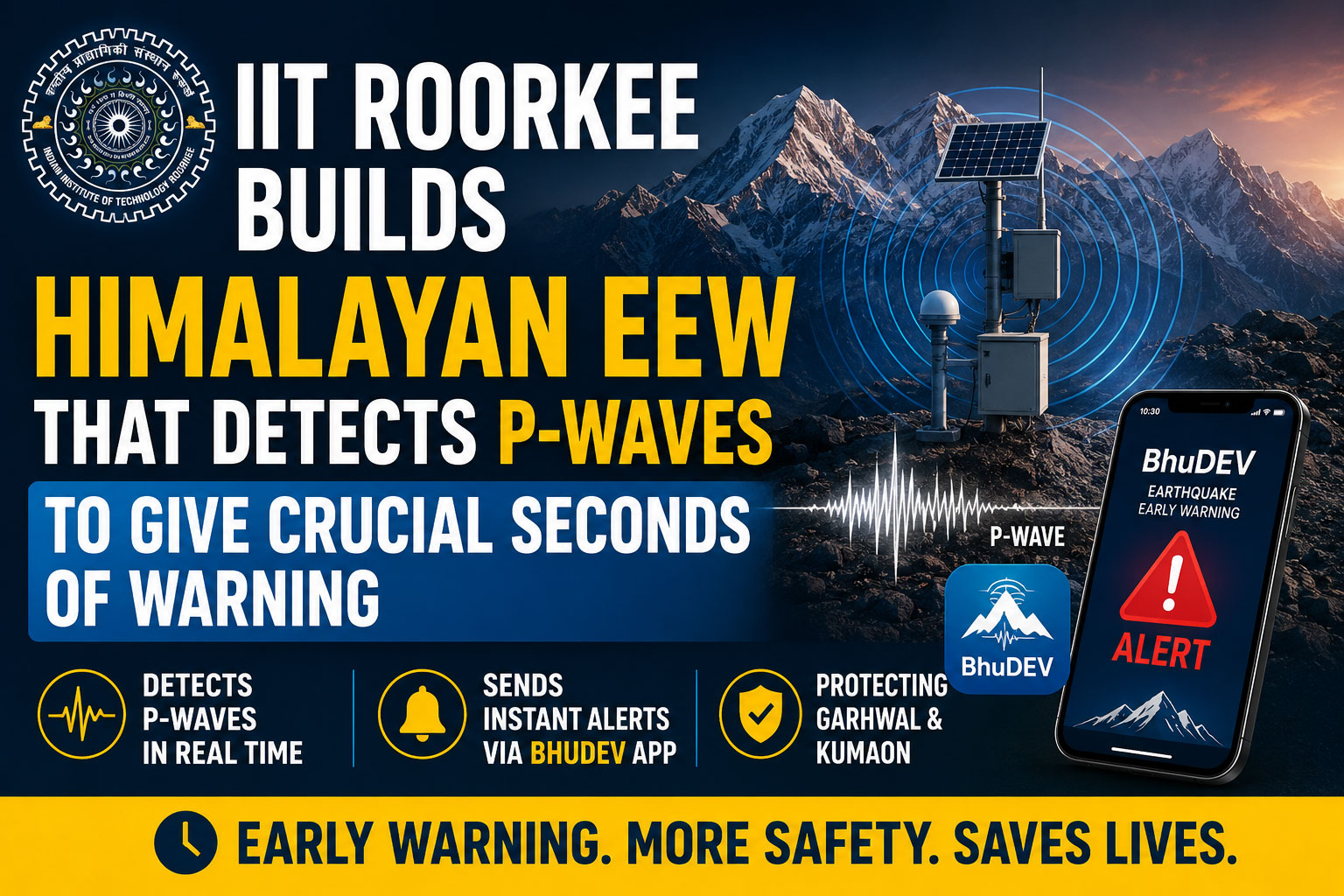
IIT Roorkee’s P‑wave based early‑warning system sends real‑time alerts via BhuDEV app, offering critical seconds for safety across Garhwal and Kumaon.
A life‑saving detection system for the Himalayas
IIT Roorkee, in collaboration with the Uttarakhand government and the National Centre for Seismology, has developed an earthquake early‑warning (EEW) system tailored for the Himalayan region. The system identifies the earliest seismic arrivals – primary or P waves – and converts those detections into real‑time alerts delivered to users through platforms such as Uttarakhand’s BhuDEV app. While the system cannot predict earthquakes, it can provide precious seconds of lead time before damaging S‑waves (strong shaking) arrive, enabling people and automated systems to take rapid protective actions.
How P‑wave detection works
Earthquakes generate different kinds of seismic waves. P waves travel fastest and usually cause only minor disturbance, while later‑arriving S waves and surface waves produce the strongest shaking. The EEW system continuously monitors ground motion across a network of sensors. When a P wave arrives, the system rapidly analyses its characteristics – amplitude, frequency content, and travel time – to estimate the likely intensity and arrival time of the subsequent stronger waves. It then issues an alert if the projected shaking exceeds predefined thresholds.
Coverage and current deployment
IIT Roorkee’s EEW currently covers Uttarakhand’s Garhwal and Kumaon regions, both of which lie in seismically active Himalayan terrain. The partners installed seismic sensors, set up low‑latency data links, and integrated the detection logic with the BhuDEV app to disseminate alerts to citizens and authorities. Planners have designed the network with expansion in mind: engineers will add more sensors and processing nodes to widen geographic coverage and improve detection speed and accuracy across more Himalayan belts.
Seconds that matter: use cases for alerts
Even a short warning – typically a few seconds to tens of seconds – can materially reduce harm. The EEW can trigger automated responses such as shutting down industrial processes, halting trains, opening elevator doors, and isolating gas or chemical lines. For individuals, alerts give time to drop, cover and hold on, move away from hazardous locations, or switch off stoves and heaters. In hospital and school settings, seconds can help staff brace patients and secure equipment. Although brief, these windows significantly lower casualties and infrastructure damage during strong shaking.
Integration with BhuDEV app and authorities
IIT Roorkee integrated the EEW backend with the BhuDEV app to ensure timely public messaging. The app receives alerts and pushes notifications to users in affected zones. At the same time, the system feeds warnings to emergency operations centres and state authorities so they can initiate preparedness protocols. Combining public alerts with institutional actions increases the chance that even small lead times translate into meaningful safety outcomes.
Challenges in Himalayan EEW
Designing EEW for the Himalayas poses unique challenges. The region’s complex geology, variable crustal structure, and sparse instrumentation in high‑altitude areas complicate rapid and accurate magnitude and location estimation. Signal noise from landslides, weather, and human activity also increases false alarms. To address these issues, IIT Roorkee engineers calibrated detection thresholds for regional seismic characteristics, designed sensor placements that balance coverage and latency, and implemented robust signal‑processing techniques to filter noise.
Plans for expansion and improvement
IIT Roorkee plans to scale the network across more Himalayan districts and refine its algorithms to reduce false positives and increase lead time. Adding more sensors – especially in strategic mountain corridors – will shrink detection blind spots and allow localised alerts with longer warnings. The team also intends to integrate machine‑learning models to better discriminate P waves from other signals and to couple the EEW with offline preparedness drills to build public trust and usability.
Collaboration and institutional support
The project reflects close collaboration between academia, state government, and national seismology agencies. The National Centre for Seismology provided regional seismic expertise and data frameworks, while the Uttarakhand government supported deployment logistics and public integration through BhuDEV. IIT Roorkee led algorithm design, system integration, and field testing. This trilateral model combines scientific rigour, operational capacity, and governance pathways to deliver a practical public safety tool.
Managing expectations: warnings vs predictions
Communicators emphasise that EEW is not a prediction system – scientists still cannot forecast the timing of earthquakes with certainty. Instead, EEW provides rapid alerts after an earthquake has started somewhere else, using physics and sensor networks to buy time. Authorities will need to educate the public about appropriate responses and the system’s limitations to avoid complacency or panic.
A step forward for Himalayan resilience
IIT Roorkee’s P‑wave based EEW marks a meaningful advance in earthquake resilience for a region with frequent seismic risk. By delivering seconds that matter via the BhuDEV app and official channels, the system helps individuals and institutions reduce exposure to sudden shaking. As the network expands, and as sensors and algorithms improve, the EEW has the potential to save lives and reduce damage across the Himalayan states – transforming a few seconds into decisive action.
#IITRoorkee #EarthquakeEarlyWarning #EEW #PwaveDetection #BhuDEV #Seismology #HimalayanSafety #DisasterPreparedness #SeismicMonitoring #PublicSafety
Disclaimer
The information in this article is based on available public sources and official statements as of the time of publication. While we aim for accuracy, we do not guarantee completeness or correctness. We advise readers to verify key details from official sources before making any decisions. The website (iitiimsamvaad.com) is not liable for any loss or damage arising from the use of this content. The authors are also not responsible for any such loss or damage.