

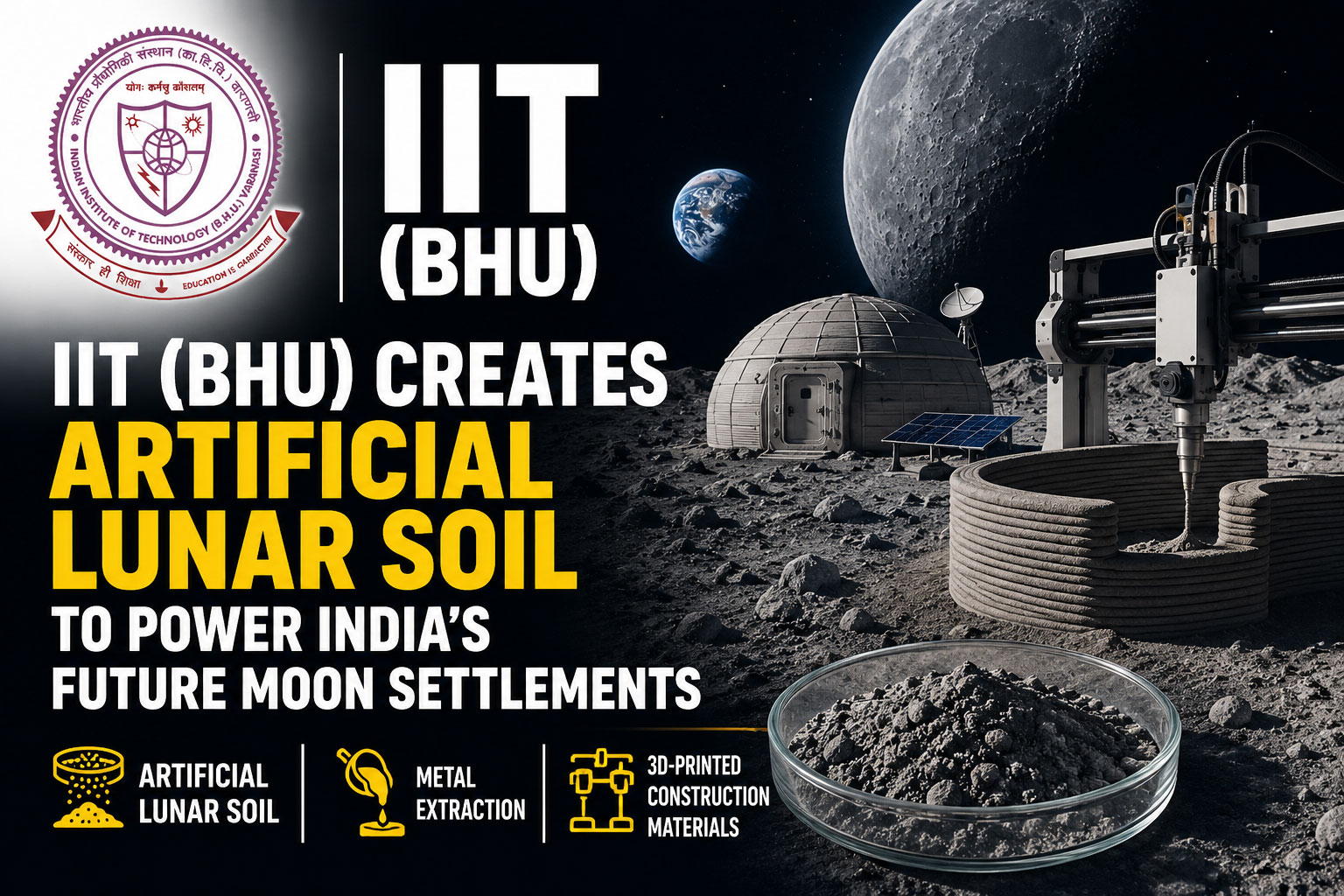
IIT (BHU) scientists have developed artificial lunar soil and begun work on metal extraction and 3D-printed construction materials, advancing technologies for long-term human presence on the Moon.
A milestone for India’s lunar ambitions
Scientists at IIT (BHU) have developed artificial lunar soil, or lunar soil simulant, marking a significant step for India’s future lunar missions and long-term human spaceflight. This achievement, coming after the success of Chandrayaan-3, strengthens national efforts to build advanced lunar technologies and eventually establish a permanent human presence on the Moon. The project directly supports the global push toward living and working in space rather than only visiting it.
Multidisciplinary team behind the breakthrough
This is a deeply multidisciplinary effort led by Professor Kamlesh Kumar Singh of the Department of Metallurgical Engineering. The core team includes Dr. Pawan Sharma (Mechanical Engineering), Dr. Udita Ghosh (Chemical Engineering), and ISRO scientist Dr. Ankush Kumar, underlining close collaboration between academia and India’s space agency. Research scholars Rachita Singh and Abhishek Singh from Metallurgical Engineering are also contributing actively, highlighting the role of young researchers in frontier space-tech work.
Linking research to self-reliant space technology
IIT (BHU) Director Professor Amit Patra has framed the work as a key step toward self-reliant and sustainable space technology. He emphasises that using local resources will be essential for building infrastructure on the Moon and sustaining a long-term human presence. In other words, India cannot rely indefinitely on launching heavy construction materials from Earth; it must learn to use lunar regolith and in-situ materials to support habitats, landing pads and operations. The institute has committed itself to cutting-edge, multidisciplinary research to help realise this national goal.
Focus on the Moon’s south polar region and ISRU
Professor Kamlesh Kumar Singh points out that Chandrayaan-3 has intensified global interest in the Moon’s south polar region, which is believed to hold water ice and other critical resources. This research builds on the concept of In-Situ Resource Utilisation (ISRU), which means using materials already present on the Moon for construction and manufacturing. ISRU also aims to reduce launch costs, minimise dependence on Earth supplies and make future missions more sustainable. IIT (BHU)’s work positions India to participate meaningfully in this paradigm shift.
How scientists created artificial lunar soil
According to the researchers, the lunar surface is covered with a thin layer called regolith, which holds important minerals and metallic compounds, including plagioclase, olivine, pyroxene, ilmenite, chromite, quartz and silica. Based on these scientific insights, the team selected specific soils, rocks and chemical elements on Earth to mimic this composition. They then processed the mixture and converted it into extremely fine, uniform particles through ball milling, creating a simulant that behaves like real lunar soil in laboratory conditions.
From simulant to 3D-printed infrastructure
Scientists are now studying the flow properties of slurry-based ink made from this artificial lunar soil. The aim is to enable 3D printing of structural elements in space – such as bricks, tiles, landing pads and other construction materials. If the slurry flows and solidifies in the right way, future robotic systems could use this technique on the Moon to print shelters and infrastructure directly from lunar regolith. This would drastically reduce mission costs and make long-term lunar bases more feasible.
Extracting metals and building materials from regolith
Beyond construction, the team has started research on extracting metals from the soil simulant and producing lunar construction materials. Regolith contains various metallic compounds that can be processed into useful metals, potentially providing structural materials, shielding or components for equipment. Developing metal extraction techniques from lunar-like regolith is therefore central to building a closed-loop resource system on the Moon, where habitats, tools and infrastructure can be made largely from local materials.
Key objectives and future applications
The project’s main objectives include: synthesising and analysing artificial lunar soil; developing metal extraction techniques from lunar soil-like regolith; exploring 3D printing possibilities using the simulant and derived materials; and creating technologies required for future lunar habitation and sustainable space missions. As India expands its lunar exploration and human spaceflight programmes, IIT (BHU) researchers believe these technologies could play a significant role in future habitation missions and deep-space ventures, from Moon bases to longer-range exploration.
Towards permanent human presence on the Moon
Taken together, IIT (BHU)’s work on artificial lunar soil, metal extraction and 3D-printed infrastructure directly supports the broader vision of establishing a permanent human presence on the Moon. By turning regolith from a dusty surface layer into a resource for construction and manufacturing, the project shifts the conversation from exploration to settlement. For India, this research also embodies a strategic move: it pushes the country closer to self-reliant, sustainable space technologies that can stand alongside global efforts in the coming era of lunar habitation.
#IITBHU #LunarSoilSimulant #ISRU #MoonHabitation #Chandrayaan3 #3DPrinting #SpaceTechnology #RegolithResearch #MetallurgicalEngineering #HumanSpaceflight
Disclaimer
The information in this article is based on available public sources and official statements as of the time of publication. While we aim for accuracy, we do not guarantee completeness or correctness. We advise readers to verify key details from official sources before making any decisions. The website (iitiimsamvaad.com) is not liable for any loss or damage arising from the use of this content. The authors are also not responsible for any such loss or damage.