

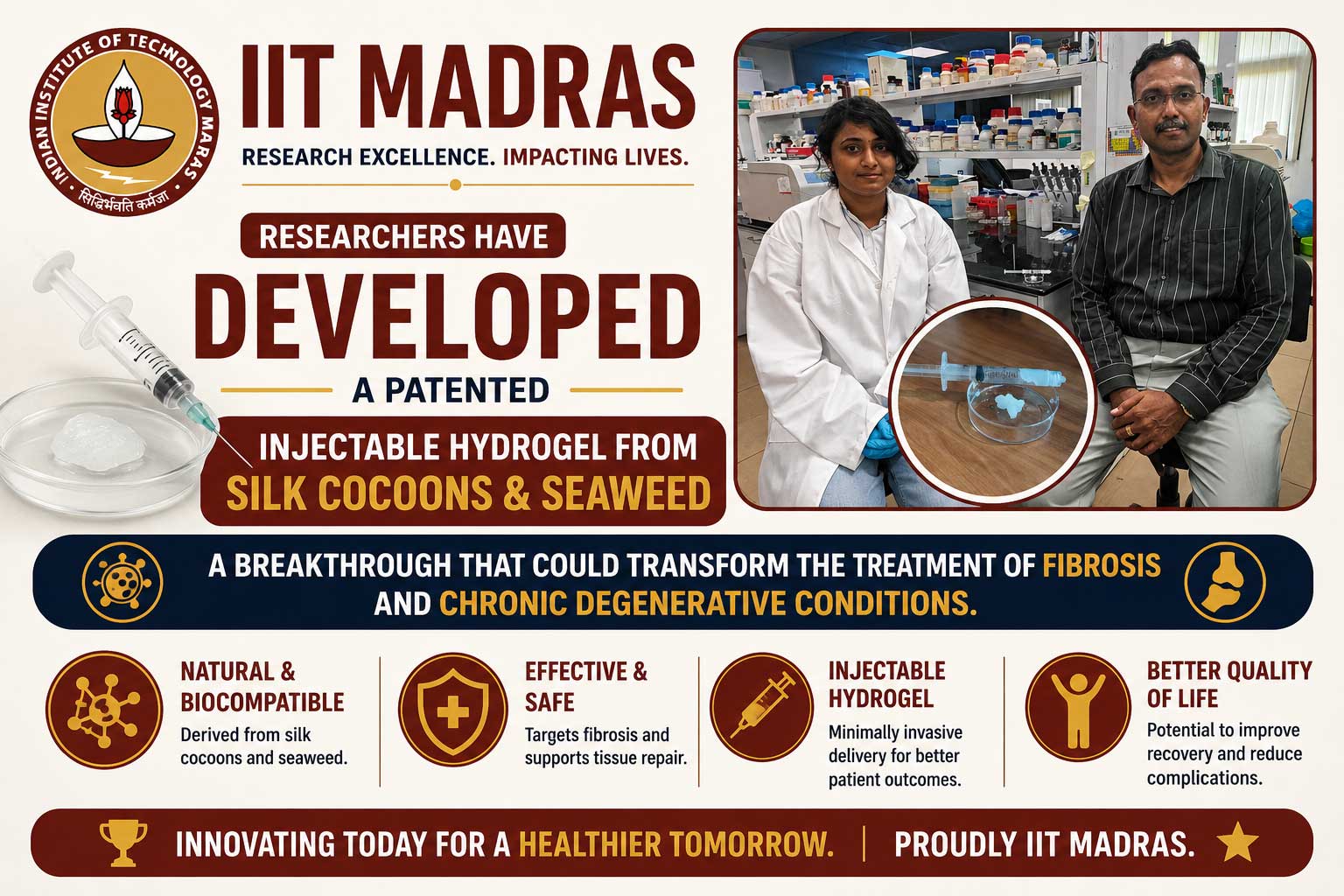
IIT Madras researchers have developed a patented injectable hydrogel from silk cocoons and seaweed that treats fibrosis at ~USD 300, cutting costs dramatically from USD 2,000–3,000.
IIT Madras Unveils Patented Injectable Hydrogel
Researchers at the Indian Institute of Technology Madras (IIT Madras) have developed a patented, injectable hydrogel made from silk cocoons and seaweed that could transform the treatment of fibrosis and chronic degenerative conditions. This biodegradable and biocompatible innovation delivers antifibrotic and anti-inflammatory drugs directly to affected sites in a sustained manner, potentially reducing therapy costs from USD 2,000–3,000 to around USD 300.
Published in ACS Applied Bio Materials and Materials Today Bio, the study was co-authored by Ms. Varshiny Gopinath and Prof. Vignesh Muthuvijayan from IIT Madras, and Prof. Mahadevan Rajasekaran from the University of California San Diego Health. The hydrogel responds to inflammation, releases doses as needed, and degrades safely within the body.
Global Burden of Fibroproliferative Diseases
Highlighting the global impact, Prof. Vignesh Muthuvijayan said, “Fibroproliferative diseases, including pulmonary, liver, kidney and muscle fibrosis, are linked to nearly 45% of deaths globally. Existing treatments often require prolonged drug administration, can cause significant side effects and are frequently unable to stop disease progression effectively at the targeted site.”
Fibrosis occurs when excessive scar tissue forms in organs, impairing their function. Current therapies often involve systemic drug delivery, which exposes the entire body to medication and increases the risk of side effects while limiting the drug concentration at the affected site.
Minimally Injectable Therapy That Converts to Gel
Explaining the mechanism, Ms. Varshiny Gopinath added, “The newly-developed platform seeks to address these limitations through a minimally invasive injectable therapy that converts from liquid to gel at body temperature, conforming precisely to the treatment site. Once administered, it can remain active locally for several days, reducing the need for repeated oral or systemic dosing.”
The hydrogel’s liquid-to-gel transition ensures it flows easily during injection and then solidifies at the target site, creating a localized drug reservoir. This sustained release maintains therapeutic drug levels over several days, improving efficacy while minimizing systemic exposure and side effects.
Smart Drug Release and Safe Degradation
The hydrogel responds to inflammation, releasing drug doses as needed and degrading safely after completing its therapeutic function. This smart, stimulus-responsive behavior ensures that medication reaches the inflamed tissue precisely when required, optimizing treatment outcomes.
The biodegradable nature of the hydrogel eliminates the need for surgical removal, as the body naturally breaks it down and eliminates the components. The use of silk cocoons and seaweed – both natural, biocompatible materials – further enhances safety and reduces the risk of adverse reactions.
Future Deployment Through Technology Transfer
Regarding future deployment, Prof. Vignesh Muthuvijayan stated, “IIT Madras is exploring pathways for real-world deployment through technology transfer, licensing to industry partners, or start-up creation. Potential applications include use during surgical procedures, where the gel can be applied directly before wound closure to provide localized therapy without additional intervention.”
The next phase of development will include advanced preclinical testing in disease models and patient-derived organoids, optimisation of dosage and release kinetics, long-term safety studies, manufacturing scale-up, and regulatory planning for translational use. These steps will prepare the hydrogel for clinical trials and eventual market approval.
Potential Beyond Fibrosis: Treating Sarcopenia
Follow-up studies also show the hydrogel’s potential in treating sarcopenia, an age-related muscle loss condition. This expands the platform’s applicability beyond fibrosis to other degenerative conditions where localized, sustained drug delivery offers significant therapeutic advantages.
By addressing multiple chronic conditions with a single, versatile platform, the IIT Madras hydrogel represents a major step forward in personalized, cost-effective medicine. The technology promises to make advanced fibrosis treatment accessible to millions of patients worldwide, particularly in resource-constrained settings where current therapies remain prohibitively expensive.
#IITMadras #InjectableHydrogel #FibrosisTreatment #SilkCocoons #SeaweedHydrogel #BiodegradableMaterial #DrugDelivery #BiomedicalInnovation #CostEffectiveHealthcare #MedTech
Disclaimer
The information in this article is based on available public sources and official statements as of the time of publication. While we aim for accuracy, we do not guarantee completeness or correctness. We advise readers to verify key details from official sources before making any decisions. The website (iitiimsamvaad.com) is not liable for any loss or damage arising from the use of this content. The authors are also not responsible for any such loss or damage.