

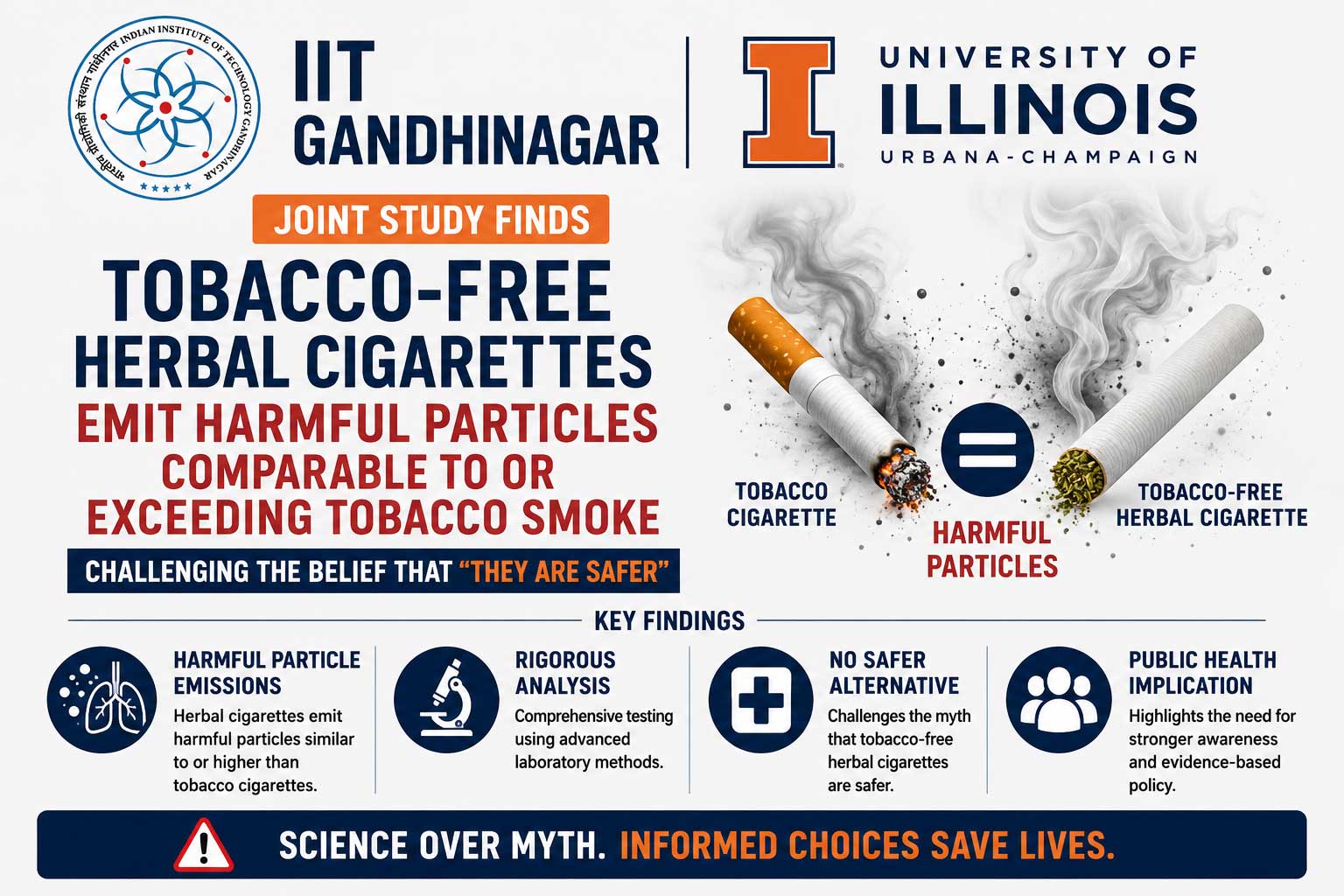
A joint IIT Gandhinagar–University of Illinois study finds tobacco-free herbal cigarettes emit harmful particles comparable to or exceeding tobacco smoke, challenging the belief that they are safer.
Herbal Cigarettes Not Safer Than Tobacco, Study Reveals
A joint study by the Indian Institute of Technology (IIT) Gandhinagar and the University of Illinois Urbana-Champaign has found that herbal cigarettes marketed as natural and tobacco-free alternatives are not safer than conventional tobacco cigarettes. These herbal variants can produce emissions that are comparable to or even exceed tobacco smoke.
The research, published in the Journal of Hazardous Materials on World No Tobacco Day 2026, challenges the widely held belief that tobacco-free means risk-free. The study compared emissions from two tobacco cigarette brands sold in India and four herbal cigarette variants containing basil, clove, cinnamon, mint, green tea, water lily, and chamomile. Two herbal variants used tendu leaves as wrappers, similar to those used in bidis.
Emissions Comparable to or Exceeding Tobacco Smoke
Prof. Sameer Patel from IIT Gandhinagar said, “Our findings challenge the widely held belief that tobacco-free means risk-free. Emissions from herbal cigarettes are comparable to or exceed those from tobacco cigarettes on nearly every metric we measured. Leaf-wrapped herbal variants turned out to be the most hazardous of all the samples tested.”
The research examined the physical, chemical, and oxidative properties of mainstream smoke generated from herbal and tobacco cigarettes available in the Indian market. Researchers used a sealed automated two-chamber rig designed to simulate human inhalation. The researchers channelled smoke emissions into real-time instruments, while they collected filter samples for physical and chemical characterisation.
Fine Particles Linked to Cardiovascular and Respiratory Diseases
The researchers found that herbal cigarette smoke emitted particles smaller than 500 nanometres at concentrations around 20 per cent higher than tobacco smoke. The study states that such particles associates with cardiovascular and respiratory diseases.
The research team also measured oxidative potential, which reflects the capacity of smoke particles to generate reactive oxygen species linked to inflammation, lung tissue remodelling, and vascular changes associated with heart disease. Herbal cigarette particulate matter recorded higher oxidative potential than tobacco cigarette particulate matter.
Tendu leaf-wrapped herbal cigarette variants recorded oxidative potential around 49 per cent higher than paper-wrapped variants.
Toxic Metals and Misleading Health Claims
Chemical analysis also found that one basil-filled herbal cigarette contained the highest lead concentration among the samples tested, despite the brand marketing it as “chemical-free with 100% natural filler for a healthy lifestyle.”
Prof. Vishal Verma from the University of Illinois Urbana-Champaign said, “That finding is important because many consumers associate nicotine-free products with reduced harm.”
The study also highlighted that several herbal cigarette brands marketed themselves with claims related to cough relief, sleep improvement, and anxiety reduction. Dr. Alok Kumar Thakur, lead author, said, “However, there is limited scientific evidence evaluating the emissions and toxicological impacts of these products.”
Dr. Thakur completed his PhD at IIT Gandhinagar under the Prime Minister Research Fellowship programme and is currently pursuing postdoctoral research at Colorado State University.
Regulatory Gaps Surrounding Herbal Cigarettes
The study highlighted regulatory gaps surrounding herbal cigarettes. India’s Cigarettes and Other Tobacco Products Act, 2003 (COTPA) regulates tobacco products through warning labels, advertising restrictions, and public smoking rules, while tobacco-free products may fall outside these provisions.
Dr. P.S. Ganesh Subramanian from the University of Illinois said, “Combustion, fine particles, soot, trace metals, and the wrapper around them all matter more than what is written on the box.”
The researchers released the findings around World No Tobacco Day on 31 May, whose theme this year is “Unmasking the appeal: countering nicotine and tobacco addiction.” The study serves as a critical warning to consumers, regulators, and public health officials about the hidden dangers of herbal cigarettes marketed as safe alternatives.
#IITGandhinagar #UniversityOfIllinois #HerbalCigarettes #TobaccoFree #WorldNoTobaccoDay #HarmfulEmissions #PublicHealth #COTPA #FineParticles #RespiratoryDisease
Disclaimer
The information in this article is based on available public sources and official statements as of the time of publication. While we aim for accuracy, we do not guarantee completeness or correctness. We advise readers to verify key details from official sources before making any decisions. The website (iitiimsamvaad.com) is not liable for any loss or damage arising from the use of this content. The authors are also not responsible for any such loss or damage.