

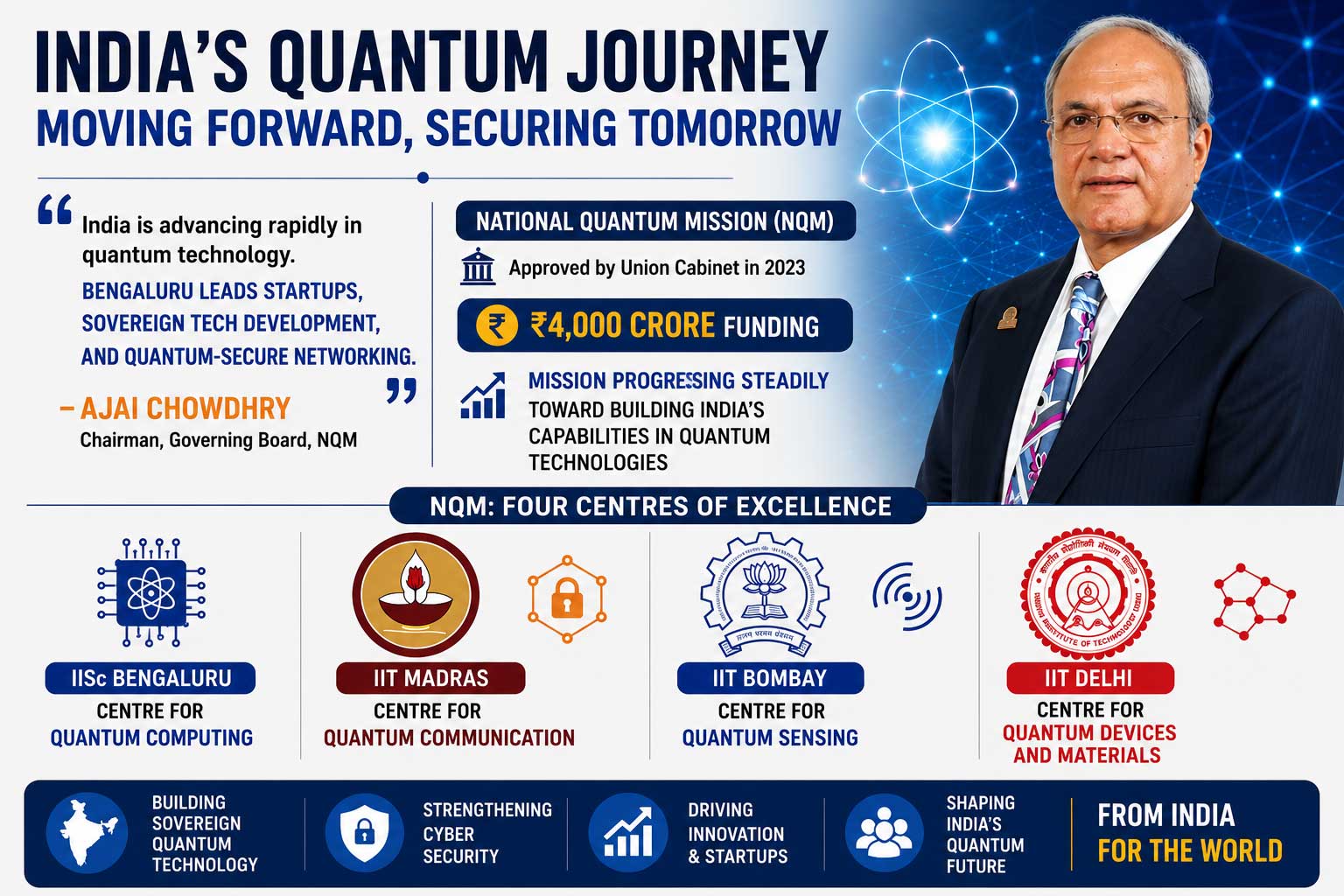
Ajai Chowdhry, Chairman of NQM’s Governing Board, says India is advancing rapidly in quantum technology, with Bengaluru leading startups, sovereign tech development, and quantum-secure networking.
National Quantum Mission Advances with Lab-to-Market Approach
The National Quantum Mission (NQM), approved by the Union Cabinet in 2023 with ₹4,000 crore in funding, is progressing steadily toward building India’s capabilities in quantum technologies. According to Ajai Chowdhry, Chairman of the Mission Governing Board, the mission follows a ‘lab to market’ concept and started in earnest in January 2024.
In addition to the central funding, ₹2,000 crore sits with four other institutions – the Department of Defence, Department of Space and Atomic Energy, Ministry of Electronics and Information Technology, and Department of Telecom – all working in parallel on quantum technologies. The mission created four hubs: IISc for quantum computing, IIT Madras for quantum communication, IIT Bombay for quantum sensing, and IIT Delhi for quantum devices and materials.
Bengaluru Leads Quantum Startups and Breakthroughs
Bengaluru, with its large concentration of research institutions, software and hardware companies, and startups, stands at the heart of India’s quantum ambitions. Most startups backed by the NQM are based in Bengaluru, including QNu, a quantum-secure networking company that tested a 500-kilometre quantum-secure network. India became the second country in the world to achieve this milestone.
Another Bengaluru-based startup, QpiAI, announced a 64-qubit chip this year and will deliver a 64-qubit quantum computer next year – the most powerful in the country. Various research institutions have now achieved Technology Readiness Level-2 and 3 in different quantum computing technologies, with one institute developing a photonics computer and another working on neutral atoms.
Quantum Security Protects Against Future Threats
Chowdhry emphasized the urgent need for quantum security. If a powerful quantum computer appears in China, it can easily break India’s cybersecurity. Financial systems, electrical grids, and defence systems must become quantum secure to prevent future threats.
Bad actors are already harvesting data to decrypt it later using future quantum computers. Chowdhry stated that quantum security must be implemented at the earliest to prevent this. The mission is also working on non-destructive chip testing technology that can analyse imported chips and detect unauthorised modifications, addressing growing concerns over hidden backdoors.
Sovereign Technology Prevents Technological Colonisation
Around 40 startups are now working in quantum technology, with the majority based in Bengaluru. The NQM invites proposals from startups and software and hardware companies to design and make components, recognizing that every part of a quantum computer matters.
Countries are increasingly protecting technologies through export controls. Chowdhry warned that India must have technology sovereignty or risk being colonised. The mission is creating components in India, building domestic alternatives to global products. Many components currently have only a single global supplier, so developing a second source in India presents a significant market opportunity.
“Quantum today is where AI was five years ago,” Chowdhry said. “If you don’t get into quantum today, you are going to miss the bus.”
Talent Development and Resource Availability
Money is not a problem, Chowdhry noted, as India’s cost of development is one-tenth of America’s cost. The country has a terrific advantage because of the quality of its people. About 1,000 scientists are currently working on quantum, but the mission needs many more.
The NQM has tied up with the All India Council for Technical Education (AICTE) and created an undergraduate programme for quantum in 100 universities, giving each ₹1 crore to set up labs. The mission recently announced an MS programme and expects to create thousands of quantum professionals in the next three to five years.
Future Breakthroughs and Karnataka’s Quantum Leadership
The mission expects to create a 2,500-kilometre quantum-safe network within the next two years, much ahead of target. It will also work on making the internet quantum secure, ensuring that data remains totally secure and non-trackable.
India’s first commercially deployable quantum computer launched at IIT Dharwad, which will aggressively create quantum networking professionals to implement quantum networking across the country. The Karnataka government, the first in the country to invest in quantum, created a Centre of Excellence for quantum at IISc two years ago and worked with NQM to develop India’s first state quantum policy.
#NationalQuantumMission #QuantumTechnology #Bengaluru #AjaiChowdhry #QNu #QpiAI #QuantumComputing #QuantumSecurity #Aatmanirbharta #QuantumStartups
Disclaimer
The information in this article is based on available public sources and official statements as of the time of publication. While we aim for accuracy, we do not guarantee completeness or correctness. We advise readers to verify key details from official sources before making any decisions. The website (iitiimsamvaad.com) is not liable for any loss or damage arising from the use of this content. The authors are also not responsible for any such loss or damage.