

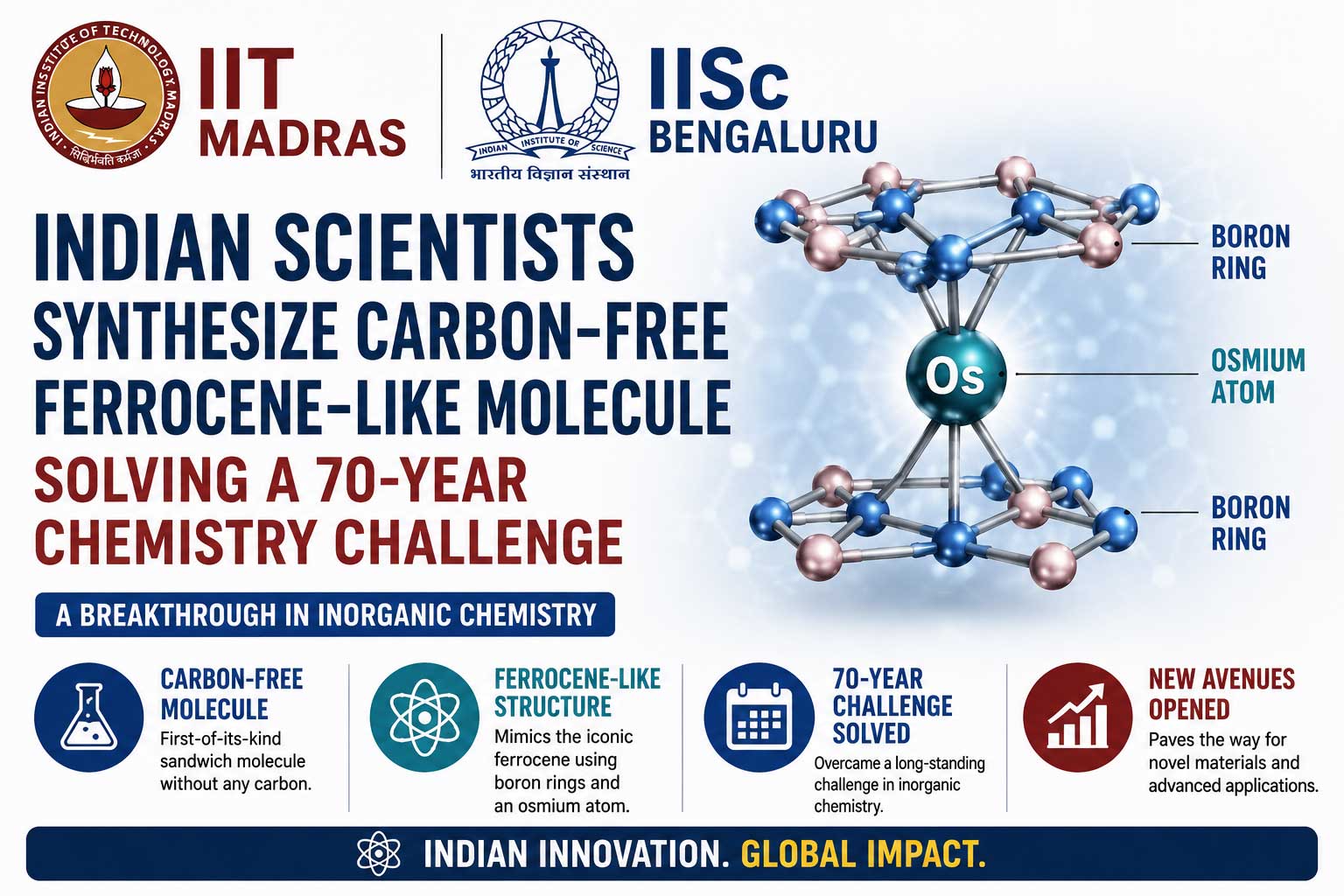
IIT Madras and IISc Bengaluru researchers solved a 70-year Ferrocene Puzzle using osmium and boron rings, by synthesizing a carbon-free molecule with a ferrocene-like sandwich structure,
Indian Scientists Achieve Major Chemistry Breakthrough
Researchers at the Indian Institute of Technology (IIT) Madras and the Indian Institute of Science (IISc), Bengaluru, have achieved a major chemistry breakthrough by synthesizing a new carbon-free molecule that copies the unusual ‘sandwich’ structure of the famous carbon-containing ferrocene molecule. This discovery solves a problem that has challenged scientists for over seven decades.
Scientists around the world tried different combinations, but a truly carbon-free molecule with similar structure and stability could not be synthesized until now. The research team, led by Sundargopal Ghosh and Stutee Mohapatra at IIT Madras in collaboration with Eluvathingal Jemmis of IISc Bengaluru, has opened new doors in molecular chemistry.
Ferrocene’s Unique Sandwich Structure Fascinates Scientists
Scientists discovered Ferrocene in the early 1950s, and modern technologies widely use this compound in medicines, batteries, advanced materials, and electronics. Its unique structure – an iron atom ‘sandwiched’ between two large and flat carbon ringed-molecules – has attracted significant scientific interest for decades.
For decades, scientists tried to create similarly structured molecules with elements other than carbon but could not succeed. Carbon has a special place in chemistry, with an entire branch – organic chemistry – dedicated to the study of carbon and its compounds. Carbon efficiently combines with itself and other elements to form very stable, large, and complex molecules.
Scientists wondered whether ferrocene’s special structure resulted only from carbon rings or whether other elements could form similar sandwiched structures between themselves.
Carbon-Free Molecule with Osmium and Boron Rings
The Indian research team designed a new molecule with osmium at the centre instead of iron, sandwiched between two boron-based rings instead of carbon rings. The structure closely resembles ferrocene but remains entirely carbon-free.
The discovery appeared in Science journal, one of the world’s most prestigious scientific publications. Initial investigations revealed that the new molecule is structurally stable, and the bonding between osmium and boron rings is very strong, potentially making it more robust than ferrocene.
Sundargopal Ghosh said, “It is a fundamental breakthrough of great interest. It answers a question that scientists had been interested in for very long. It does open new possibilities for designing novel materials that can have special properties. Those possibilities are still being explored.”
Academic Breakthrough with Potential Future Applications
Right now, scientists see the discovery mainly as an academic breakthrough. Scientists are still investigating its potential applications. The synthesis demonstrates that elements other than carbon can form stable sandwich structures, challenging long-held assumptions about molecular design.
This achievement proves that boron-based rings can replace carbon rings while maintaining structural integrity and stability. The strong osmium-boron bonding suggests the molecule could withstand harsher conditions than ferrocene, opening possibilities for applications in extreme environments.
The breakthrough answers a fundamental question in chemistry that scientists have pursued for 70 years: whether ferrocene’s structure depends exclusively on carbon or if other elements can replicate it.
New Possibilities for Material Design
The discovery opens new possibilities for designing novel materials with special properties. Researchers can now explore boron-based sandwich molecules for applications in catalysis, energy storage, electronics, and advanced materials. The ability to create carbon-free analogues of well-known molecules expands the toolkit available to chemists and materials scientists.
As investigations continue, scientists will explore the molecule’s reactivity, electronic properties, and potential uses in industrial processes. The breakthrough demonstrates India’s growing strength in fundamental research and its ability to solve long-standing scientific challenges that have puzzled the global community for decades.
#IITMadras #IIScBengaluru #ChemistryBreakthrough #Ferrocene #CarbonFreeMolecule #Osmium #BoronRings #ScienceJournal #IndianResearchers #MolecularChemistry
Disclaimer
The information in this article is based on available public sources and official statements as of the time of publication. While we aim for accuracy, we do not guarantee completeness or correctness. We advise readers to verify key details from official sources before making any decisions. The website (iitiimsamvaad.com) is not liable for any loss or damage arising from the use of this content. The authors are also not responsible for any such loss or damage.