

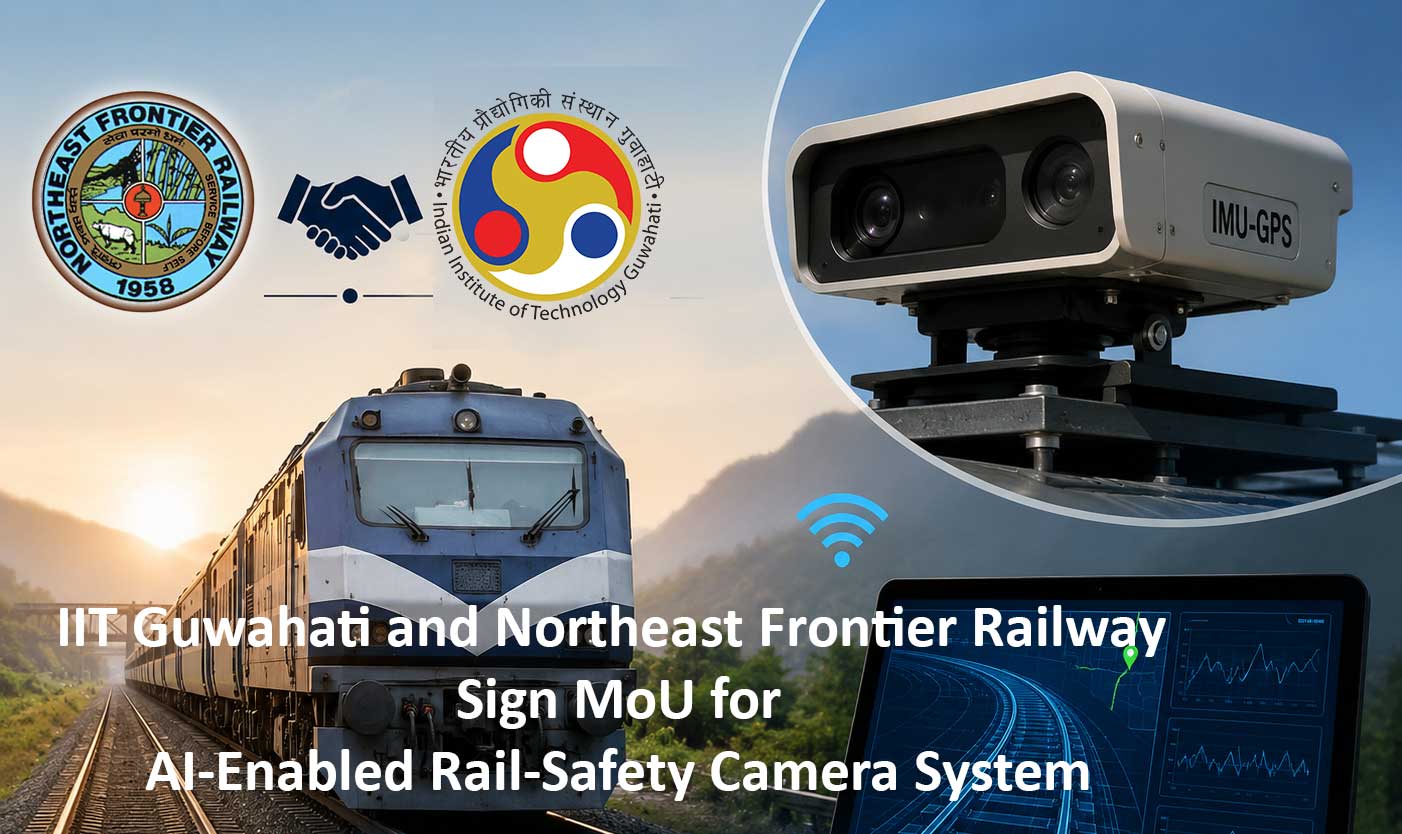
Northeast Frontier Railway has signed an MoU with IIT Guwahati to deploy an advanced IMU‑GPS camera system for real‑time track monitoring and enhanced passenger safety.
Northeast Frontier Railway and IIT Guwahati join forces
The Northeast Frontier Railway (NFR) has signed a Memorandum of Understanding (MoU) with the Indian Institute of Technology Guwahati (IIT Guwahati) to enhance rail safety by deploying an advanced camera‑based monitoring system on its network. The initiative will introduce a plug‑and‑play onboard camera system that uses vibration sensors and GPS technology to continuously monitor track conditions and detect potential safety hazards in real time.
The collaboration aims to strengthen operational efficiency, service reliability, and passenger safety across NFR’s routes, which cover a complex terrain of hills, river valleys, and long‑span bridges. By integrating research‑driven innovation from IIT Guwahati with rail‑operations expertise from NFR, the project supports the broader vision of data‑driven, technology‑enabled infrastructure management in Indian Railways.
How the camera system works
The new system combines an Inertial Measurement Unit (IMU) sensor with GPS technology to capture precise information on track vibration, alignment, and irregularities as trains move along the line. The IMU‑GPS event camera system mounts directly on locomotives and coaches in a plug‑and‑play configuration, requiring minimal retrofitting or structural changes.
As the train runs, onboard sensors continuously record vibration patterns and positional data, while event‑based cameras trigger recording when the system detects anomalies such as track misalignment, uneven surfaces, or damaged components. The combination of real‑time image capture and sensor readings enables continuous mapping of track defects across the network and generates instant alerts for maintenance teams.
Real‑time detection and predictive maintenance
The camera system detects and analyses track abnormalities in real time, including loosened rails, poor ballast conditions, and geometric irregularities that can compromise safety. Instead of relying solely on periodic manual inspections, NFR can now leverage the system for predictive and condition‑based maintenance, identifying issues before they escalate into failures.
By shifting from reactive fault‑reporting to proactive defect‑mapping, the technology reduces dependence on visual checks and ground patrols, which can miss subtle problems or be constrained by terrain and weather. The system also improves the frequency and coverage of monitoring, especially in remote and high‑risk sections of the Northeast Frontier Railway network.
Enhancing safety, efficiency, and data‑driven operations
The collaboration with IIT Guwahati aims to develop a scalable and cost‑effective solution that can be deployed fleet‑wide without disrupting regular operations. The IMU‑GPS event‑camera system is expected to:
- Minimise the risk of derailments and track‑related accidents
- Shorten response times to critical defects
- Extend the life of track infrastructure through targeted maintenance
The initiative will also generate a rich dataset of track‑condition information, which can be fed into rail‑management information systems to support decision‑making on maintenance schedules, asset replacement, and route‑planning. In the longer term, this data can support the development of AI‑driven analytics models to forecast track‑degradation patterns and optimise maintenance strategies.
A strategic step toward safer rail travel
For the Northeast Frontier Railway, the partnership with IIT Guwahati represents a strategic investment in technology‑enabled safety and modernisation. The new camera system aligns with Indian Railways’ broader push toward digitalisation, automation, and safer operations, particularly in geographically challenging regions.
The initiative also strengthens the role of technical institutions like IIT Guwahati in shaping real‑world infrastructure solutions. By translating cutting‑edge research in sensor technology, imaging systems, and data analytics into practical rail‑safety tools, the collaboration sets a model for future industry‑academia partnerships in the transportation sector.
Through this MoU‑driven project, Northeast Frontier Railway is moving closer to a future where rail travel is not only faster and more reliable but also safer and more resilient, thanks to continuous, intelligence‑driven monitoring of the tracks that keep India connected.
Disclaimer
The information in this article is based on available public sources and official statements as of the time of publication. While we aim for accuracy, we do not guarantee completeness or correctness. We advise readers to verify key details from official sources before making any decisions. The website (iitiimsamvaad.com) is not liable for any loss or damage arising from the use of this content. The authors are also not responsible for any such loss or damage.