
The Delhi government teams up with IIT Kanpur’s AIRAWAT Research Foundation to deploy AI‑powered tools for real‑time, hyper‑local air‑quality analysis and decision‑making.
Delhi signs AI‑focused air‑quality pact with IIT Kanpur
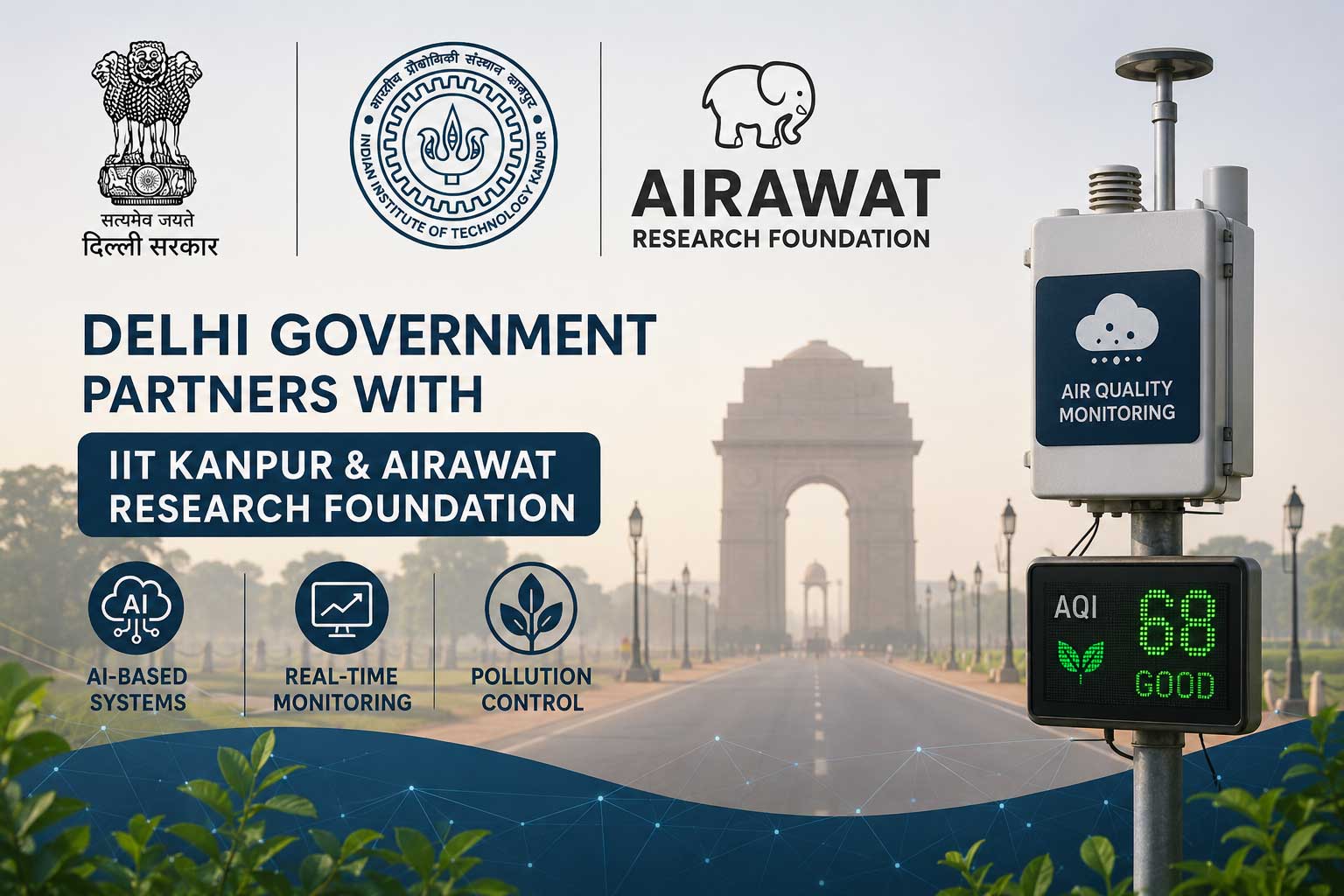
The Delhi government has announced a collaboration with IIT Kanpur’s AIRAWAT Research Foundation to deploy AI‑powered technologies for improved air‑quality monitoring, analysis, and management. The partnership aims to address Delhi’s persistent air‑pollution crisis through advanced, technology‑backed solutions that provide transparency, granular data, and actionable insights.
This initiative adopts a knowledge-based collaboration model that emphasises capacity building and scientific inputs, rather than immediate financial commitments, unlike conventional technology-procurement contracts. The move positions Delhi as one of the first Indian cities to systematically integrate artificial intelligence into its air‑quality governance framework.
AI systems for real‑time monitoring and prediction
Under the partnership, IIT Kanpur’s AIRAWAT Research Foundation will help design and deploy AI‑driven systems that capture and process real‑time air‑quality data from across the national capital. The focus is on generating hyper‑local measurements at the neighbourhood and ward level, going beyond broad city‑wide averages.
The AI‑enabled platform will also provide predictive analytics, forecasting pollution spikes based on factors such as weather patterns, traffic density, industrial activity, and seasonal changes like crop‑residue burning and dust storms. These forecasts will support proactive interventions, such as adjusting industrial operations, enhancing dust‑control measures, and guiding public‑health advisories before pollution levels reach critical thresholds.
Decision‑support tools for evidence‑based governance
A key objective of the initiative is to build decision‑support tools for Delhi’s environment and disaster‑management authorities. The AI‑driven systems will integrate raw sensor data with historical pollution records, satellite imagery, and meteorological inputs to create dashboards and visualisation tools for policymakers and field agencies.
These tools will help officials identify high‑risk zones, track the effectiveness of existing measures such as odd‑even schemes and emission‑control norms, and simulate pollution‑reduction scenarios before committing to large‑scale regulatory changes. By relying on data‑driven insights and scientific analysis, the government aims to strengthen evidence‑based governance in environmental management.
Environment minister outlines long‑term goals
Delhi’s Environment Minister, Manjinder Singh Sirsa, highlighted the initiative’s potential to transform how air pollution is monitored, analysed, and managed in the national capital. He said the goal is to move beyond reactive, ad‑hoc responses – such as emergency measures during winter smog – to a proactive, technology‑enabled approach.
“AI‑driven systems can offer hyper‑local air‑quality data, predictive analytics, and decision‑support tools that are essential for formulating effective, targeted policies,” he stated. “The collaboration is also intended to build local institutional capacity, so that Delhi can sustain and expand this technological backbone on its own in the future.”
A knowledge‑centred, non‑financial collaboration
Officials from both the Delhi government and IIT Kanpur emphasised that the partnership is primarily a knowledge‑centred effort, designed to enhance Delhi’s technical and institutional capabilities without imposing major upfront financial obligations. The AIRAWAT team will contribute research expertise, AI models, and sensor‑integration know‑how, while the Delhi government will provide access to monitoring networks, policy frameworks, and implementation channels.
By focusing on long‑term learning and institutional strengthening, the initiative aims to create a sustainable air‑quality ecosystem that can be scaled to other Indian cities facing similar challenges. The partnership also opens the door to joint research projects, training programmes, and public‑awareness campaigns that connect scientific findings with community action.
Improving public health and urban livability
The long‑term vision of the Delhi–IIT Kanpur collaboration is to improve public health and urban livability by making air‑quality information more precise, accessible, and actionable. When residents receive hyper‑local alerts and can see the impact of policy‑driven interventions on PM2.5 and PM10 levels, they are more likely to adjust behaviour – such as reducing outdoor activity during peak pollution hours or using cleaner transport modes.
By embedding AI and advanced analytics into the core of its environmental governance, Delhi aims to turn air‑quality management from a crisis‑driven activity into a continuous, intelligence‑driven process – one that aligns with India’s broader goals of sustainable urban development and climate resilience.
Disclaimer
The information in this article is based on available public sources and official statements as of the time of publication. While we aim for accuracy, we do not guarantee completeness or correctness. We advise readers to verify key details from official sources before making any decisions. The website (iitiimsamvaad.com) is not liable for any loss or damage arising from the use of this content. The authors are also not responsible for any such loss or damage.