

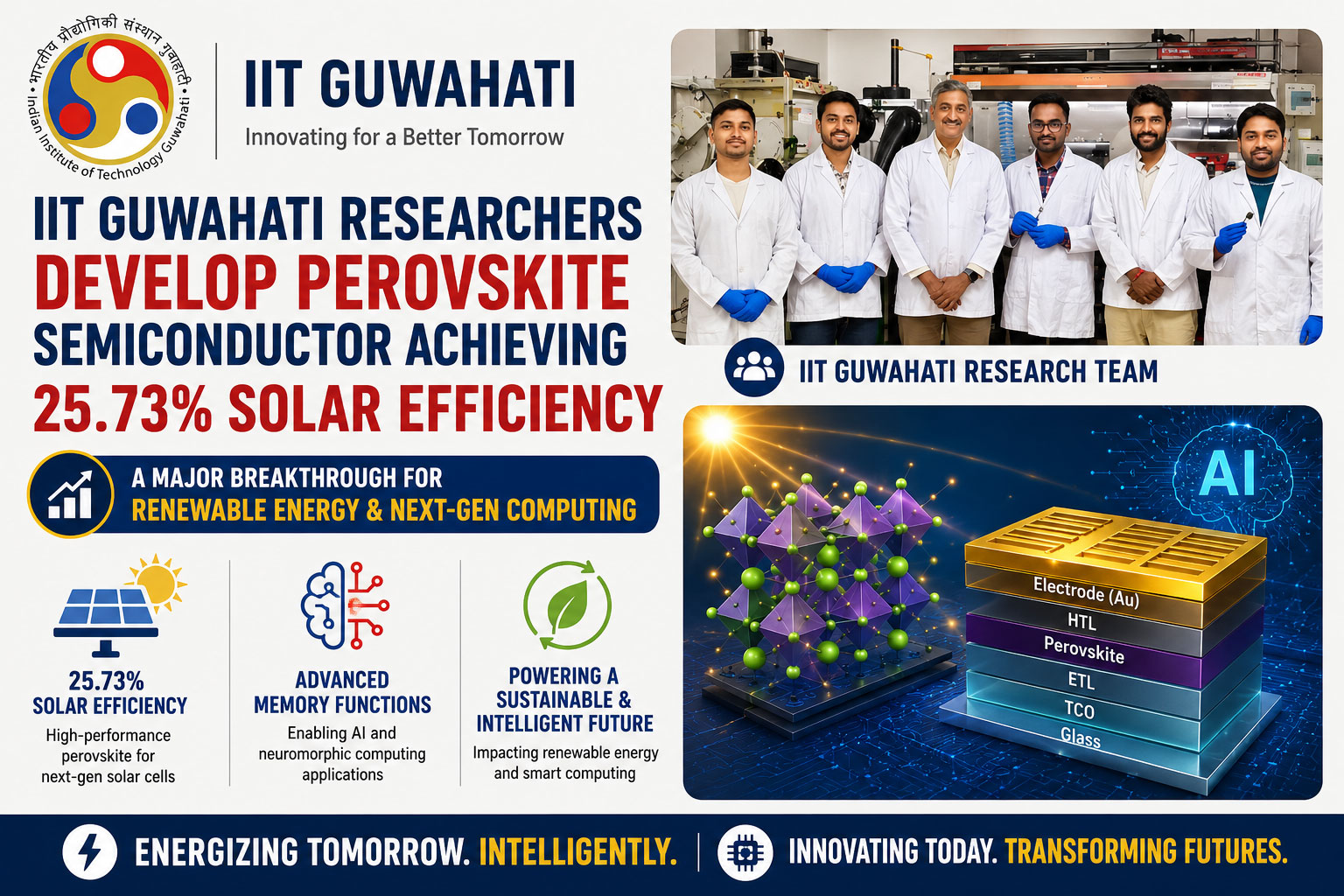
IIT Guwahati researchers developed a perovskite semiconductor achieving 25.73% solar efficiency and advanced memory functions for AI and neuromorphic computing applications.
IIT Guwahati Achieves Breakthrough in Perovskite Semiconductor Technology
Researchers at the Indian Institute of Technology (IIT) Guwahati have developed an innovative semiconductor platform based on hybrid perovskite materials capable of delivering high-efficiency solar energy conversion and advanced memory functions required for neuromorphic computing applications. This significant breakthrough could advance both renewable energy and next-generation computing technologies.
The research, led by Parameswar K Iyer, a professor in the Department of Chemistry and Centre for Nanotechnology at IIT Guwahati, addressed critical challenges that have hindered the commercialisation of perovskite-based technologies despite their immense potential in photovoltaics and memory devices. The team successfully overcame technical limitations that previously prevented widespread adoption of perovskite technologies.
Perovskites Offer Promise Beyond Silicon Solar Cells
Perovskites, a class of semiconductor materials characterised by their unique crystal structure, have emerged as one of the most promising alternatives to conventional silicon for solar energy applications. Their exceptional ability to absorb sunlight and efficiently separate electrical charges has enabled rapid improvements in solar cell performance over the past decade.
Besides, their defect-tolerant electronic properties and ion migration behaviour also make them attractive candidates for resistive-switching memory devices, commonly known as memristors or resistive random-access memory (R-RAM). However, despite the potential, perovskite technologies struggle with several technical limitations that researchers must overcome.
Molecular Interface Engineering Solves Critical Challenges
In solar cells, losses occur at material interfaces due to surface defects, chemical reactions and energy-level mismatches that often trap charge carriers and lead to recombination, reducing efficiency. In memory applications, uncontrolled ion migration and defect-assisted conduction mechanisms often result in inconsistent switching behaviour, poor endurance and reduced data retention.
To overcome these barriers, Iyer’s team developed a novel molecular interface engineering strategy using two specially designed donor-acceptor organic molecules. These highly luminescent organic compounds are deposited as ultrathin interfacial layers measuring just 10-15 nanometres, around a hundred thousand times thinner than a human hair, between the charge transport layer and the perovskite absorber layer in solar cell devices. These engineered molecules act as interfacial regulators, controlling charge transport and suppressing defect formation.
Solar Cells Achieve Record 25.73% Efficiency
The molecules significantly improve both device efficiency and stability by reducing charge trapping and facilitating smoother movement of photogenerated carriers across the interface. Iyer stated, “The results have been remarkable. Solar cells incorporating the new interfacial engineering approach achieved a power conversion efficiency of 25.73 per cent, which is nearly one-quarter of the sunlight incident on the device converted directly into electricity. Such efficiency levels place the technology among the best-performing perovskite solar cells reported globally.”
The devices also retain nearly 90 per cent of their original performance after prolonged storage under ambient conditions. Even under continuous thermal and illumination stress, they maintain around 75 per cent of their initial efficiency, demonstrating substantial resistance to environmental degradation.
Same Material Enables Advanced Neuromorphic Memory Devices
Beyond solar energy applications, the IIT Guwahati researchers also demonstrated that the same formamidinium (FA)-based perovskite material could be employed in advanced memory devices. Using a 220-nanometre-thick active layer, the team fabricated memristor devices exhibiting stable low-power resistive switching, reliable endurance characteristics and multistate memory behaviour.
Ramkrishna Das Adhikari, one of the researchers, explained, “These characteristics are particularly important for neuromorphic computing, an emerging computing paradigm designed to mimic the way biological brains process information through interconnected networks resembling neurons and synapses. Neuromorphic systems are widely viewed as a key technology for future hardware because of their ability to perform complex computations while consuming far less energy than conventional processors.”
Multilevel Memory Enables Edge Computing and Secure Cryptography
The research also led to new insights into the fundamental switching mechanisms within perovskite memristors. The team identified the critical roles played by defect states and ion migration in governing device performance, contributing to a deeper understanding of how such memory systems function.
The devices demonstrated multilevel memory states, enabling them to store more information than traditional binary memory systems. This feature could be highly beneficial for edge computing platforms and next-generation non-volatile memory architectures. The stochastic formation of conductive filaments within the devices also enables true random number generation, offering promising opportunities for secure computing, cryptographic systems and next-generation intelligent electronic technologies.
Iyer concluded, “Our research demonstrates the potential of perovskite-based semiconductor technologies for next-generation solar cells and memory devices. Such advances could accelerate the large-scale commercialisation of integrated optoelectronic systems combining energy harvesting, information storage and intelligent computing within a single technological framework.”
The team has already pushed solar cell efficiency beyond 26 per cent in subsequent experiments and is now focusing on enhancing long-term performance under real-world operating conditions. Researchers are collaborating with industry partners to develop scalable manufacturing processes for large-area and flexible perovskite devices and have filed multiple patents covering both perovskite solar cell technologies and memory devices.
#IITGuwahati #Perovskite #SolarCell #NeuromorphicComputing #Semiconductor #AI #Memristor #RenewableEnergy #Nanotechnology #CleanEnergy
Disclaimer
The information in this article is based on available public sources and official statements as of the time of publication. While we aim for accuracy, we do not guarantee completeness or correctness. We advise readers to verify key details from official sources before making any decisions. The website (iitiimsamvaad.com) is not liable for any loss or damage arising from the use of this content. The authors are also not responsible for any such loss or damage.