
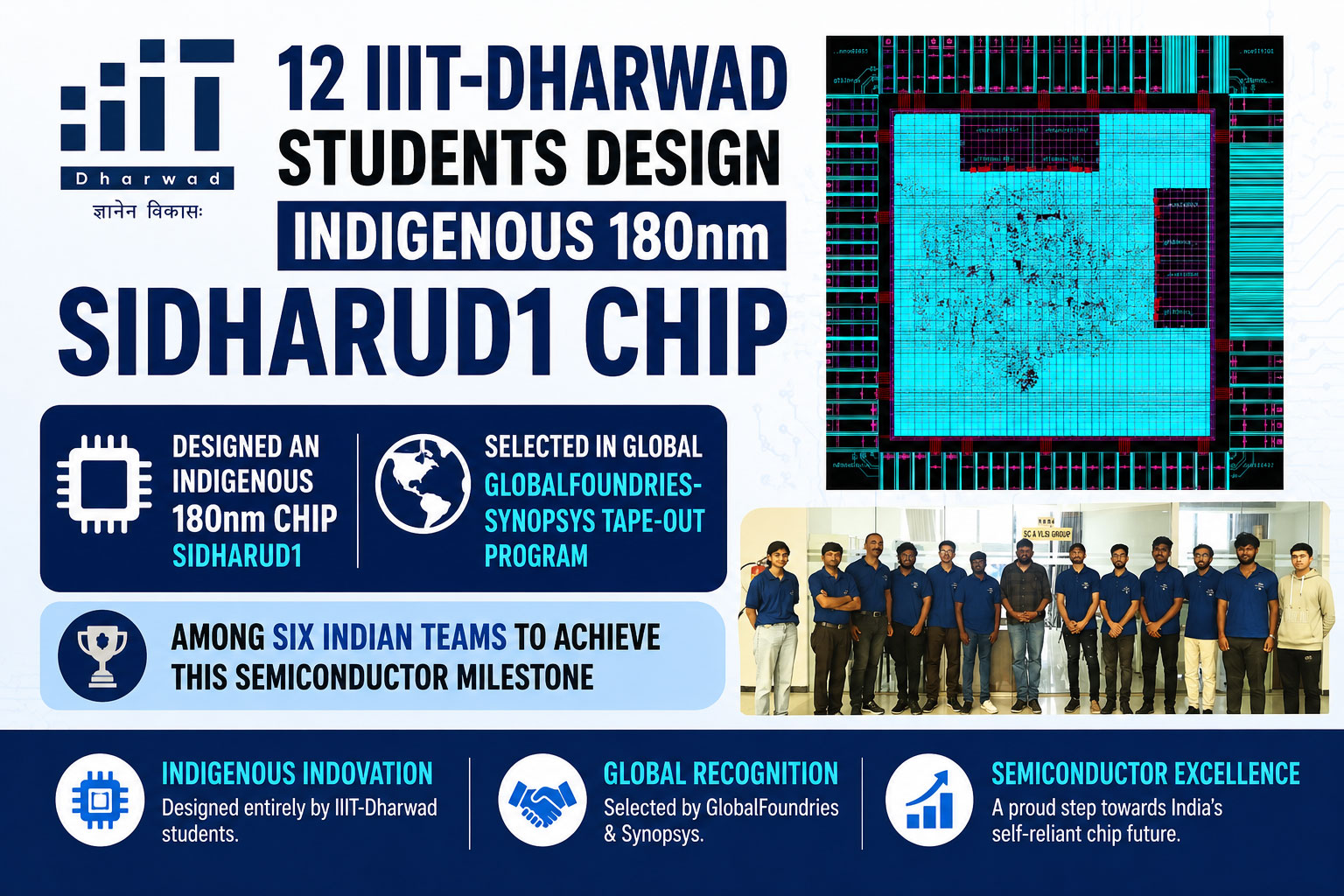
12 IIIT-Dharwad students designed indigenous 180nm SIDHARUD1 chip, selected in global GlobalFoundries-Synopsys tape-out program among six Indian teams achieving this semiconductor milestone.
IIIT Students Design Custom Indigenous Silicon Chip
A team of 12 final and pre-final year engineering students from the Indian Institute of Information Technology (IIIT) has successfully designed a custom 180nm silicon chip in a major push for indigenous technological innovation. The program selected the chip, named ‘SIDHARUD1’, as part of a prestigious global chip tape out program, making the institution one of the few select cohorts globally to achieve this milestone.
The project executed under a highly competitive global joint collaboration organized by GlobalFoundries, a semiconductor manufacturing giant based in Germany, and Synopsys, a leading electronic design automation (EDA) software vendor. Out of 55 teams qualified worldwide, the IIIT student team secured a spot as one of only six teams selected from India.
Chip Solves Critical Hardware Pin Limitation
The chip addresses a common hardware limitation in modern computing. Standard microprocessors and microcontrollers on a computer board run critical software but are restricted by a fixed number of physical pins (often limited to 40 pins), making it incredibly difficult to connect additional devices or sensors as system demands grow. The newly developed ‘SIDHARUD1’ chip acts as a GPIO (General Purpose Input Output) expander.
Utilizing the open source I2C communication protocol, the chip requires just two physical wires to connect alongside a host microprocessor, instantly expanding its capacity to manage an additional 25 peripheral devices (comprising 16 inputs and 9 outputs). Furthermore, the architecture is scalable; combining four of these chips can scale a system’s capacity to handle up to 100 inputs seamlessly.
Programmable Chip Performs Localized Data Pre-Processing
Beyond expanding connectivity, the chip features programmable capabilities and can perform localized data pre-processing, such as filtering out data noise, before information even reaches the main processor. Researchers developed the entire architecture using a RISC-V open-source processor core, eliminating dependencies on expensive, proprietary paid Intellectual Property (IP).
Dr. Jagadish D.N., Assistant Professor and the lead project coordinator, said that the accomplishment highlights the design capabilities of the students. “The complete design was driven by our students. Rather than relying on restrictive, paid commercial IPs, they utilized open-source frameworks—reminiscent of premier national initiatives like IIT Madras’ ‘Shakti’ processor. They wrote custom code, ran exhaustive simulations, and successfully finalized the layout for production.”
Intensive Project Spans Five Months to Tape-Out
The intensive project spanned from May to September, at which point the final design was frozen and submitted for “tape-out” (the final logic design phase before manufacturing). The chip is currently undergoing physical fabrication at GlobalFoundries’ facility in Germany and is expected to arrive at the campus fully packaged within a month for hardware testing.
Industry experts heavily backed the student cohort throughout the development lifecycle. Alongside academic guidance from Dr. Jagadish, the team received technical mentorship from prominent industry leaders, including Dr. Anand Bariya of the Deshpande Foundation and Santosh Devanallikar from Nokia.
Director Hails Student Efforts and VLSI Ecosystem
Director IIIT-Dharwad, SR Mahadeva Prasanna, hailed the efforts of the students and congratulated them for their achievement. The IIIT team attributed the success to the director for his mentorship, constant encouragement and support by setting up the VLSI ecosystem and seeding the much needed minor degree specialization in VLSI.
This indigenous chip design achievement demonstrates India’s growing capability in semiconductor technology and validates the institute’s commitment to building practical VLSI design skills among students. The success proves that Indian engineering students can compete globally in cutting-edge semiconductor design when provided with proper infrastructure, mentorship, and access to open-source technologies.
Open-Source Approach Eliminates Proprietary IP Dependencies
The team’s decision to use RISC-V open-source processor core instead of proprietary paid IP represents a strategic approach aligned with India’s broader semiconductor mission. This approach reduces costs, eliminates licensing restrictions, and enables students to understand the complete design process without financial barriers. The methodology mirrors IIT Madras’ ‘Shakti’ processor initiative, which also leveraged open-source frameworks to develop indigenous semiconductor capabilities.
The SIDHARUD1 chip represents more than just a technical accomplishment – it symbolizes India’s emerging strength in semiconductor design and the potential for student-led innovation to drive national technological advancement. As the chip completes fabrication and arrives for testing, the IIIT-Dharwad team will validate its performance and demonstrate how indigenous design can meet global quality standards.
#IIITDharwad #IndigenousChip #SIDHARUD1 #SemiconductorDesign #VLSI #RISC-V #ChipTapeOut #GlobalFoundries #Synopsys #StudentInnovation
Disclaimer
The information in this article is based on available public sources and official statements as of the time of publication. While we aim for accuracy, we do not guarantee completeness or correctness. We advise readers to verify key details from official sources before making any decisions. The website (iitiimsamvaad.com) is not liable for any loss or damage arising from the use of this content. The authors are also not responsible for any such loss or damage.