

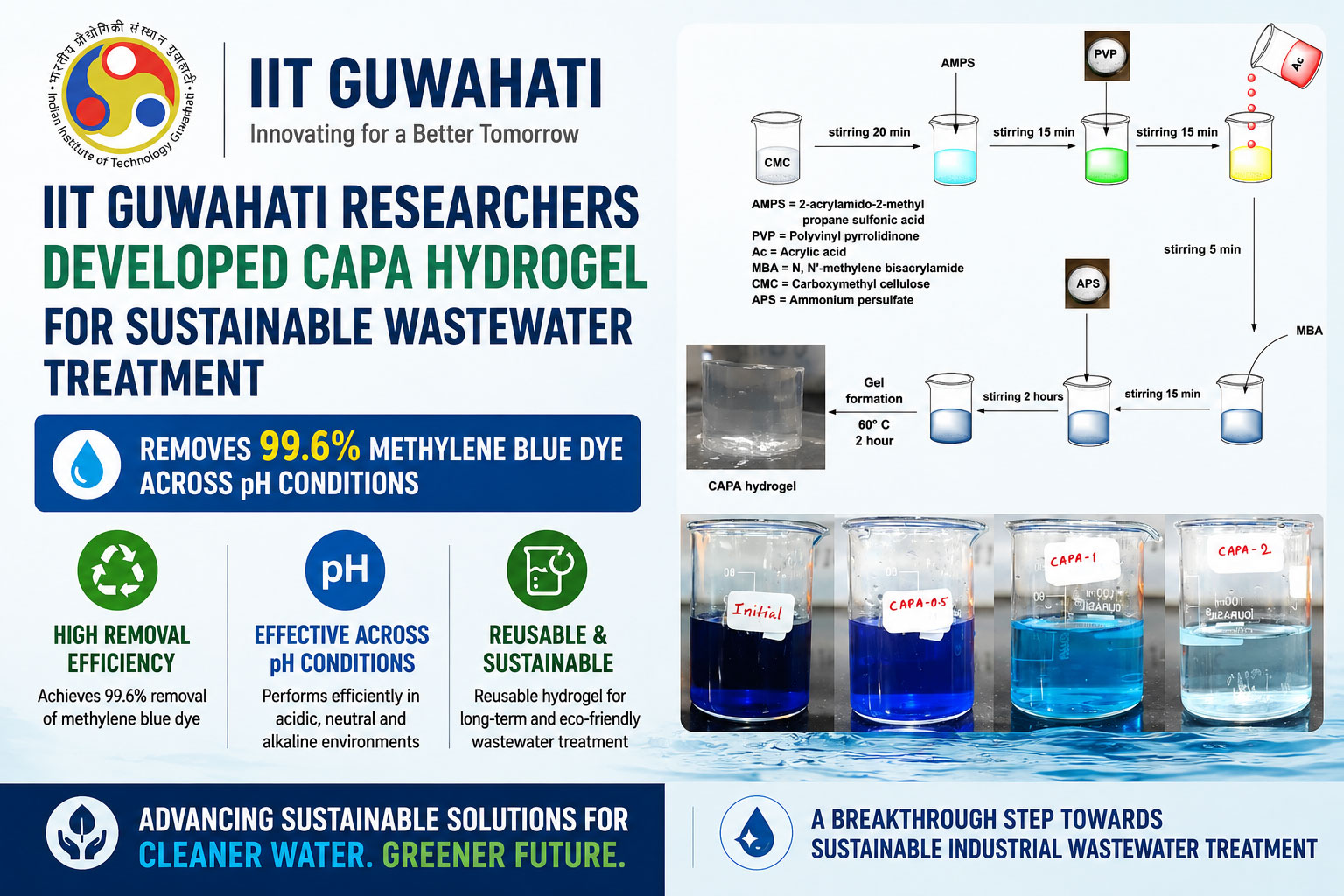
IIT Gandhinagar researchers created CAPA hydrogel removing 99.6% methylene blue dye, working across pH conditions and reusable for sustainable industrial wastewater treatment.
The problem : Toxic Dyes Threaten Water Systems Globally
Colors brighten our lives and define countless items we use daily – from vibrant clothes we wear to decorative paper and packaging materials, as well as our footwear, bags, and belts. Dyes add different colors to these things by binding themselves to the structure of the material they color. Methylene blue (MB), a dye used to color papers, leather products, silk, wool, and employed as a diagnostic agent in rubber and cosmetic industries, serves as a prime example.
After these dyes serve their purpose, billions of tons of dye-containing wastewater enter water systems every year. According to a news story on the University of Bath website, 80% of such wastewater generated in low- and middle-income nations gets used directly for irrigation or released untreated into water sources. These dyes eventually render streams, rivers, and lakes unfit for human and animal use while negatively impacting aquatic organism habitats. MB also causes health issues such as vomiting, breathing problems, diarrhoea, eye burns, jaundice, and cancer.
Adsorption Emerges as Promising Wastewater Treatment Alternative
Researchers explored strategies like membrane filtration, coagulation, and electrochemical treatment to facilitate MB removal from water. However, drawbacks include expensive approaches, unwanted byproduct formation, and failure to achieve removal of multiple dyes. Adsorption has emerged as a promising alternative due to its ease of use, lower energy investment, and adsorbent material reuse. Adsorption simply involves one substance sticking to the surface of another substance. Yet, developing materials that remain stable under different conditions and can be efficiently reused remains challenging.
IITGN Researchers Create CAPA Hydrogel Acting as Microscopic Sponge
Researchers from the Indian Institute of Technology Gandhinagar (IITGN) published a study in ACS Applied Polymer Materials addressing this issue by developing hydrogels – advanced materials acting like microscopic sponges. Besides MB, the engineered materials robustly trapped other popular dyes like crystal violet and rhodamine B, even when multiple dyes existed in the same water-based solution, demonstrating nonselective affinity. This ability proves particularly important because wastewater from dye-using industries rarely contains only a single pollutant.
Hydrogels are soft materials containing numerous tiny pores that absorb lots of water and biological fluids. In this study, researchers created CAPA, a hydrogel using carboxymethyl cellulose (CMC) – a biodegradable material derived from cellulose made up of many glucose units – and additional components including acrylic acid.
Acrylic Acid Adjustment Fine-Tunes Hydrogel Performance
Dr Hitarth Patel, who recently defended his PhD thesis from IITGN and serves as the study’s first author, explained: “The key innovation lay in adjusting the amount of acrylic acid. By changing this single ingredient, we were able to fine-tune the structure, surface properties, and adsorption behaviour of the materials.”
The team tested three versions containing different acrylic acid amounts for MB removal ability. The best-performing hydrogel, CAPA-2, adsorbed 99.6% of MB dye. Further, its adsorption capacity of approximately 475 mg of dye per gram of hydrogel places CAPA-2 among the highest-performing CMC-based hydrogels reported for MB removal. Several studies reported values generally between 30 mg/g to 250 mg/g.
Opposites Attract: Negatively Charged Hydrogels Trap Positively Charged Dyes
These hydrogels contain many negatively charged sites while dyes like MB carry positively charged sites, making them naturally drawn to the hydrogels – an “opposites attract!” situation. The study found that increasing acrylic acid proportion led to increased negative surface charges in hydrogels, enhancing adsorption. Analysis indicated hydrogen bonds and hydrophobic or water-repelling interactions between MB and dry hydrogel pockets. These materials contain extremely tiny pores with average pore diameter of ~25 nanometres and suitable charged surfaces allowing them to trap, bind, and pull out MB, crystal violet, and rhodamine B dye molecules from wastewater.
CAPA-2 Works Across pH Conditions and Repeats Performance
Most hydrogels have a pH ‘comfort zone’ for working efficiency. Interestingly, CAPA hydrogels engineered in this study behaved distinctly. While all three adsorbed MB most effectively at pH 7 (neutral), CAPA-2 performed this task very well in both acidic and alkaline environments (pH 3 and 10).
CAPA-2 also resembled a sponge not losing much cleaning power after washing and reuse. After four reuse cycles, it showed only slight performance decline (from 99.55 to 95.91 mg/g). This durability suggests using such materials may help reduce wastewater treatment costs.
Sustainable Solution Aligns with Global Environmental Goals
Dr Bhaskar Datta, Professor in Chemistry and Biological Sciences and Engineering departments at IITGN, stated: “Innovations like CAPA hydrogels with high dye-removal capacity, stability across different pH conditions, and repeated usability represent promising solutions to industrial wastewater treatment.” Future directions involve evaluating real-world performance of smart sponges generated in this study.
This work resonates with the Government of India’s focus on sustainable water management and pollution control and the United Nations’ Sustainable Development Goal 6 (Clean Water and Sanitation), while aligning with Goals 9 (Industry, Innovation and Infrastructure) and 14 (Life Below Water).
#IITGandhinagar #CAPAHydrogel #WastewaterTreatment #DyeRemoval #SustainableWater #EnvironmentalScience #Hydrogel #PollutionControl #WorldEnvironmentDay #CleanWater
Disclaimer
The information in this article is based on available public sources and official statements as of the time of publication. While we aim for accuracy, we do not guarantee completeness or correctness. We advise readers to verify key details from official sources before making any decisions. The website (iitiimsamvaad.com) is not liable for any loss or damage arising from the use of this content. The authors are also not responsible for any such loss or damage.