
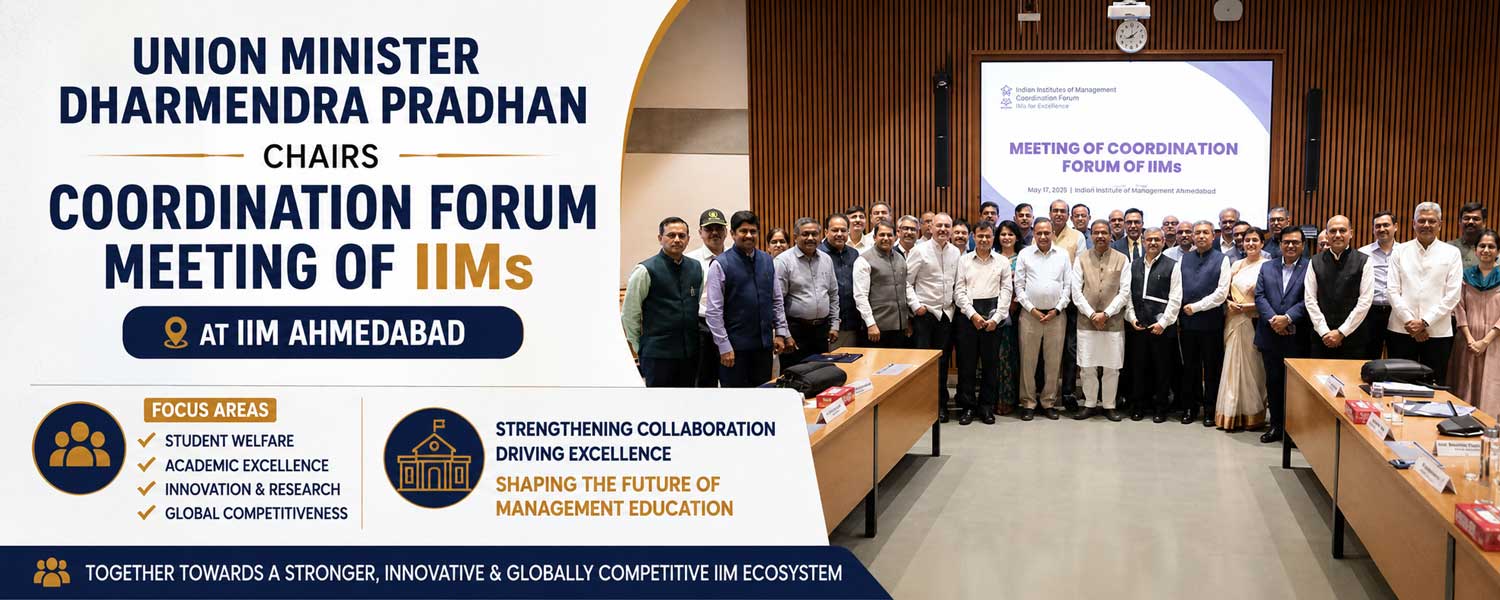
Union Minister Dharmendra Pradhan chairs the Coordination Forum meeting of IIMs at IIM Ahmedabad, focusing on student welfare, academic excellence, innovation, and global competitiveness.
Minister leads IIM Coordination Forum meeting
Union Minister for Education Shri Dharmendra Pradhan, who also serves as Chairman of the Coordination Forum of Indian Institutes of Management (IIMs), chaired the Coordination Forum Meeting of the IIMs at the Indian Institute of Management Ahmedabad (IIM‑A) campus. The meeting was convened by the Department of Higher Education, Ministry of Education (MoE), in collaboration with IIM Ahmedabad on 14 May 2026.
The forum brought together Chairpersons of the Boards of Governors of all IIMs, Directors of IIMs, and senior officials from the Department of Higher Education, the Government of Gujarat, and the Government of Uttar Pradesh. The delegates convened to deliberate on matters of shared interest and to strengthen cooperation, coordination, and synergy across the IIM system.
IIMs as catalysts of nation‑building
Addressing participants, Shri Pradhan emphasised that India’s IIMs rank among the strongest catalysts of nation‑building and economic transformation. He noted that the institutes have not only shaped India’s management‑education landscape but have also become global models of excellence in leadership and management education.
The Minister highlighted that the discussions centred on how IIMs can deepen their role in the Viksit Bharat 2047 vision. He stressed the importance of student welfare, institutional coordination, academic excellence, innovation, and global competitiveness as core pillars shaping the IIMs’ contribution to national development. Pradhan added that by aligning their priorities with this long‑term national goal, IIMs can help India build a more inclusive, knowledge‑driven, and innovation‑oriented economy.
Strengthening innovation and values‑driven education
Pradhan further stated that IIMs must nurture innovation ecosystems, adapt to emerging global challenges, and promote values‑driven education that balances technical excellence with social responsibility. He observed that the institutes can evolve into national assets that not only support India’s journey toward becoming a developed nation but also amplify India’s voice in global policy and management‑education discourse.
The Minister urged the IIM leadership to foster stronger industry–academia partnerships, invest in interdisciplinary research, and expand outreach to smaller cities and underserved communities. He highlighted that IIMs should play a leading role in generating evidence‑based policy inputs, human‑capital development, and scalable governance‑innovation models relevant to India’s diverse socio‑economic context.
Role of the Coordination Forum in institutional synergy
Shri Vineet Joshi, Secretary, Department of Higher Education, underscored the importance of the Coordination Forum in strengthening collaboration and institutional coordination among the IIMs. He described the forum as a structured platform through which IIMs can share best practices, align policies, and address common challenges in a coordinated manner.
Joshi noted that the forum enables the institutes to move from siloed thinking to collective leadership, ensuring that India’s IIM system behaves as an integrated national ecosystem rather than a collection of isolated institutions. He commended the role of IIM Ahmedabad as the host and collaborating partner in organising the meeting, recognising its long‑standing contribution to management education and institutional governance.
Key issues discussed at the meeting
The deliberations at the Coordination Forum addressed several critical issues shaping the future of the IIM system. Participants discussed the IIMs’ contribution toward Viksit Bharat 2047 goals, including the role of management‑education institutions in building leadership capacity, entrepreneurial ecosystems, and public‑sector capabilities.
Among the specific themes, the group deliberated on aligning undergraduate‑level entrance examinations with the futuristic requirements of the country, ensuring that admission processes emphasise critical thinking, problem‑solving, and innovation‑orientation. The forum also explored the development of standard operating procedures (SOPs) for MBA admissions, including inter‑IIM migration of students and fee‑refund policies, to bring greater transparency and consistency across institutes.
Faculty development and systemic fairness
The meeting also focused on human‑capital development within the IIM ecosystem. Delegates discussed formulating a policy for providing exposure to young faculty and young IIMs through a secondment policy across the IIMs. Such a framework would also allow junior faculty and faculty from newer IIMs to gain experience at established institutes, facilitating knowledge transfer and capacity‑building.
Participants further deliberated on implementing reservation rosters for faculty and non‑faculty positions in line with national guidelines. They emphasised the need for transparent, equitable, and data‑driven approaches to recruitment, career progression, and institutional diversity. The discussion underscored that diversity and inclusion must remain central to how IIMs strengthen their academic and administrative ecosystems.
By addressing these issues in a coordinated forum, the IIMs aim to build a more coherent, responsive, and globally competitive management‑education system that supports India’s economic and social‑development priorities in the coming decades.
Disclaimer
The information in this article is based on available public sources and official statements as of the time of publication. While we aim for accuracy, we do not guarantee completeness or correctness. We advise readers to verify key details from official sources before making any decisions. The website (iitiimsamvaad.com) is not liable for any loss or damage arising from the use of this content. The authors are also not responsible for any such loss or damage.