

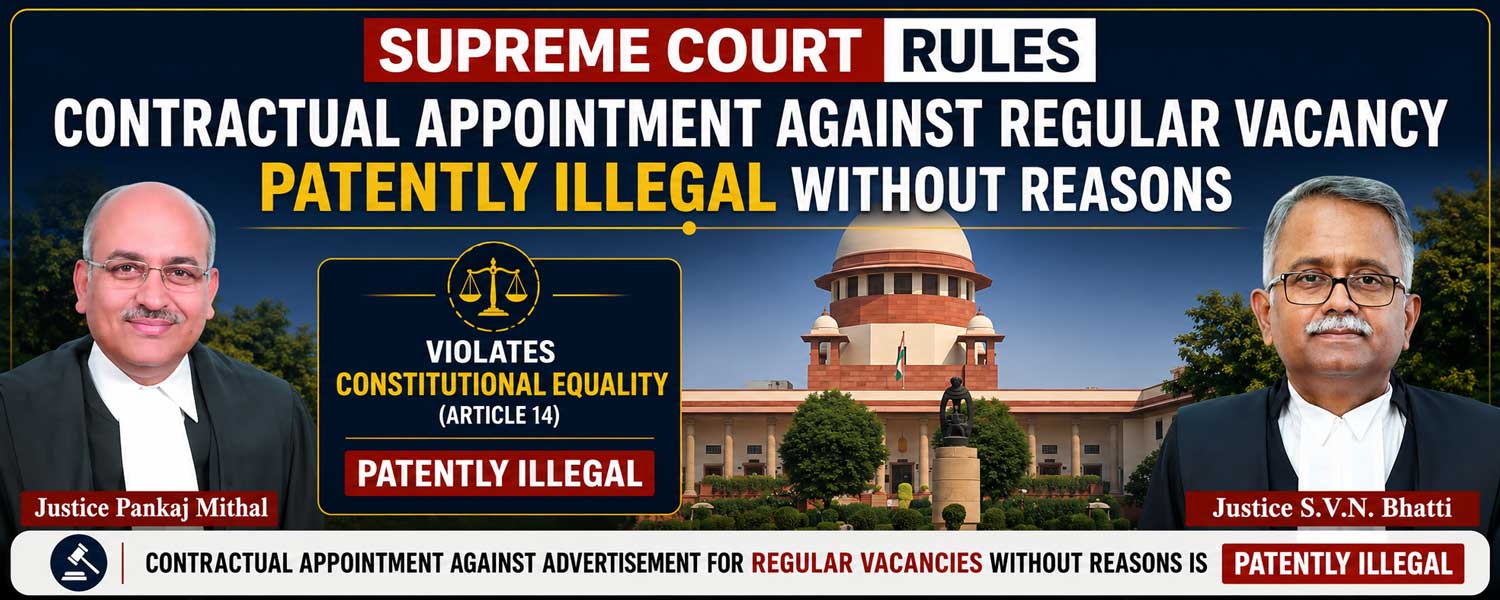
The Supreme Court rules that appointing a candidate on a contractual basis against an advertisement for regular vacancies without reasons violates constitutional equality and is “patently illegal” in a dispute arose at IIIT‑Allahabad.
Court strikes down contractual faculty appointment
The Supreme Court of India has held that appointing a candidate on a contractual basis against an advertisement issued for regular vacancies is “patently illegal and unconstitutional” when authorities fail to record any reasoned justification for such differential treatment. A bench comprising Justice Pankaj Mithal and Justice S.V.N. Bhatti allowed an appeal by an Assistant Professor who had been given only a contractual posting despite being shortlisted through a regular‑recruitment process at the Indian Institute of Information Technology, Allahabad (IIIT‑Allahabad).
The bench directed the institute to issue the appellant a regular appointment as Assistant Professor within four weeks, with continuity of service, but without financial benefits for the intervening period during which he held a contractual post. The Court emphasised that the issue was not one of “regularisation” of an existing contractual employee, but of the legality of converting a regular‑vacancy advertisement into a contractual‑hiring exercise without clear grounds.
Background: regular faculty advertisement in 2013
The dispute arose from an advertisement issued in January 2013 by IIIT‑Allahabad for regular faculty positions in Pay Band‑IV and Pay Band‑III. The appellant, Tiwari, applied for the post of Assistant Professor in the Information Security/MSCLIS stream. He held a Ph.D. in Information Security from the University of Allahabad, a first‑division M.S. in Cyber Law and Information Security from IIIT‑Allahabad (CGPA 9.02/10), and prior teaching experience at Ewing Christian College, along with guest‑faculty work at IIIT‑Allahabad.
On 18 March 2013, the institute’s Selection Committee interviewed candidates for the advertised regular posts. While thirteen candidates received regular appointments, the institute offered Tiwari and another candidate only 12‑month contractual appointments at ₹40,000 per month, despite their having the prescribed qualifications. The Court later observed that the record showed no reasons whatsoever for denying Tiwari the regular post for which he was shortlisted and interviewed.
Cancellation and repeated contractual treatment
Authorities cancelled all appointments made in 2013 in March 2014, leading to litigation before the Allahabad High Court. Earlier writ proceedings prompted the institute to reconsider the matter, but by 2017 the institute once again offered Tiwari only a contractual appointment, even though it had originally conducted the recruitment process for regular vacancies.
Tiwari challenged the re‑issuance of a contractual offer before the High Court’s Single Judge and later the Division Bench, but those courts dismissed his writs, relying on the argument that he had accepted the contractual appointment without protest and had continued to work under those terms. The Supreme Court disagreed with this reasoning and set aside the impugned order.
Constitutional equality and uniform treatment
Writing the judgment, Justice Bhatti stressed that the institute had initiated the recruitment process for regular appointments and therefore the Selection Committee owed all invited candidates equal and uniform treatment. The Court held that, because the appellant met the advertised qualifications and other shortlisted candidates received regular posts, denying him a regular appointment without any recorded rationale violated Articles 14 (equality before law) and 16 (equality of opportunity in public employment) of the Constitution.
The Court observed that the competent authority cannot unilaterally change the procedure advertised for regular vacancies into a contractual‑hiring process without a transparent, reason‑based decision. “The record does not disclose any reason for denying the post for which the Appellant was shortlisted and interviewed,” the bench stated, concluding that the contractual appointment against a regular‑vacancy notice was invalid and must be corrected by issuing Tiwari a regular appointment with service continuity.
Cause Title: LOKENDRA KUMAR TIWARI VERSUS UNION OF INDIA AND OTHERS
Citation : 2026 (SC) 495
Disclaimer
The information in this article is based on available public sources and official statements as of the time of publication. While we aim for accuracy, we do not guarantee completeness or correctness. We advise readers to verify key details from official sources before making any decisions. The website (iitiimsamvaad.com) is not liable for any loss or damage arising from the use of this content. The authors are also not responsible for any such loss or damage.