

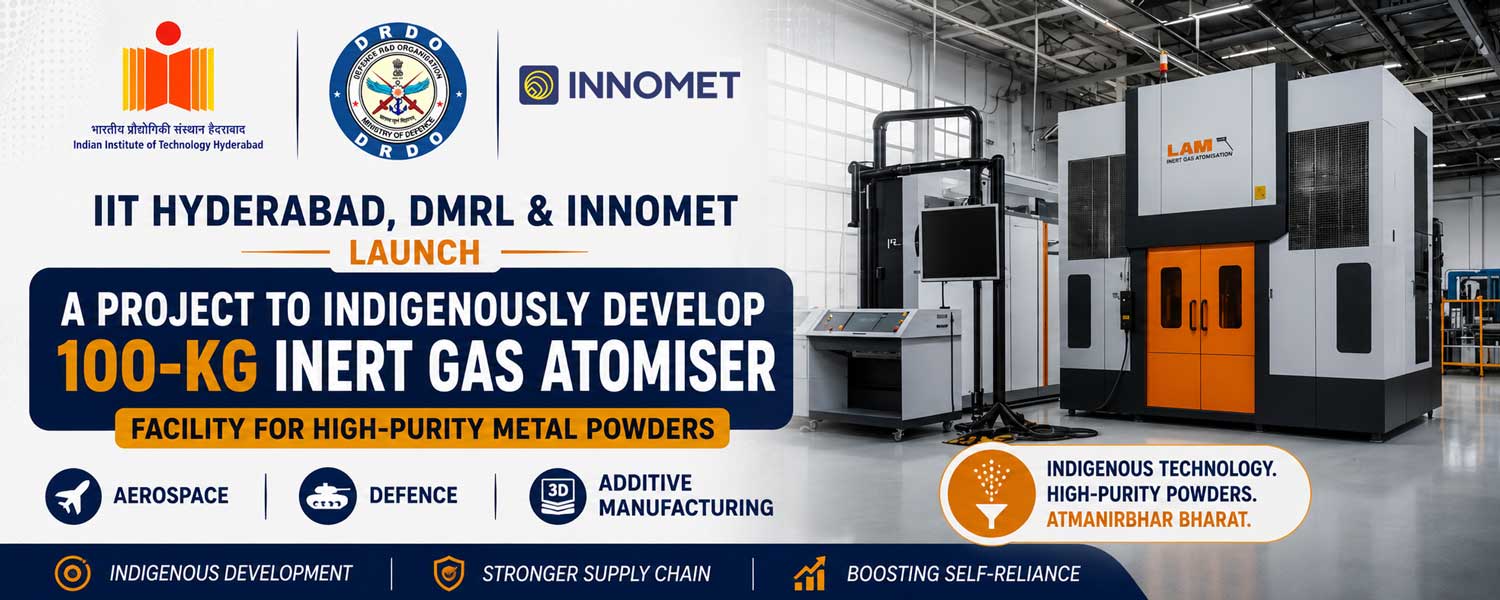
IIT Hyderabad, DMRL, and Innomet launch a project to indigenously develop a 100‑kg inert gas atomiser facility for high‑purity metal powders for aerospace, defence, and additive manufacturing.
Indigenous gas atomiser project launched
The Indian Institute of Technology, Hyderabad (IIT‑H), in collaboration with the Defence Metallurgical Research Laboratory (DMRL) and Hyderabad‑based Innomet Advanced Materials Ltd., has launched a joint project for the indigenous development of a 100‑kg inert gas atomiser facility. The project aims to design, build, and commission a high‑throughput gas atomiser capable of producing high‑purity, spherical metal powders for critical aerospace, defence, energy, and additive‑manufacturing applications.
The initiative receives funding from the DRDO Industry Academia Centre of Excellence at Indian Institute of Technology (BHU) Varanasi, under the Directorate of Futuristic Technology Management (DFTM) of the Defence Research and Development Organisation (DRDO). This support underscores the strategic importance India places on building self‑reliant capabilities in advanced metal‑powder technologies and reducing dependence on imported atomiser systems.
Objectives and technical scope
The core objective of the project is to develop a 100‑kilogram‑scale gas atomiser that can consistently produce fine, spherical metal powders with tightly controlled chemical composition and particle‑size distribution. The facility will use inert gases such as argon or nitrogen to atomise molten metal into droplets, which solidify rapidly into high‑integrity powder particles.
The target powders include nickel‑based superalloys, various grades of steel, cobalt‑based alloys, and high‑entropy alloys, all of which are vital for advanced strategic systems such as jet engines, rocket components, nuclear‑energy hardware, and high‑performance structural parts. These powders will also serve additive manufacturing (3D printing) processes, enabling the fabrication of complex, lightweight, and mission‑critical components for aerospace and defence platforms.
Roles of IIT‑H, DMRL, and Innomet
Under the project, IIT‑Hyderabad will take the lead in process design, fluid‑dynamics modelling, and experimental validation of the gas atomiser. The institute’s research teams will develop computational models to optimise melt‑stream stability, gas‑jet configuration, and cooling rates, ensuring high yield and repeatable powder quality. IIT‑H will also guide the design of control and safety systems, particularly for high‑pressure gas handling and emergency‑shutdown protocols.
The Defence Metallurgical Research Laboratory (DMRL) will provide metallurgical and application‑oriented inputs from the defence and aerospace sectors. DMRL will define powder‑quality requirements, mechanical‑performance benchmarks, and qualification protocols that align with national defence‑grade standards. By linking the facility’s output to real‑world component‑performance needs, DMRL ensures that the project remains tightly coupled with India’s strategic technology priorities.
Hyderabad‑based Innomet Advanced Materials Ltd. will act as the industrial partner, responsible for engineering realisation, fabrication, and commissioning of the atomiser plant. Innomet will integrate the research‑driven designs into a robust, scalable commercial installation and manage the balance‑of‑plant infrastructure – such as furnace systems, inert‑gas supply networks, and downstream powder‑handling equipment. The company will also explore commercial‑scale deployment options for the technology, enabling broader access to advanced metal powders across the Indian manufacturing ecosystem.
Facility location and dual‑use research model
The 100‑kg gas atomiser facility will be located at Innomet’s premises in Hyderabad, providing a secure, industry‑ready environment for operation and maintenance. However, the project also includes a five‑year research‑access arrangement under which both DRDO (through DMRL) and IIT‑Hyderabad will retain the right to use the facility for their research activities.
This dual‑use model allows government laboratories and academic institutions to conduct fundamental and applied experiments – such as novel‑alloy development, process‑optimisation studies, and advanced‑powder‑characterisation work – while the same plant serves as a commercial‑scale production unit. The arrangement fosters technology transfer, skills development, and rapid innovation cycles, as insights from research directly refine industrial‑scale practices.
Strategic importance for aerospace, defence, and manufacturing
Developing a domestically designed and built gas atomiser of 100‑kg capacity marks a significant step toward self‑reliance in critical metal‑powder technologies. High‑purity, spherical powders are essential for modern additive‑manufacturing platforms, hot‑isostatic‑pressing (HIP), and advanced coating technologies, all of which underpin high‑performance aerospace and defence systems.
By enabling India to produce these powders indigenously, the project helps shorten supply chains, reduce procurement lead times, and tailor powder chemistries to specific national‑security and industrial requirements. The facility also strengthens India’s position in the global advanced‑manufacturing landscape, particularly as additive‑manufacturing becomes central to next‑generation aerospace and defence‑component fabrication.
Disclaimer
The information in this article is based on available public sources and official statements as of the time of publication. While we aim for accuracy, we do not guarantee completeness or correctness. We advise readers to verify key details from official sources before making any decisions. The website (iitiimsamvaad.com) is not liable for any loss or damage arising from the use of this content. The authors are also not responsible for any such loss or damage.