


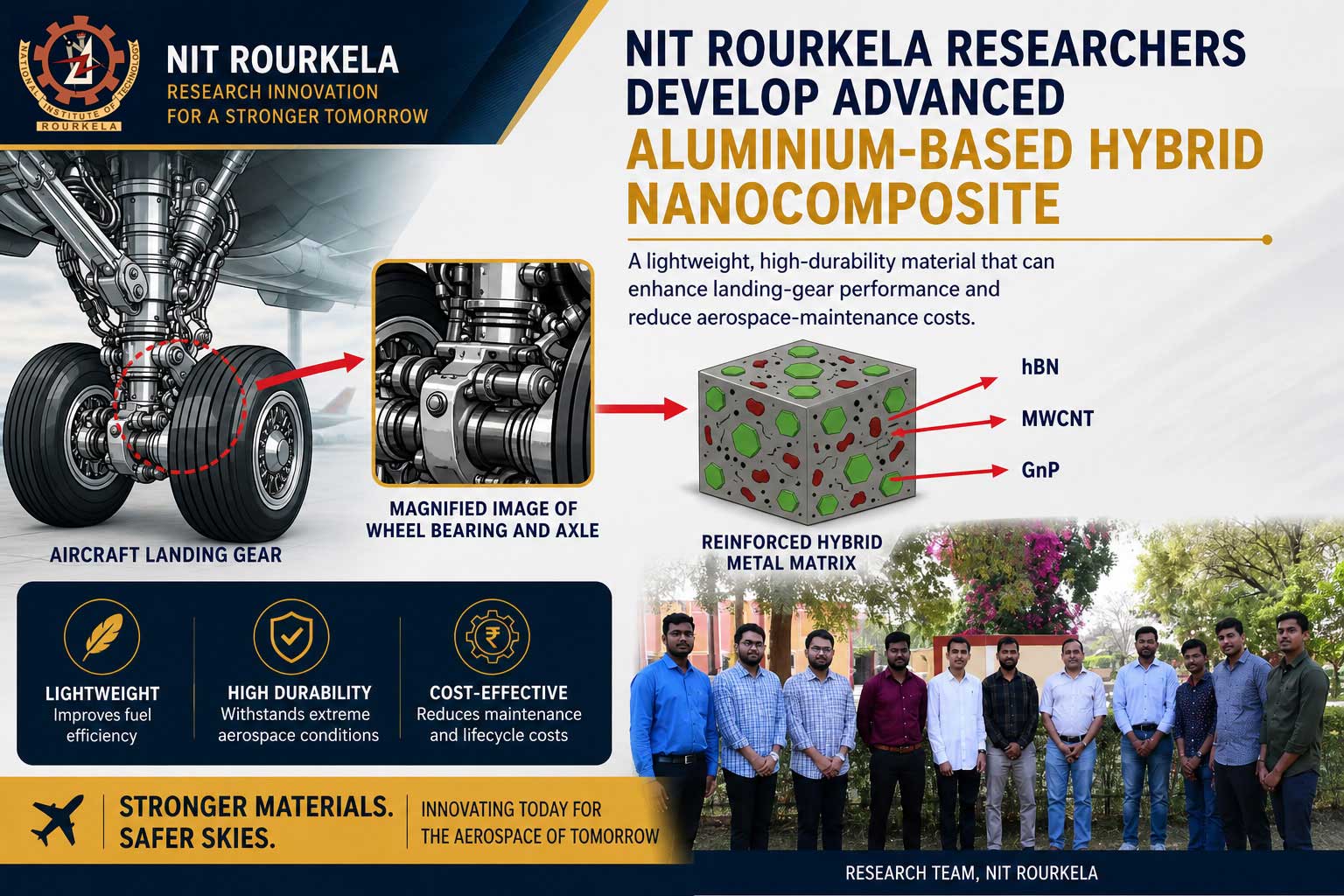
NIT Rourkela researchers develop a lightweight, high‑durability aluminium‑based hybrid nanocomposite that can enhance aircraft landing gear performance and reduce aerospace‑maintenance costs.
A new material for next‑generation landing gear
A research team at the National Institute of Technology (NIT) Rourkela has developed a lightweight, high‑durability material that could significantly enhance the performance of aircraft landing gear. The innovation addresses a long‑standing trade‑off between light weight and structural resilience in components that must endure repeated, high‑stress ground operations.
Landing gear systems bear the entire weight of the aircraft during taxiing and absorb the shock of repeated runway impacts during takeoff and landing. Traditionally, these components are fabricated from aluminium and its alloys, which offer low weight but can show durability limitations under extreme loading and fatigue conditions.
Designing a hybrid aluminium nanocomposite
To overcome these limitations, Prof. Syed Nasimul Alam, Associate Professor in the Department of Metallurgical and Materials Engineering, along with his research group – including Dr. Arka Ghosh, Dr. Ashutosh Das, Dr. Pankaj Shrivastava, Mr. Nityananda Sahoo, Parth Patel, and Dr. Velaphi Msomi from the University of South Africa – has developed an advanced aluminium‑based hybrid nanocomposite. The findings were published in the journal Materials Letters.
The team engineered the material at the nanoscale, where dimensions are over 100,000 times thinner than a human hair, enabling superior mechanical and tribological properties. They introduced carbon nanotubes to enhance compressive strength and load‑bearing capacity, while graphite nanoplatelets improved overall mechanical performance and wear resistance. To ensure thermal stability and high‑temperature integrity, they added hexagonal boron nitride into the matrix.
Uniform dispersion and advanced processing
A key innovation lies in the uniform dispersion of these nanoparticles within the aluminium metal matrix. The researchers achieved this by exposing the mixture to high‑frequency sound waves, which broke agglomerates and distributed the nanofillers evenly. The homogenised composite powder was then compacted under high pressure and heated in an oxygen‑free environment, a process known as spark plasma sintering (SPS). This treatment produced a dense, strongly bonded structure suitable for aerospace applications.
Explaining the breakthrough, Prof. Alam noted that the hybrid nanocomposite exhibits excellent wear resistance due to a synergistic load‑bearing mechanism. The nanoparticles form a three‑dimensional reinforcing network that enhances structural stability and load transfer across the material. A thin protective surface layer that develops during processing further reduces wear and extends component life.
Performance and potential applications
The new material shows strong promise for use in defence aircraft and unmanned aerial vehicles (UAVs), where both light weight and durability are critical. Compared to ultra‑high‑strength steels, titanium alloys, and conventional aluminium alloys, the nanocomposite offers an estimated 40–60% improvement in cost‑effectiveness, combining high performance with lower material and maintenance costs.
The composite can help deliver lighter landing‑gear assemblies, which reduce aircraft weight and improve fuel efficiency while maintaining or increasing safety margins under repeated impact loads. The innovation could also lead to reduced inspection and repair intervals, lower maintenance costs, and enhanced operational reliability for military and commercial fleets.
Patents, scaling, and strategic alignment
The NIT Rourkela team already holds a patent for the powder‑mixing technique used in the nanocomposite’s development and is in the process of filing a second patent for the overall technology. Their next step involves scaling up production through the Powder Metallurgy route, enabling the fabrication of larger, complex landing‑gear components suitable for real‑world testing and eventual integration into aircraft platforms.
Aligned with the Government of India’s Atmanirbhar Bharat initiative, this development positions India as a potential contributor to next‑generation aerospace materials, strengthening domestic capability in advanced metallurgy and high‑performance engineering. If successfully commercialised, the NIT Rourkela nanocomposite could become a key enabler of lighter, safer, and more cost‑efficient aircraft landing systems – both in India and on the global stage.
Disclaimer
The information in this article is based on available public sources and official statements as of the time of publication. While we aim for accuracy, we do not guarantee completeness or correctness. We advise readers to verify key details from official sources before making any decisions. The website (iitiimsamvaad.com) is not liable for any loss or damage arising from the use of this content. The authors are also not responsible for any such loss or damage.