

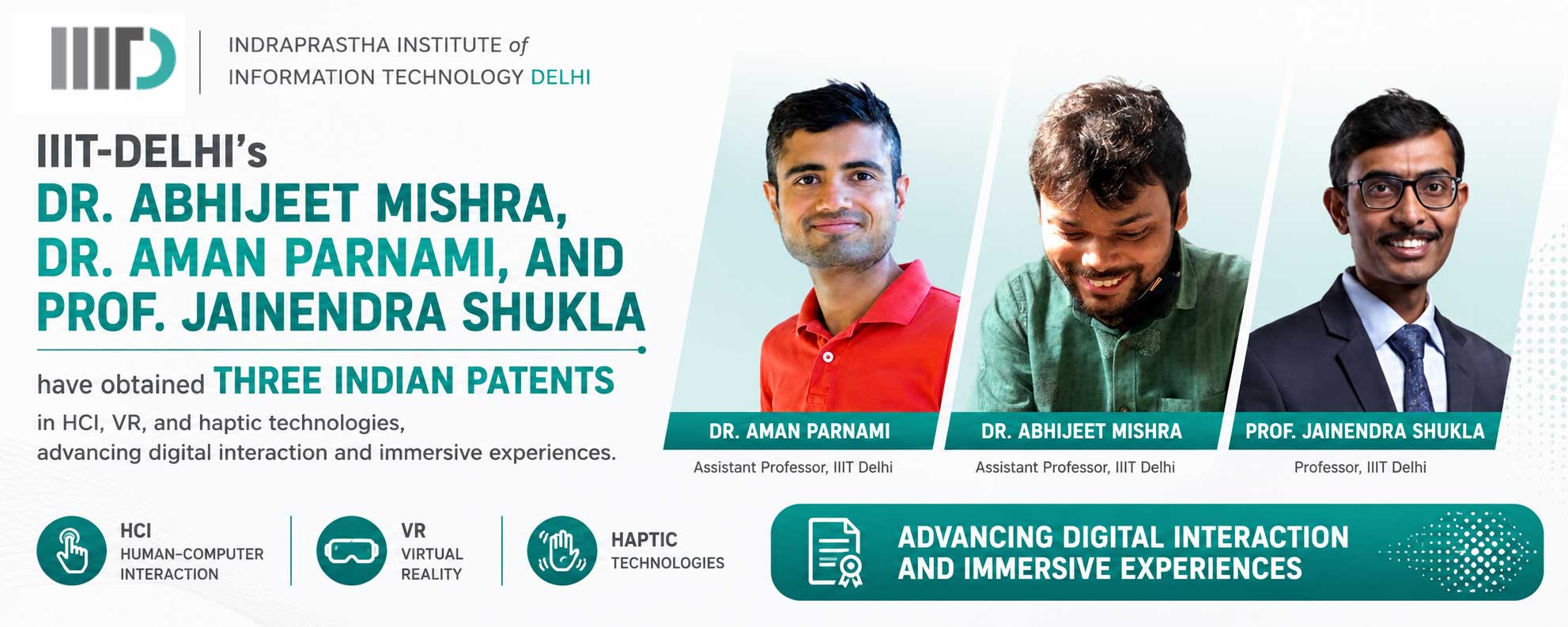
IIIT‑Delhi’s Dr. Abhijeet Mishra, Dr. Aman Parnami, and Prof. Jainendra Shukla have obtained three Indian patents in HCI, VR, and haptic technologies, advancing digital interaction and immersive experiences.
IIIT‑Delhi team patents three HCI innovations
Researchers at the Indraprastha Institute of Information Technology, Delhi (IIIT‑Delhi) have secured three Indian patents in the domains of human‑computer interaction (HCI), virtual reality, and haptic technologies. The patents recognise the work of Dr. Abhijeet Mishra, Dr. Aman Parnami, and Prof. Jainendra Shukla, all associated with India’s research and academic ecosystem. The achievement underlines IIIT‑Delhi’s focus on impactful, interdisciplinary research that bridges laboratory innovation and real‑world applications.
The team members also acknowledged the support and guidance of the Department of Human‑Centered Design at IIIT‑Delhi, which provided the research environment, infrastructure, and methodological framework that enabled the development and prototyping of these technologies. The patents also reflect the institute’s growing reputation for producing practical, user‑centred innovations in digital interaction and immersive technologies.
Patent 1: Magnetic‑field‑shielded input‑sensing casing
The first patent, titled “A Casing System for Electronic Devices Using Magnetic Field Shielding for Input Sensing”, introduces a novel approach to magnetic‑field‑based interaction sensing. The system uses a magnetic‑field‑shielding casing around electronic devices to isolate and control how magnetic fields interact with embedded sensors, enabling more accurate and reliable input detection.
Through controlled experiments and machine‑learning integration, the researchers demonstrated that the system achieves over 90% accuracy in magnetic‑field‑based interaction sensing. The technology also simplifies the design of touch‑less and proximate interaction layers, reducing the need for complex sensor hardware and extensive calibration. The patent opens the door to next‑generation HCI prototyping and interaction design, particularly for wearable and compact electronic devices where traditional touch interfaces face space and usability constraints.
Patent 2: Smartphone‑based VR interaction for precision tools
The second patent, “A Virtual Reality (VR) Interaction Method and Device for Simulating Miniature Control Manipulation of Precision Hand‑Held Tools”, introduces a platform the team has named MobiTangibles. The system uses smartphones as VR interaction devices to simulate the fine‑grained manipulation of miniature, precision hand‑held tools such as those used in surgery, micro‑assembly, and laboratory work.
By integrating magnetic‑field sensing into the smartphone platform, MobiTangibles reduces the need for purpose‑built VR controllers or complex physical prototyping. The patent outlines a method by which users can perform sub‑millimetre‑level control manipulations, and the system translates these movements into virtual environments with high fidelity.
The approach aims to make immersive VR experiences more accessible and scalable, especially in resource‑constrained settings. Educators, researchers, and small‑scale developers can use standard smartphones instead of expensive dedicated hardware to prototype and deploy sophisticated VR‑based training and design tools.
Patent 3: HaptiDrag – thin, programmable friction feedback
The third patent, “A device with the Ability to Generate Varying Levels of Drag (Friction) Effects on Real Surfaces”, introduces HaptiDrag, an ultra‑thin, lightweight haptic device that generates realistic drag and friction effects on real‑world surfaces. The technology also uses electroadhesion – applying small electric fields across conductive and dielectric surfaces – to modulate the perceived friction between a user’s hand or a device and the underlying surface.
Conventional haptic systems often rely on bulky mechanical actuators or vibration motors, which limit their scalability and ergonomic suitability. HaptiDrag addresses these limitations by offering programmable friction levels without moving parts, enabling smooth, low‑power tactile feedback. The inventors also see applications in touchscreens, digital workbenches, and immersive training systems, where realistic tactile cues can enhance precision and user immersion.
Vision: from lab research to practical interaction
Speaking about the achievement, Dr. Abhijeet Mishra said the patents result from a sustained effort to build interaction technologies that are accessible, scalable, and user‑centric. “Our primary objective has always been to close the gap between cutting‑edge research and its practical applications,” he said. “We hope these patents will contribute to the future of digital interactions and immersive experiences, making advanced HCI tools available beyond elite research labs.”
Prof. Jainendra Shukla added that the patents mark an encouraging milestone for their research group. “More importantly, they reflect the broader possibilities emerging in human‑computer interaction and immersive technologies,” he said. “We hope this work opens new opportunities for collaboration, and we look forward to working with researchers, practitioners, and industry partners to translate such ideas into impactful real‑world technologies.”
These patents reinforce IIIT‑Delhi’s role as a hub for interdisciplinary, application‑oriented research, linking HCI, VR, and haptics to real‑world challenges in digital interaction, education, and everyday user‑experience design.
Disclaimer
The information in this article is based on available public sources and official statements as of the time of publication. While we aim for accuracy, we do not guarantee completeness or correctness. We advise readers to verify key details from official sources before making any decisions. The website (iitiimsamvaad.com) is not liable for any loss or damage arising from the use of this content. The authors are also not responsible for any such loss or damage.