

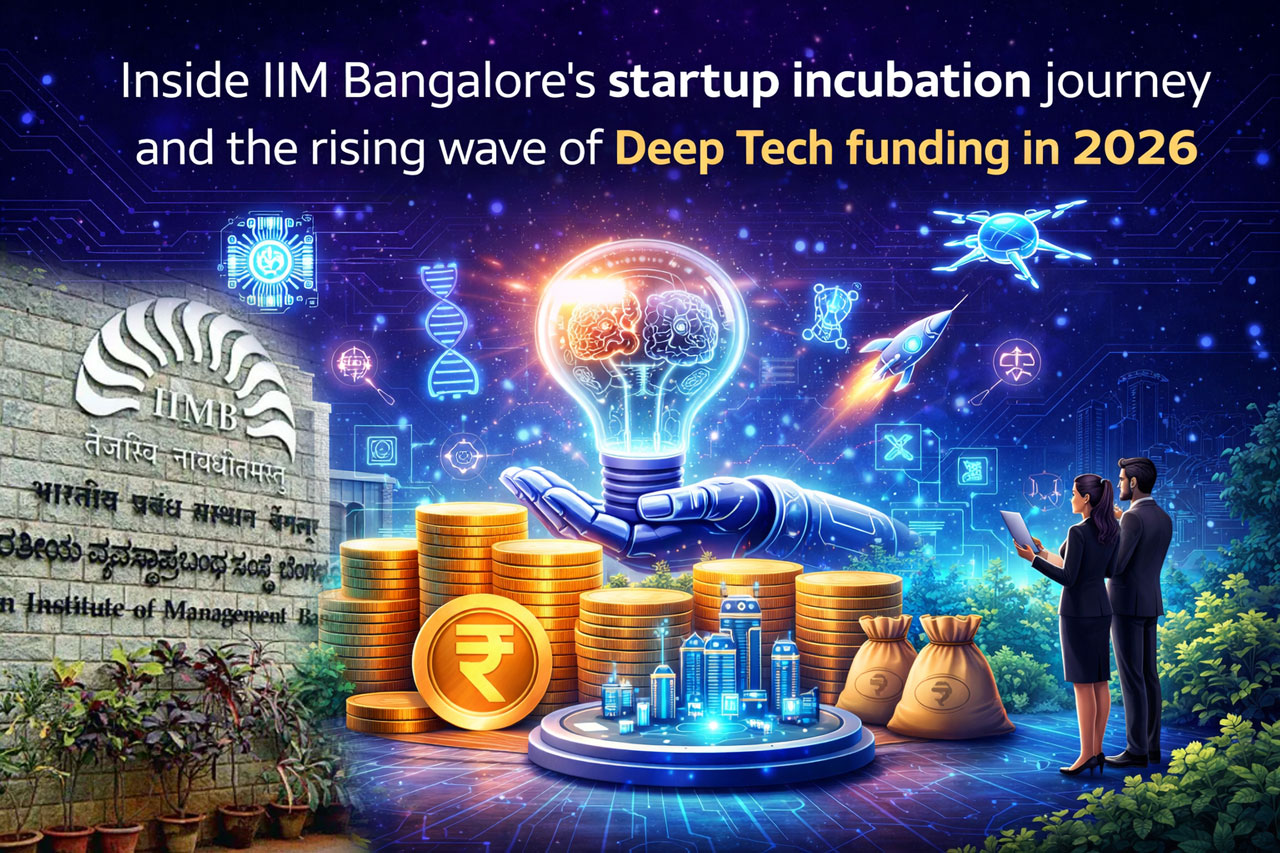
IIM Bangalore’s startup and entrepreneurship centre, NSRCEL, has spent over a decade refining its incubation model, evolving from a mentor‑led hub into a more structured engine for early‑stage innovation. At the same time, India’s deeptech ecosystem is gaining momentum, with venture capital commitments expected to deepen in 2026 as investors increasingly back science‑driven startups.
IIM Bangalore’s NSRCEL, the institute’s flagship startup and entrepreneurship centre, has spent years learning how to guide nascent ventures while simultaneously rethinking its own internal operating model. Today, NSRCEL’s work is as much about refining its own processes as it is about contributing to the wider Indian startup ecosystem beyond the campus.
A key strength in NSRCEL’s model, as Ganesh and several alumni highlight, lies in the day‑to‑day “rituals of support.” This includes having empathetic mentors who help founders refine pitches, iterate product‑market fit, and navigate early‑stage friction. It also involves the quiet but crucial act of making quick, targeted introductions – between a founder and a corporate pilot, a faculty expert and a research‑driven startup, or an early‑stage investor and a promising prototype. In many cases, these small interventions are what separate a stuck idea from a live pilot or a first customer.
NSRCEL’s operating model is also shifting in response to the changing nature of innovation. As more startups emerge from technology‑driven research, the centre is increasingly working at the intersection of business and science. According to Ganesh – NSRCEL now needs frameworks that allow for co‑incubation with university science labs and corporate innovation teams, so that deep‑technology ideas can move from the lab to the market without losing their scientific integrity. This has led to closer collaboration with engineering and natural‑science institutions, as well as with industry‑funded research units.
The broader capital environment is another major driver of change. Investors today expect more rigorous governance, better financial hygiene, and clearer unit economics than they did even a few years ago. Ganesh notes that legal and accounting practices are under sharper scrutiny, and founders are expected to demonstrate not only product potential but also a disciplined approach to cash flow, compliance, and risk management. For NSRCEL, this means that incubation is not just about coaching founders on product and market strategy, but also about building financial and operational maturity from day one.
At the same time, the investment landscape for deeptech is gaining momentum. In 2025, venture capital firms frequently declared that they would increase bets on the deeptech segment – startups grounded in core science such as advanced materials, biotechnology, semiconductors, AI‑driven hardware, and climate‑oriented engineering. Market‑intelligence data from Tracxn show that VCs have, to a large extent, made good on that promise.
As of December 2025, deeptech startups in India had raised approximately $1.57 billion across 265 deals, compared with $1.24 billion across 388 rounds in 2024. The numbers indicate that while the total number of deals dipped slightly, cheque sizes grew, suggesting that investors are backing fewer but more mature, capital‑intensive deeptech ventures. Many of these funds are going to early‑stage companies that sit at the cusp of commercialisation, where the gap between lab‑stage R&D and market‑ready products is most acute.
A further signal of institutional confidence came in September 2025, when eight venture capital and private equity firms from India and the United States – including Accel – came together to launch the India Deep Tech Investment Alliance. The alliance aims to create a coordinated, long‑term pool of capital for deep‑technology startups, alongside efforts to standardise evaluation frameworks, co‑investing structures, and ecosystem support such as talent access and policy advocacy.
Put together, NSRCEL’s evolving incubation model and the broader acceleration of deeptech funding point to a maturing Indian startup ecosystem – one that is no longer focused only on consumer apps and marketplace platforms, but is increasingly building and financing science‑driven innovation. For IIM Bangalore, it also means that the value of its entrepreneurship centre will be judged not only by the number of startups that graduate from its programme, but by how many of them go on to shape the next generation of technology‑driven industries in India and beyond.