


Telangana Irrigation and Civil Supplies Minister N. Uttam Kumar Reddy has announced a multi‑pronged strategy to put the state’s flagship irrigation projects back on track and complete unfinished work within a defined timeframe. Speaking in the Telangana Assembly on Sunday while responding to the debate on the voting of demands for grants, the Minister detailed plans to rehabilitate the three Kaleshwaram project barrages, re‑energise the Pranahita‑Chevella project, and review the Palamuru‑Rangareddy project’s viability.
Rehabilitating the Kaleshwaram Barrages
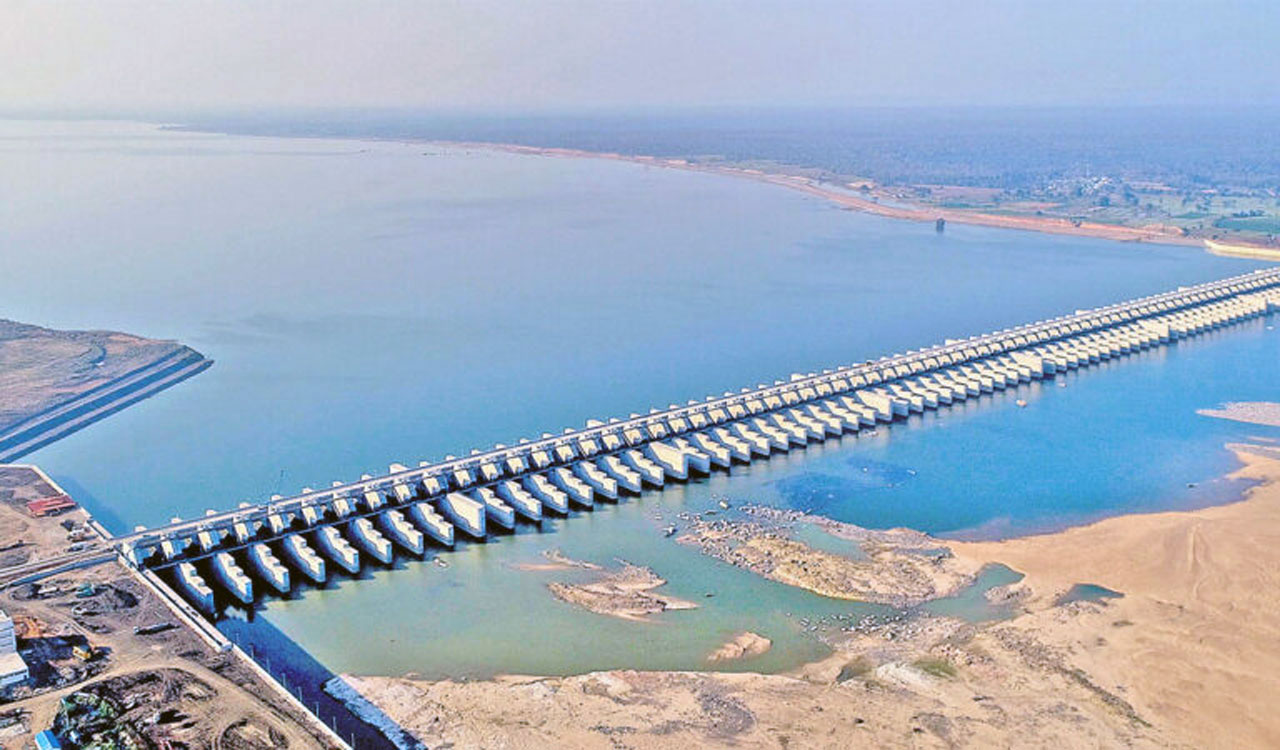
The Minister said the government is actively working on the rehabilitation and revival of the Medigadda, Annaram, and Sundilla barrages under the Kaleshwaram Lift Irrigation Scheme (KLIS). He revealed that Indian Institute of Technology Delhi and international experts will assess and advise on the structural integrity and operational efficiency of the three structures to ensure scientific and credible restoration.
Uttam Kumar Reddy criticised the earlier BRS government, alleging that it took high-cost borrowings at exorbitant interest rates to finance the Kaleshwaram project, which led to a crippling annual interest outgo. “Because of the mistakes of the previous regime, the present government pays about ₹10,000 crore every year just towards interest for this project,” he said.
To address governance and safety concerns, he added that a National Dam Safety Authority (NDSA) inquiry has been initiated to evaluate the condition of the dams. Along with this, the government has also instituted a Vigilance and Enforcement (V&E) inquiry and a one‑man judicial inquiry under a retired Supreme Court judge to probe irregularities that may have occurred during the planning, design, construction, quality control, and operation and maintenance of the three barrages.
The rehabilitation work, he stressed, is progressing carefully, even though it may appear slow to the public. “We are not rushing into decisions that could risk safety or compromise engineering standards,” he observed, underscoring the importance of both technical correctness and financial prudence.
Pranahita‑Chevella with Tummidihatti Barrage
On the Pranahita‑Chevella project, the Minister announced that the government intends to take the work forward with Tummidihatti as the original source barrage, as envisaged in the project’s foundational plan. However, he clarified that authorities have revised the route for transmitting water from Tummidihatti to the command areas.
The earlier proposed Tummidihatti–Yellampally alignment via Mancherial and coal‑mine zones involves several technical and environmental challenges, including terrain complexity, mine‑related subsidence risks, and land‑acquisition difficulties. Hence, the government has assigned R.V. Engineering Consultancy, an agency working in collaboration with IIT Chennai, to vet the alternative route linking Tummidihatti with the Sundilla Barrage.
He also said that authorities will take up the project soon once they finalise the feasibility of the new route, targeting completion of the entire Pranahita-Chevella work in about three years. The goal is to ensure that water not only reaches the barrage system but also flows efficiently to the right‑bank command areas, especially in the drought‑prone regions of the Marathwada and Telangana borders.
Palamuru‑Rangareddy: Laxmidevipally and Shadnagar‑Parigi
Switching to the Palamuru‑Rangareddy Lift Irrigation Scheme, the Minister outlined a time‑bound plan to assess the Laxmidevipally reservoir. He said that authorities will conduct a technical and financial viability study for Laxmidevipally within a week to determine whether it can supply water to areas such as Shadnagar, Parigi, and surrounding regions.
“Based on the study report, land acquisition will be initiated,” he informed the House. The Laxmidevipally study will clarify the optimal capacity, catchment utilisation, and integration of the reservoir with the broader Palamuru-Rangareddy system, which diverts water from the Krishna River to serve Telangana’s arid zones.
Broader Vision for Water Security
The Irrigation Minister’s statements portray a clear vision: to revive what authorities have compromised, refine what they have already undertaken, and push forward megaprojects within defined deadlines. The rehabilitation of Kaleshwaram, the revival of Pranahita‑Chevella with a viable route, and the pragmatic review of Laxmidevipally under the Palamuru‑Rangareddy project are all pieces of a larger strategy to secure water for agriculture, drinking supply, and industrial growth across Telangana.
By involving IIT Delhi and IIT‑linked consultants, the government is also signaling a shift toward data‑driven decision‑making and independent technical validation, rather than relying solely on political timelines. For farmers and residents in the command areas, the announcements represent a renewed hope that long‑delayed water projects may finally translate into irrigated fields, assured drinking‑water pipelines, and long‑term resilience against drought.
Disclaimer
The information in this article is based on available public sources and official statements as of the time of publication. While we aim for accuracy, we do not guarantee completeness or correctness. Readers are advised to verify key details from official sources before making any decisions. The website (iitiimsamvaad.com) and its authors are not liable for any loss or damage arising from the use of this content.