


IIT Kanpur’s Hostel Sleep Study: Valuable Science or Misplaced Priorities?
IIT Kanpur’s research links hostel conditions to student sleep quality, sparking debate: Does it tackle India’s real challenges amid AI shifts, energy crises, and campus suicides?
Probing Sleep in the Halls of IIT Kanpur
Every research project begins with a question – and the questions universities choose to pursue reveal what they value. At the Indian Institute of Technology Kanpur (IIT Kanpur), a recent research project turned one of the most mundane aspects of campus life into a formal research topic: sleep.
A team led by Professor Anubha Goel from the Department of Civil Engineering has been investigating whether hostel‑environment factors, such as ventilation, humidity, and temperature, affect how well students sleep and how alert they feel in classrooms. The study signals a growing interest in student‑well‑being, but it also sparks a broader debate about whether premier technical institutes are directing their research gaze toward the most pressing societal problems.
From survey data to sensor‑driven insights
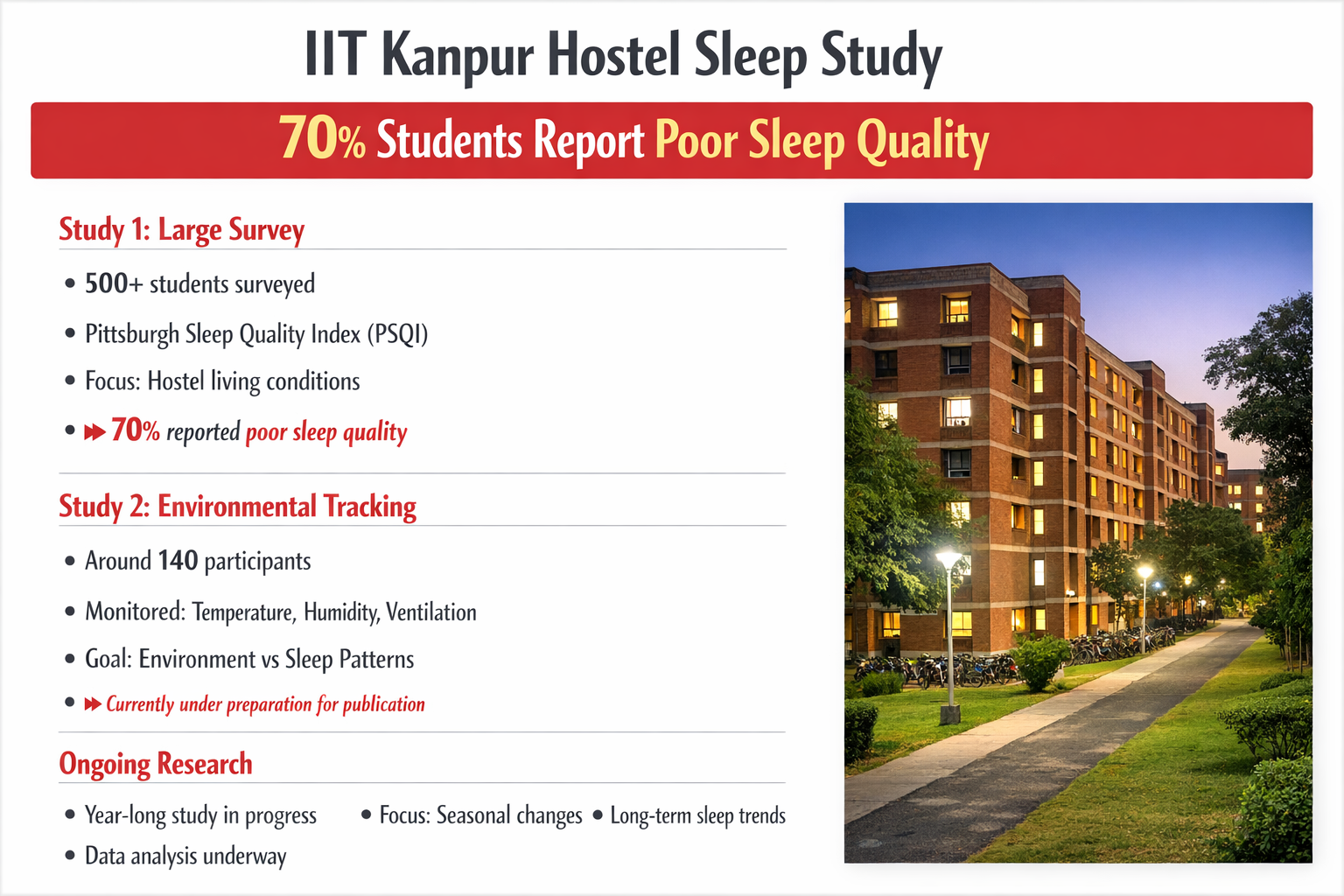
The research began by surveying over 500 students using the Pittsburgh Sleep Quality Index, a standard tool to assess sleep quality. The survey found that nearly 70% of respondents reported poor sleep quality, a striking figure that underscored the need for a deeper investigation.
The team then moved to a second phase, where sensors installed in hostel rooms measured temperature, humidity, and airflow, while smartwatches tracked the sleep patterns of around 140 students. The aim was to link indoor environmental conditions to sleep outcomes and, eventually, to academic performance. The study uses a carefully designed methodology that combines subjective feedback with objective, sensor‑based data, giving it a solid scientific foundation.
A useful but narrow focus
There is no doubt that the research is not meaningless. Sleep quality directly affects cognition, productivity, and mental health, and international studies have long shown that indoor environmental quality shapes how well people rest and function. In that sense, the IIT Kanpur project contributes to a growing literature on healthy indoor environments in educational and residential spaces.
Yet critics raise a simple but uncomfortable question: Should this be the primary research focus of one of India’s premier technology institutes? In an era defined by artificial intelligence, climate change, energy transitions, and deep‑tech innovation, prestige‑broad institutes like the IITs are expected to lead India’s technological and societal transformation – not merely to optimise hostels.
The era of AI and the weight of expectations
We are living through a moment when artificial intelligence is restructuring entire industries. Jobs are evolving, research frontiers are expanding, and new technologies are redefining how societies function. Institutions like IIT Kanpur sit at the heart of this transition, expected not only to produce skilled engineers but also to set the country’s research and innovation agenda.
Given that role, their research priorities inevitably attract scrutiny. A study on hostel ventilation and sleep quality is scientifically valid and can yield actionable insights for campus‑design improvements. But when viewed against the scale of global technological and environmental challenges, it can appear disproportionately small.
The larger building question: energy and cooling
The most urgent building‑related issue in India today is not student sleep. It is energy and cooling. Urban India faces soaring electricity bills and record AC use. Even though fewer than 20% of Indian households own an air conditioner, cooling already accounted for around 60 gigawatts of India’s peak electricity load in 2024, according to the International Energy Agency.
That is roughly enough electricity to power several megacities the size of Delhi at once. Sales of air conditioners are rising rapidly – India sold about 14 million units in 2024 alone, a 27% increase over 2023 – and households are increasingly turning to mechanical cooling as temperatures climb.
This has consequences far beyond student comfort. Cooling demand has become a major driver of electricity use. During the 2024 heatwave months, air conditioning reportedly contributed to nearly 30% of the increase in India’s electricity demand, according to analysis by Ember. The result is a growing “cooling–power loop”: rising heat drives AC adoption, which increases electricity demand, strains power grids, and pushes up emissions from power generation.
Cities urgently need buildings that are energy‑efficient, naturally ventilated, and climate‑responsive. Yet the IIT Kanpur study, in its current form, does not appear to address this broader urban‑design and climate‑resilience challenge. Instead, it remains focused on how specific infrastructure issues in hostels affect sleep, a problem that, while real, occupies a relatively narrow slice of the energy and climate picture.
The more pressing crisis on campus
There is another, far darker issue on the IIT Kanpur campus that may warrant a different kind of research investment. Over the past two years, IIT Kanpur has reported one of the highest numbers of student suicides among IIT campuses, with eight students dying by suicide in that period alone.
This statistic has repeatedly triggered questions about campus culture, mental‑health support systems, and the pressures faced by students, especially research scholars and PhD candidates. Critics argue that if the institute wishes to explore student well‑being beyond traditional academics, several more urgent questions deserve rigorous study:
- Why do certain campuses show higher clusters of student suicides than others?
- How effective are existing counselling and mental‑health services?
- What institutional and structural factors contribute to psychological distress among students?
These questions are complex, but they are precisely the sort of challenge that IITs, with their expertise in data analysis, systems design, and social‑science–informed research, are well‑equipped to study.
Research choices reveal institutional priorities
Universities reveal their priorities through the problems they choose to investigate. A sleep‑and‑ventilation study may improve campus infrastructure, influence future hostel design, and even contribute to broader research on healthy built environments. It is, in many ways, a benign and socially useful project.
However, when viewed against the backdrop of rapid technological change, escalating climate pressures, and a visible student‑mental‑health crisis, the research choices can feel small relative to the scale of the surrounding challenges. The IIT system was built to tackle some of the toughest questions facing Indian society – from energy, defence, and infrastructure to digital governance and climate resilience.
The real debate, therefore, is not about whether building design affects sleep quality. The question is whether India’s most elite institutions are asking the biggest questions they possibly can, or whether they are allowing their research agendas to drift toward safer, more manageable, but ultimately narrower problems
Disclaimer
The information in this article is based on available public sources and official statements as of the time of publication. While we aim for accuracy, we do not guarantee completeness or correctness. We advise readers to verify key details from official sources before making any decisions. The website (iitiimsamvaad.com) is not liable for any loss or damage arising from the use of this content. The authors are also not responsible for any such loss or damage.